Nairn’s London #12
The Gun, Coldharbour

THEN: You will know a bit about East End topography by the time you find this one. Coldharbour is a tiny loop road off Preston’s Road, which is the eastern entry to the Isle of Dogs, and the Gun is at the southern end of it. Good hunting. It is a good friendly dockland pub that has neither been irreparably spoilt by the brewers nor irreparably taken up. The special thing, unsuspected from inside, is at the back – through the Saloon in summer, down the passage past the Ladies and Gents in winter. For the Gun is a riverside pub, and the particular bit of the riverside is the sharpest part of the curve around Blackwell Point. Nowhere is the muddy horizontal excitement of the Thames more urgent than here, framed in a tiny terrace, the curvature making sure that the maximum amount of swift-running water stays in the view.

NOW: Every bit the good friendly dockland pub of Nairn’s day. Some miracle, because its now run by a big brewery: Fullers. Its still a great bolthole, but with Canary Wharf a stones throw away, the city boys have moved in. There’s even a shuttle service that runs between the pub and the offices. The Thames view is still as urgent, as violent, but the O2 (or the millennium dome, depending on your age) now sits proudly across the way, waving from the other side.

Nairn's London - photos far.001

Nairn’s London #17
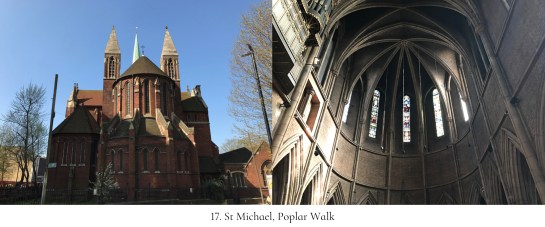
St Michael, Poplar Walk

THEN: Perfection is rare anywhere and perfection due to a reasoned balance rather than an inspired leap is maybe rarer still. So North Croydon is worth a visit if you don’t look at any other buildings for the rest of the year. J. L. Pearson in his later buildings had the rare gift of being able to take the hackneyed theme of a late-thirteenth-century church and restate its essence exactly, with complete natural sweetness. That a hundred people had tried before and failed makes no difference; any achievement as good as this is beyond relative values. Perhaps the best of all his churches: red brick outside, pale yellow brick inside, apsed and vaulted, burning with a completely stead, cool flame. Off the south transept, Person built a chapel, a church within a church, with a complete octagon of columns – a devotional toy. Stand inside the octagon, and look out: every relationship between the multitude of arches, vaults, shafts and mouldings is completely harmonious. It is a Gothic cathedral, re-created without magic by the century which discovered evolution.

NOW: Easy to find but hard to see – it took two weekend trips to Croydon and several hours of waiting before its doors opened for me to look inside. Even then, I had to hurriedly survey it to avoid the beginning of mass. Outside, from the east, its a dead ringer for Hogwarts. On the inside, it’s a space built to inspire. Grand but not imposing, cool but not cold. If you’re along this way and you find the doors open, be sure to pop your head inside.
Nairn's London - photos far.002

Nairn’s London #16
Dulwich Art Gallery

THEN: One of Soane’s most original, least satisfying designs. For once, the miraculous inventiveness is not connected up to an emotional purpose. It remains an intellectual solution, a beautifully played game of chess. It was severely damaged in 1944, and the restoration, though exact, is oddly unsympathetic. It emphasised the aloof man-hating part of Soane which was dominant in the design anyway. So Dulwich is a great curiosity, not a masterpiece. The collection is completely conventional but of high quality: the kind of selection that would appear in any big country house but without the same distressing proportion of duds. And occasionally amongst the talent there is a real masterpiece like Watteau’s Fête Champêtre, where the familiar portentous melancholy is screwed up to an unexpected pitch by flecks and gleams of light on the grey dress of the central figure.

NOW: Immaculately preserved, its probably in better nick today than it was in the sixties. On approach, the building does little to warm your cockles. But the gardens are lush, and there’s a busy cafe to the right of the gate. Inside, the space lacks character, forcing full attention upon the collection itself. I searched for Watteau’s Fête Champêtre, but I’ve a feeling they’ve sold it. No matter, there are plenty of other old masters here and its well worth an afternoon.

Nairn's London - photos far.003

Cocktail #15. Long Island Iced Tea
Source: Difford’s Guide to Cocktails

Recipe:
1/2 shot White rum
1/2 shot Gin
1/2 shot Vodka
1/2 shot Triple sec
1/2 shot Tequila
1/2 shot Sugar syrup
1/2 shot Freshly squeezed lime juice
1/2 shot Freshly squeezed lemon juice
Top up with Coca Cola

Shake first eight ingredients together, and strain into ice filled glass. Top with cola, stir and garnish with a wedge of lemon.

Cocktails so far.001

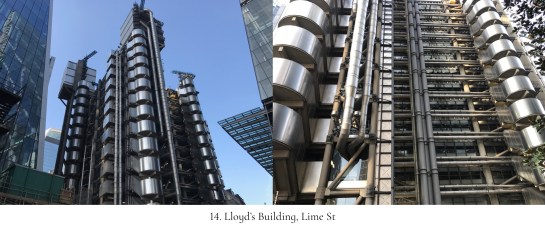
#14. Lloyd’s Building, Lime St
London’s pompidou, this place is all inside out. The style is known as bowellism: maximising space on the inside by pushing everything outside. Lifts, stairs, power and pipes all surround the building, casting a wobbly shadow onto Leadenhall Market below. It was designed by Richard Rogers and houses Lloyds of London (the insurance market).

My London - photos far copy.001

#15. Liberty, Great Marlborough St
Not as old as the tourists believe, but still a building of stature. Liberty sits just off Regent Street, a mock-tudor mansion amidst a sea of beaux-arts buildings. Inside, its a nightmare to navigate, but for all its intricate dark wood panelling, you forgive it. The timber was given by ships including HMS Hindustan and HMS Impregnable.

My London - photos far copy.002

#16. 30, St Mary Axe
Famously known, of course, as the Gherkin. An icon, and not just for its appearances on The Apprentice opening credits. On screen, it looks slightly toyish. But in the flesh, its scale is mesmeric. Stand underneath it, and the curvature will throw you off balance and makes you weak at the knees.

My London - photos far copy.003

#17. Leadenhall Market, Leadenhall Pl
Tucked away beneath the Lloyds building sits Leadenhall market. It dates from to the 14th century, and as you step underneath the vaulted ceilings, you’re transported back there. The shops here include a knowledgeable cheesemonger, a great wine shop, a pen specialist and an old man boozer. My people.

My London - photos far copy.004

#18. Borough Market, Stoney St
One of the first places I try to take visitors, its busyness has the perfect energy to help them acclimatise to the hustle of everyday London. At over 1000 years old, its the original craft food market, and there are still some fantastic suppliers nestled underneath the railway lines. Very worthy of a place on my list.

My London - photos far copy.005

#19. Selfridges, Oxford St
A temple to commerce. Romantic classical fascia, on an early 20th century frame. There’s always something interesting on display, and there’s a fantastic cigar room in the basement. It holds a special place in my heart, being the first place I had lunch with my wife.

My London - photos far copy.006

Cocktail #17. Mojito
Source: Jamie Oliver’s DrinksTube

Recipe:
2 shots Barcardi Carta Blanca
1/2 Fresh lime
12 Fresh mint leaves
2 teaspoons of sugar
Dash of soda water
Crushed ice

Muddle the lime wedges and sugar together. Put the mint in one hand and clap, to bruise the leaves. Push mint down into glass. Half fill with ice and pour in Barcardi. Stir and top with crushed ice, soda and garnish with mint.

Cocktails so far.001

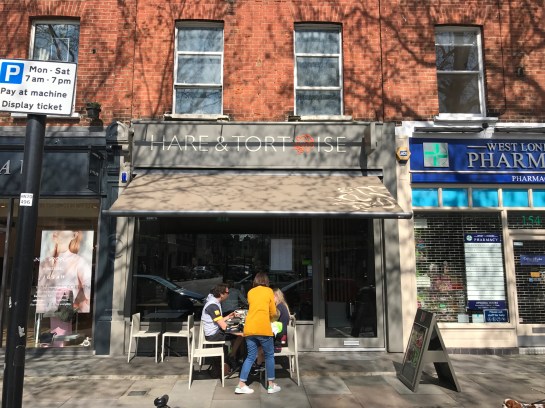
Restaurant: Hare and Tortoise, Chiswick High Rd
Time: Sunday lunchtime
With: –
Stand-out dish: Okonomiyaki Stick
First in the door at this restaurant on Chiswick High Rd. But it filled up quickly, and by the time I left there was a queue forming. The interiors are modern and clean, with lots of muted grey and wood. Its not my favourite fit out, but not too much to complain about either. Other than the James Blunt soundtrack perhaps. Its also not cheap, especially considering it’s described as a Japanese canteen. But the food was quick to the table, and the sashimi and toro nigiri were tasty. The okonomiyaki sticks really stood out – sweet but spicy, hot and delicious.

IMG_4758IMG_4753

Nairn’s London #20
All Souls, Station Road

THEN: Nothing outside. But inside, to roof the central octagon, the architect put an amazing timber cage on top of his mean walls: a temple inside a temple, the intensity making an absurdity of the weary Gothic detail underneath. The architect’s other buildings are just as weary, so perhaps this was the one marvellous thing in his whole life. It is enough.

NOW: No real time to sit and admire, as a service was just starting. But as Nairn suggests, the roof is magnificent. There’s a real sense of utility – you get the feeling beauty is a by-product, not present in the architects original ambition. And its all the better for it. Modern pine-style furniture detracts from the church’s overall grandeur. But its worth a look, nonetheless.

Nairn's London - photos far.001

Nairn’s London #9
Chiswick House

THEN: Lord Burlington may have been an aesthetic autocrat to his followers, but he was a personal and original designer himself. Chiswick was his own house and he designed something far more than a copy of Palladio’s Villa Rotonda. Palladio’s harmony and sun-trickling mellowness have gone completely: instead there are staccato details and violent changes of scale. Mantuan violence, not Vicenzan harmony. The best place to feel this is the south front, towards the lake; a taut thin door under huge windows, smooth stucco capped by a crop of obelisks. This is in fact only ten years old: a really brilliant reconstruction done after the wings were demolished. Another building would be ruined by taking the additions away; at Chiswick the original design was so important that any amount of copy-work would have been justified.
Oddest of all is the main entrance under the portico: a dramatic, windowless cleft burrowing into the heart of the house. Mannerism could hardly go further than this secret, unostentatious penetration into the womb of the place. (The visitor today arrives by the plan ground-floor rooms and an equally unostentatious spiral stair.)
Once inside, by these sneaky portals, there is magnificence without limit. The first room is the central rotunda, and only here can any trace be found of the unemotional classicism which Burlington advocated and inflicted on England. The rest is barbarous grandeur, one of the triumphs of eighteenth century decoration in Europe, never mind Britain. Beyond the rotunda is the three-part saloon. The central rectangle has apsed ends with openings through to an octagon and a circle. And as the rooms get smaller, the scale gets bigger – something which is caught exactly by Gordon Cullen’s superb drawings in the official guide. Here, one and sixpence brings a set of graphic masterpieces as well as information. Monstrous big doors on a curve, their open pediments leering at you. Cherubs and swags of incredible density, with all Inigo Jones’s ability to suggest solid space. (In fact some of Jones’s designs for ornamental details were re-used at Chiswick.) The rooms curl back left and right from the saloon, ending in two intense closets on either side of Lord Burlington’s cleft into the building. Here, richness is achieved by the simplest means of all: wallpaper of such intensity that the whole room vibrates with colour: green and white in one sequence, red in the other. Oh those English, with their placid exteriors and all that passion underneath. The incredibly rich and complex ceiling of the Blue Room is English secret avowal at its most vivid, spoilt only by an awful painting by William Kent. Yet it must have been Kent’s magniloquent decorative sense which created this room, and al the other rooms, in the first place. That’s life.
The gardens are Kent’s too and historically important. But no fun, partly the result of trying to cram a quart into a pint pot, partly due to their dog-eared condition. Kent needed more space to do his best, whether it is seductively curvy like Rousham or stark and grand like Holkham.

NOW: There’s little chance I’ll match Nairn’s word count here. But no matter, as his review mostly still holds true. The building is in great condition, cared for by English Heritage. The wallpapers (which Nairn mentions near the end) are still as vivid and colourful as I imagine they were when he walked around. Only the gardens have changed – they’re pristine. And with their restoration came a new cafe block: concrete, cuboid, and with a slight touch of Frank Lloyd Wright.

Nairn's London - photos far.002