Nairn’s London #26
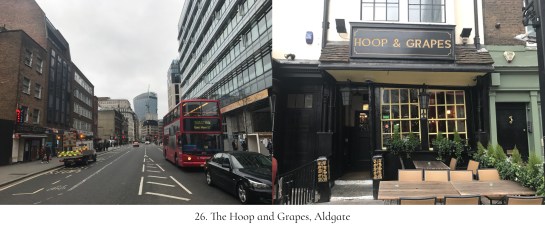
The Hoop and Grapes, Aldgate

THEN: One of the most dramatic contrasts in London. Just when the City seems to be getting to its most crowded and correct, along Fenchurch Street and Leadenhall Street, the whole thing falls away. In a few yards the bowler hats have gone, the buildings – shoddy but very expressive – house second-hand goods and small-scale tailors. The streets have stalls like Tubby Isaac’s in Goulston Street, selling eels, inscribed: ‘We lead, others follow’. This is the East End with a bang, and just around the corner are some of the roughest streets in Stepney. At the other end of Aldgate East is another moving change: the split of Commercial and Whitechapel Roads – one going to the docks and the estuary, the other pointed straight at the heart of East Anglia, those long miles beyond Newmarket. It is only a traffic block now, but it could be marvellous, given town artists and not just town planners. Half way along on the south side is the Hoop and Grapes, a lovable survival of the years just after the Fire. The inside, long, low and dark, is in the old style too.

NOW: Nairn discusses Aldgate in general, but as he finished with the pub, I’ll start with it. The Hoop and Grapes is now part of the Nicholson’s chain, and bears all of the commoditised hallmarks that you’d expect – cheap pub grub and an uninspiring beer selection. But its shape still remains – with low slung ceilings and foreboding dark wood interiors. Heading outside, the dramatic contrast between city and shanty still exists. In fact, with the addition of Vinoly’s Walkie Talkie building, the effect has only been exaggerated. Stepney is now one of the more multicultural areas in East London – you’ll struggle to buy eels these days – but the market stalls remain nonetheless. And with my recent move from Old Street to Whitechapel, its an area I’m going to get to know rather well.

aldgate

Restaurant: Shoryu, Denman St
Time: Wednesday lunchtime
With: James F
Stand-out dish: Kotteri Hakata Tonkotsu
Fairly unassuming from the outside. There are benches outside, so people can queue up to get a table. No need for us to sit on them however, as we were immediately sat in an entirely empty (second) room. As you’re shown to your seat, a gong is hit by a waiter. I’m not too sure what the significance is, but it certainly felt like the session had begun. The restaurant is a mixture of woods and black vinyl. Its got a whiff of business about it, rather than pleasure. Perhaps that’s why we both opted for green tea (mine cold, his hot) – despite it being the first of Feb, with a complete Dry January behind us. No matter, the focus here was the food. The pork belly shoryu buns were delicious, but a little over-mayo’d. And the tonkotsu was fabulous – tasty and filling. The pork was succulent and fatty, exactly what I was craving. And we were in and out in an efficient hour. Nice.

img_1563IMG_1350.JPG


#13. The Geffrye Museum
An oasis hidden in plain sight, amongst all the vietnamese restaurants and art shops of the Kingsland Road. For two centuries, these 18th century almshouses provided homes for poor Ironmonger Co pensioners. But since 1914 its been the home of a museum. The Geffrye Museum explores the development of the home from the 1600s to present day. Its white windows and green ivy cut nicely against the dark brick facade, and the terraced U-shape it forms provides a leafy courtyard to laze about in. But if you’re at all green fingered, forget the front courtyard, its the gardens at the back that you should gravitate to – period gardens from the 17th century on, and a traditional english herb garden full of medicinal and culinary plants. The buildings are all grade-I listed, but the museum is fundraising for a £15m extension that will see it open up and grow its exhibition spaces.

my-london-photos-far-copy-001

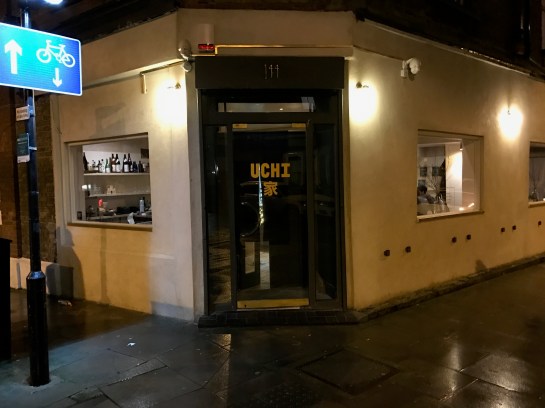
Restaurant: Uchi, Clarence Road
Time: Saturday evening
With: Wist
Stand-out dish: Soft shell crab sushi
Uchi is a small, minimalist restaurant in lower Clapton. It is one of the most beautifully designed restaurants I’ve been in. There are gorgeous gold countertops adorned with royal blue china. Plants hang from the ceiling in spherical pots. The pink and grey menus are a masterclass in design simplicity. And everyone sits on three legged wooden stools, on exposed floorboards. The food was equally good. Its a sparse menu, delivered to a high standard. The soft shell crab sushi was a high point. But its hard to choose a favourite, as there wasn’t really a dud among them. The less said about the service the better – it was slow, plates weren’t cleared away, water didn’t come, and the bill took forever. I practically had to plead with them to take my card. Nonetheless, it was great value, and the food is worth coming back for. Next time I might get takeaway.

img_5487img_9064

Nairns London #27
Kingston upon Thames

THEN: Without any doubt, the best town centre near London; in fact, one of the best in the country. The first view of the triangular Market Place seems too vivid to be true: the Market Hall, fussily Victorian, surrounded by stalls; the church tower behind to the right, half screen by trees, a wonderful half-timbered 1929 Boots behind to the left. Everything going on together, clanging like a peal of bells. And this is only half. Another triangular market place, the Apple Market, dovetails with the main space to make up a square. Buildings separate them except for one narrow alley (Harrow Passage). Here and There, with the There a reflection of the Here, like meeting the younger sister of the woman you love. Another alley (King’s Passage) runs west from the Market Place straight down to the Thames – no railings or notices, just water at the end of stairs. And all this takes up approximately the same area as one of the roundabouts on the Kingston By-pass.

NOW: Not quite the spectacle I’d hoped for. Its a pretty town square, for sure, but I’m not sure it would receive the honours of best near London today. The gilt statue of Victoria still sits on the Market Hall, and the church continues to look down warmly upon those passing by. But commercialism has left scorch marks across every frontage, and you can feel a tension between the old and new (rather than both working in harmony.) The Apple Market still exists, accessible through Harrow Passage, but it’s much quieter, a shadow of the main square. And the Kings Passage is no longer frequented by punters, who instead take Shrubsole Passage to the waterfront, via The Slug and Lettuce and Byron Burger. I doubt Nairn would rate it today.

nairns-london-photos-far-001

Nairns London #10
Shepperton Village Square

THEN: In the north of England this might be passed over: in Middlesex it has got to be noticed. But only in one direction: the view in to the square, with the old church at the end, cottages along the sides, and a road beyond which meets the river head-on because it takes a sudden bend here. Look back, and the whole thing disintegrates, dominated by an ugly, fragmented splay corner which carries a continuous stream of traffic.

NOW: In comparison to Kingston-Upon-Thames, this square has managed to retain its charm. If you were to paint out the cars and restaurant names, I doubt there would be any difference since Nairn’s day. I don’t think we passed a single person whilst there, but the parking bays were curiously full. Even at lunch, there were only two or three people in The Anchor pub. It’s a ghost town, a moment preserved in time.  Little wonder. People now call it Old Shepperton, with ‘New’ Shepperton sitting about a mile up the road.

nairns-london-photos-far-002

#12. Barbican Complex, Silk St
I often go to work at the Barbican. The buildings are dark and brooding; rendered in bleak concrete and linked together by a series of tunnels and passageways. It’s held up as late brutalism (depending on who you speak to – an architectural tour guide at the Southbank called it faux-brutalism) and was built in the late 60s and 70s. Whilst there are flashes of orange in the centre’s interior, its predominantly sombre, creating a great environment to stop and focus and think. There are green spaces and beautiful water fountains outside. And whilst it was voted one of London’s ugliest buildings in the early 2000s, I think public taste has changed and it would now be voted one of the prettiest.

my-london-photos-far-copy-001

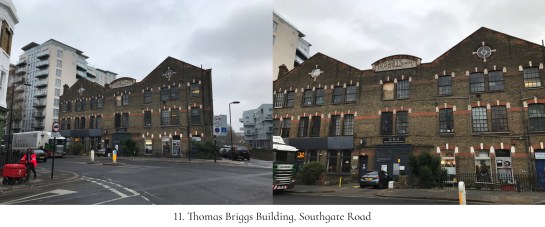
#11. Thomas Briggs Building, Southgate Road
One of my favourites on our drive out east through De Beauvoir. The road bends round just before you pass the building, so you see it from the side on your approach. Its only when you’re perpendicular with it that you spot its symmetry. Its a red and yellow brick warehouse building, once Thomas Briggs’ tent factory, now filled with various creative businesses and start ups. Time hasn’t been particularly kind to it. Window replacements have been mismatched, and the frontage erected on one side masks the brickwork and spoils the equilibrium. Nonetheless, its nice to imagine how it would have looked when first built.

My London - photos far copy.001.jpeg