A couple of weeks ago I went to my first dConstruct conference.
It’s a brilliant one day event full of clever people talking about new technology and how it will affect people, culture and the world around us.
This year, the theme was Communicating with Machines.
The theme was pretty loose, and most people didn’t actually talk all that much about it – but there was some interesting IoT nuggets.
Here’s a quick synopsis of what I remember from the talks.
They’ll be online shortly I’m sure, so you can listen to all of the really important bits that I’ve forgotten…
First up – AMBER CASE, a cyborg anthropologist. Started Geoloqi.
Defined a Cyborg as ‘anything that attaches external appendages to themselves to deal with new spaces.’
Talked a lot about a really interesting guy called Steve Mann, who started experimenting with wearable technology in the 1980s. (Interestingly, one of the things he pioneered was ‘diminished reality’, not augmented reality, where billboards etc are cancelled out by the technology – and instead display useful things like ‘remember milk’ and ‘your bus is 2 mins late’)
By 1998 he had his tech down to the size of sunglasses.
But creating ‘input’ was always the issue. Increasingly difficult to break away from the mouse.
We’ve gone from solid buttons (blackberry style) to liquid buttons (iPhone style)… Perhaps next, buttons in air? Problems being battery drain and privacy.
She went on to suggest that calm technology might be next in line. Processes that happen in the background, ambient notifications etc. Essentially, there when you need it and not when you don’t.
Geoloqi started to experiment with location based ambient notifications. Leaving messages around the city, which could then be picked up when you were in that area. Messages such as ‘This bridge is 40 years old’ or ‘My mates and I are in class writing you this message.’
Wikipedia has GPS Coordinates on wikipedia – these could even line up to where you are.
‘Don’t Eat That’ – an app that shows location based results on restaurant inspection scores.
Location based tech could work as part of home automation. E.g House could say hello when you arrive. Could let you know hyper-local weather trends (e.g when to head out for a bike ride.) Could let you know when your next bus will arrive.
Interesting testing procedure when developing tech. Rather than pay lots of people to run all over town, instead created a real world Pacman game. People ran all over the city because they WANTED to, and allowed them to test their tech.
And if we have location data, then what about if we correlated that with food data, stress data, who I’m with data, time of day data, productivity data, happiness data, ambient noise data, amount of sleep data etc? The quantified self.
The hardest bit about all of this will be getting platform owners and fragmented data sets to work together. Who will do it? Google? Apple? Microsoft?
The best tech will probably be invisible.
It will also probably help take things that are already invisible, and make them visible. e.g Harvard Happiness Challenge – did experiment where rated happiness every half an hour. Worked out that she wasn’t happy at work. So quit.
All devices should be aiming to make us superhumans.
Next up was LUKE WROBLEWSKI.
Luke’s talk was perhaps the slickest animated keynote I’ve ever seen.
He talked about infinite inputs (interesting topic considering Ambers data sets above.)
He talked about how in his lifetime he’s had mouse-mac, clickwheel-iPod and touchscreen-iPhone.
Each time a new imput has come out, there’s been new interactions to learn from a developer point of view.
And it takes AGES to learn again…
Usually you can’t just adapt what you already have (look at the generic desktop calendar widget on a mobile phone vs Google Mobile Flight tracker.’
Or Amazon desktop store, vs Amazon mobile store, vs Amazon Flow (simply take a picture of something you want and it scans through Amazon and finds it for you.)
We’ve had accelerometer inputs, magnetometer inputs and we now have full 9 axis motion and orientation sensing.
Inputs are becoming hugely advanced. Samsung ‘Smart-stay’ used the front facing camera, and checks to see if you’re looking at the screen. If you’re not looking, it pauses whatever is on (e.g Youtube) until you look back.
Google glass even has the beginnings of a bone transducer for sound.
Where next?
Disney Imagineering Touche project? Perhaps.
Capacitive touch sensitive. Objects like a table can suddenly sense whether there’s an arm, or a hand, or two hands, or two arms on it. A doorknob can tell whether it’s been grasped or just touched etc.
So soon everything will be an input.
And what then. Well, we’ll have to start learning a little bit faster!
NICOLE SULLIVAN talked about trolling.
Tenuous link to communicating with machines I think – more communicating via machines – and unfortunately I didn’t make too many notes in this one.
She talked about there being different types of troll: jealous troll, grammar nazi, biased troll and scary troll.
Interestingly she also talked about something Project Implicit, run by Harvard at http://goo.gl/2601D
Well worth a look.
SIMONE REBAUDENGO was up next, and talked about the Secret Lives of Connected Products.
He used a line I’d heard previously from John Lasseter, about how ‘a products main goal is to be used.’
And suggested perhaps this might mean peer pressure could develop between products.
He then showed his toaster project, which was great.
The toaster handle is very cute.
It’s also extremely competitive – picking its workplace depending upon the number of people there, what the space is like, whether there are any other toasters in the vicinity etc.
The toaster can tweet to try and drum up toasters from the office, or get excited when someone comes close.
It can even decide to leave if it’s not used enough.
It’s quite an interesting concept when a person doesn’t demonstrate their buying power with a product, but instead demonstrates their keeping power.
Essentially Simone was saying that connected products shouldn’t just be connected. Instead we need to start looking at the relationships between connected products. And by doing so, we’ve got a much better chance of making sense of it all.
Lunchtime came around and we got to have a play with some of the things in the foyer.
The Happiness machine (an internet connected printer that prints random happy thoughts from across the internet) and the Noisy Table (a ping pong table that makes sounds and music as it’s played) were great.
And then I popped off to Brighton Pier for some fish and chips.
After lunch, we had the delights of SARAH ANGLISS.
Sarah is a musician – using physical, automated and digital instruments to make her music.
She talked a bit about the Uncanny Valley – an interesting phenomenon that shows as machines etc get closer to looking like humans, we stop being empathetic and start fearing them.
She also talked about how some of us are obsessed with the uncanny – audiophiles are continually chasing musical nirvana, and are always one piece of kit away. They want a perfect copy of what was recorded.
I found it really interesting when she talked about infrasonic sound – tones that are so low that you feel it rather than hear it. Often used in church organs etc – it can often make you feel ‘at one with the music’ and ‘absorbed.’ Fascinating.
I can’t remember exactly why, but she also talked about the Italian Castrati – singers that were castrated before coming of age, to preserve their vocal range. Weirdly it also messed with their hormones and they generally grew to be very tall, very slim and very good looking.
She finished with one of her own compositions – very ethereal.
KEREN ELAZARI talked about hackers and hacking.
She referenced Arthur C Clarkes three laws at the start of her talk.
I love the third one… ‘Any sufficiently advanced technology is indistinguishable from magic’ by Arthur C Clarke.
The second one is equally brilliant: ‘the only way of discovering the limits of the possible is to venture a little way past them into the impossible.’
She talked about the Singularity University, which brings people together from all over the globe to use technology for good.
And a little bit about hackers and the hacker manifesto.
MACIEJ CEGLOWSKI was a hilarious speaker.
He talked about fan fiction – one of the main customer bases on his site Pinboard.
It’s a genuinely hilarious talk and well worth searching out.
He stuck up for fans, because they a) are SO NICE b) fight censorship c) fight for privacy d) never sold out e) transgress f) improve our culture
And he shared some top tips for developing.
The first of which was ‘Social is not a syrup.’ You can’t just add it on the top.
In fact, it’s not even a noun.
The second was that ‘You shouldn’t make it too easy’. His pet theory is around commenting. If you make it sufficiently difficult to comment, then you only get the people that are actually interested commenting.
The third was ‘Stop futzing with it’. Too true.
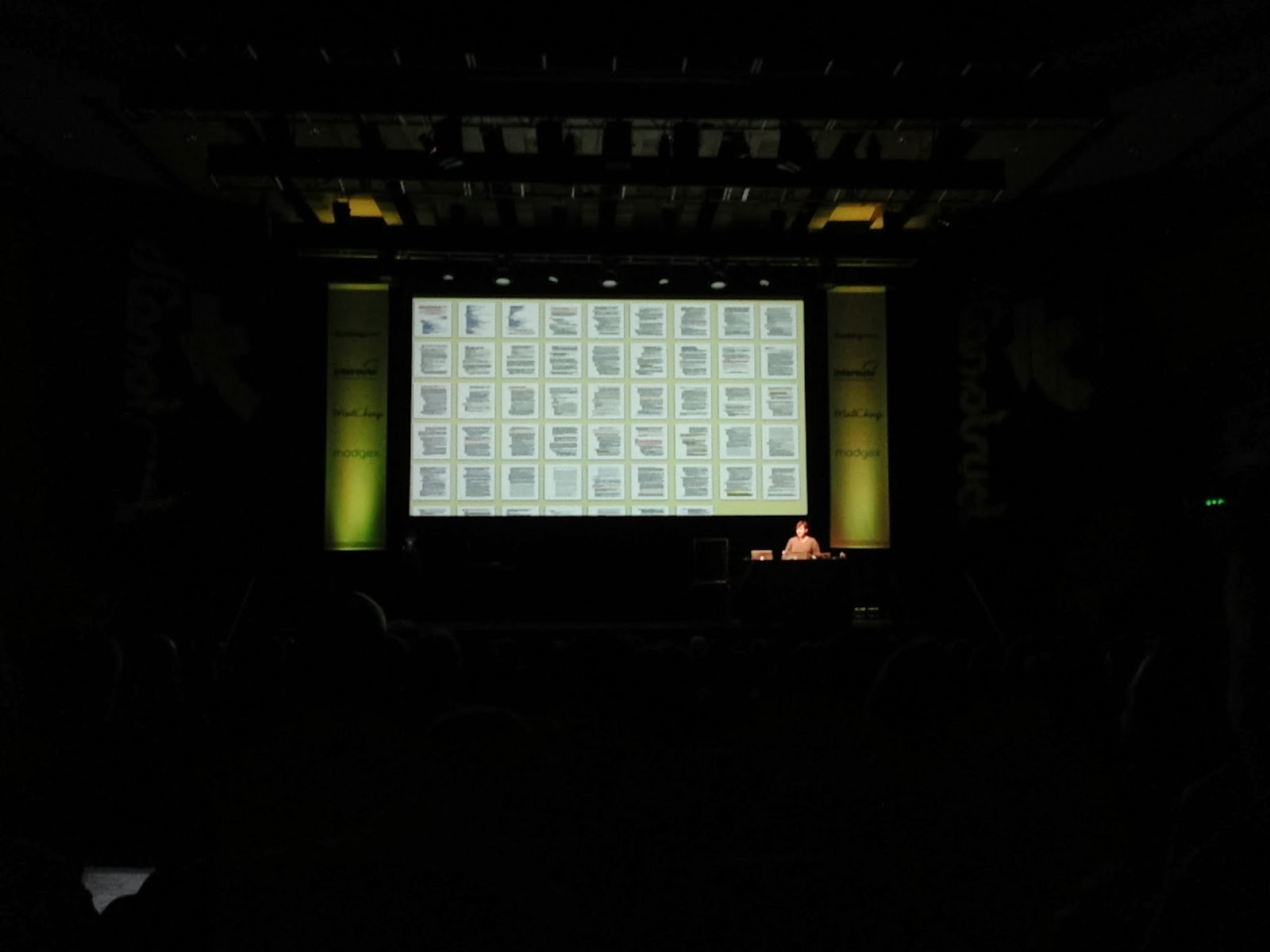
And the fourth was ‘Shut up and listen’. When developing Pinboard, he started a google document for potential users to write down any functionality that they’re like to see. In the end… he had a 53 page document. But it allowed him to work out what was most important to people.
DAN WILLIAMS spoke about the ramifications of communicating with machines everywhere.
Particularly vehement about Scenetap – a camera on the door of every club that records venue demographics (num of girls, boys, potential economic class etc.)
He found it shocking because it doesn’t offer an opt-out.
Apple stores are the same – camera as you enter.
In fact cameras are everywhere.
And under the data protection act, you can legally request the video images of yourself.
Which has given birth to the brilliant Manifesto for CCTV Filmakers.
He also spoke about the new recycling bins in the city, which have had an amazing scope creep.
First they were bins, then they were advertising sites, now they actually watch people walking past and can track them all along the street. The annoying bit being of course that they don’t function well as a bin!
Essentially it comes down to how we find ways of explaining with regards to data collection – as currently it’s just not happening.
Finally then, ADAM BUXTON spoke.
He was genuinely hilarious.
He talked about how twitter is like acid – it magnifies your personality.
And talked about his history with technology.
I think it’s worth rooting out the video to watch his presentation – as he used the slides brilliantly as a counterpoint to what he’s saying.
And that’s it. Looking forward to next year!
































 Ant Harris