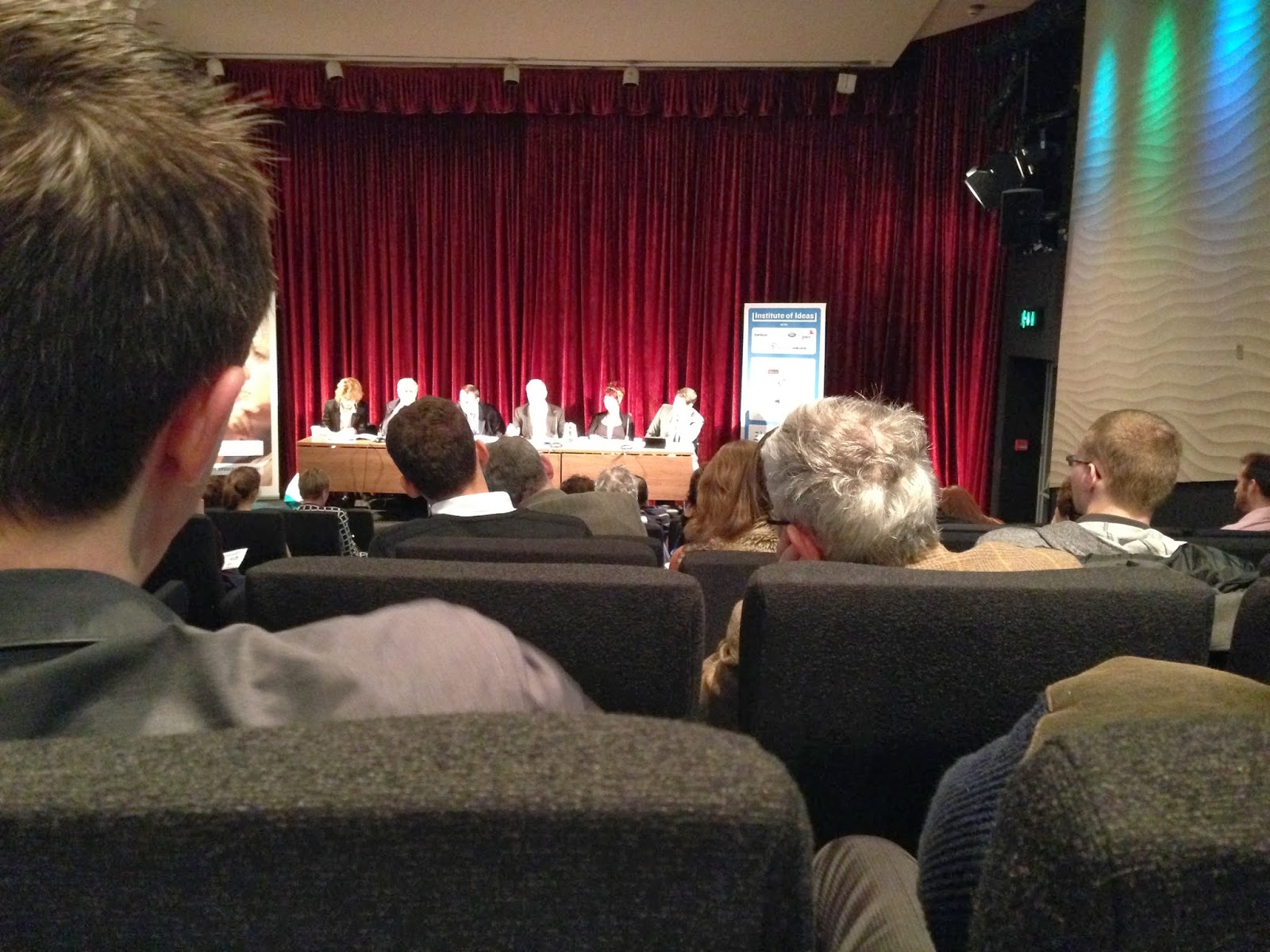
Last week I popped along to Google Firestarters – a brilliant event hosted by Neil Perkin at Google’s office in Central St. Giles. It’s a quarterly debate around the theme of agencies, marketing and innovation.

The theme for this session was ‘Planning for Good’ (something that particularly interests me as a subject matter, what with the launch of depaulbox.co.uk earlier in the year.)

First speaker up – planning legend John Grant.

John Grant was actually presenting via Google hangouts, from a villa in Italy. I’m not sure it was meant to be a Google product demo, but it worked pretty well as one.

He talked about ‘good’ sitting in three main areas; organisations that receive donations, marketing that acts as a conduit for donations e.g (red), and marketing with a social mission, like Dove.
There’s a fine line when you try and get a whole organization to ‘do good’. For some organisations – other company actions don’t stack up with the message.

In that instance, you get greenwashing – marketing spin designed to promote the perception that an organization is good-natured in some way.

That sort of hypocrisy can actually do more damage. John quoted an old Arabic proverb which fits that pretty well – ‘A good deed dies when it’s spoken about.”

Essentially – you need to make sure you’re acting like a human being not a marketing professional.

Next, we had Nick Hirst – head of planning at Dare.

Nick shared some thoughts from Dare’s latest whitepaper ‘How to make money & Feel good about yourself.’

Nick talked about the dichotomy we face when it comes to company objectives.
Milton Friedman advocated that a company must make money first – the first commitment should always be to the shareholder. Due to this, most companies have to slip improving people’s lives in the backdoor without spending an awful lot of money on it.

Nick argued it should be the other way around – Making people’s lives better is a much better purpose for a company.

Not only that, it seems to be more profitable.

When you chase after money directly, you can often fail. One example – Boeing’s share price tanked when it changed its mission from ‘Solving the worlds toughest problems using engineering’ to ‘maximise shareholder value.’

He summed it all up in this tidy model.

Finally, we listened to Sam Conniff from Livity.

Sam also talked about purpose – stating it’s the key to all success and competitive advantage.
Livity works with young people in and around Brixton.

They’re not an agency, but last year they were awarded best Marketing agency 2012.
They’re not a school, but they have a glowing Ofsted report.
And they’re not a social cause, but they’ve recently won a Big Society award.

Sam described Livity as a ‘more than profit.’ I kinda like that.

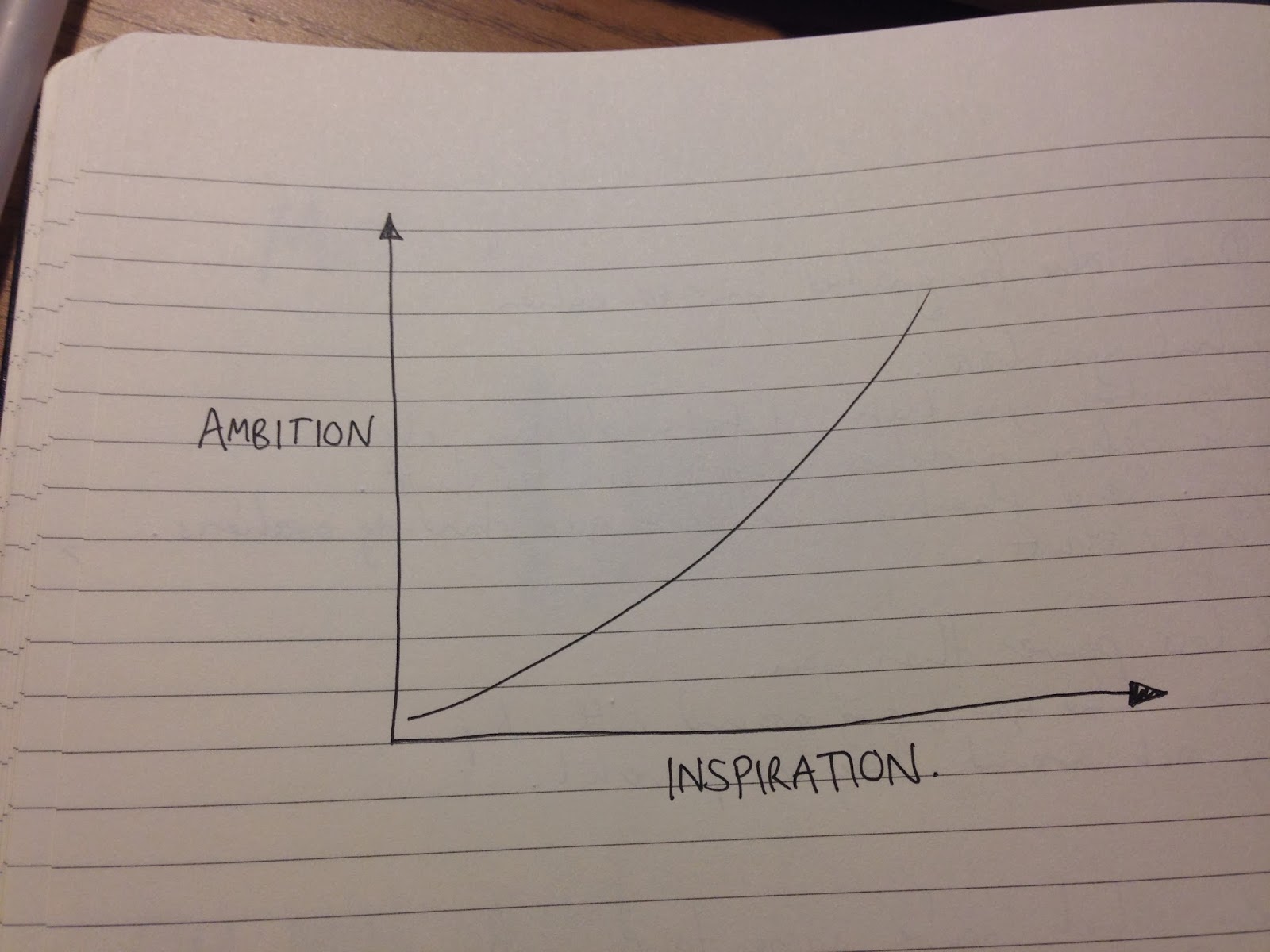
He talked about the purpose curve, and how it informs everything that they do with the kids. Giving the kids some inspiration pushes up their ambition.

Inspiration in. Ambition out. Bit more inspiration in. Bit more ambition out.

The talk was fantastic – and it’s well worth checking out a similar clip of him at TedX Brixton.

First up, Mary Portas
Mary Portas believes in the reimagination of things.
And it’s something that she’s been doing all her life.

(Rubbish pic – sorry!)

Firstly, with Harvey Nichols.

When she inherited the role off Creative Director at Harvey Nichols in the early 90s, it was a loss making department store. The few customers that did visit it would simply travel up to the top floor restaurant and have a quiet sherry or a cup of tea. Nothing more.

The clothing market at the time was all about boutiques from egotistical designers.
The department store model was broken, and she had no real budget to spend her way out of it.

She found inspiration in the theatre and art world – a near-nightly excursion of hers at the time. She decided she would make the department store like an art gallery space. Her and her staff painted everything white – walls, ceilings the lot.

One of the painter-decorators turned out to be a fine artist. He was spotted reading an art magazine on the rooftop smoking area. She asked him to paint all of the mannequins in the store.

She offered window space to talented student artists (Tom Heatherwick was one of the first.)

She asked studying creative to design the food court packaging and asked them to help install a bar on the top floor.

She was also struggling to get established & desired designers through the doors – whenever she’d try and get them in, Harrods would gazump them and offer to purchase five times as much stock from them.

So instead, she went to art colleges and asked for the most talented fashion designers. And she gave them each a space on the shop floor, without charging them for the space.

Potentially business crippling – they wouldn’t make the shop any money for being there…

BUT, they were the perfect loss leaders. They made the whole store cool, and people started to come in and buy from all of the other designers that they housed.

After Harvey Nicks, she then reimagined Manufacturing,

She was challenged to manufacture a £4 pair of jeans in the UK, at the same quality as the Chinese imports that were hitting the supermarkets.

Instead, decided to jolt the manufacturing industry back into life – but not at bottom prices like that.
Created premium underwear – kinky knickers.

Hired 8 staff that had never worked before, and 1 seamstress that was working part time in Tesco. Now has 32 staff, and the knickers are best sellers in Libertys. And stocked in many other shops including John Lewis.

Nothing is dead if there’s a way to reimagine it.

After Mary Portas, Sam Bompas took the stage.

I haven’t got much written down from his talk – apart from a beautiful German word ‘Gesamtkunstwerk’ – which means ‘total work of art’. Bompas and Parr have a fantastic talent for creating experiences, not just pieces of art. It’s a really interesting premise – ‘how can I touch every sense?’ It’s certainly something we could think more of in terms of pitching.
Bompas and Parr have some fantastic projects that are well worth looking up – Mercedes food drive-thru, atmospheric Gin and Tonics, a jelly moat around the S.S Britain etc.

Next up was Jude Kelly OBE.

She summed up all of the morning’s talks: Take something that is unloved, and turn it into something with confidence, something that’s loved, something that is desired.

The Beatles came from a horrible town – Liverpool was a rather grimy, rather poor port.
But their confidence made that town a hive of energy and ambition.
They were the outsiders that were trying to get into the establishment, and that’s what allowed them to revolutionize creativity.

You should never underestimate your own creativity.
It’s all about having massive idealism. We do not have to live like this.
It’s not about stamina for a challenge, it’s about idealism. What sort of society do we want to live in?

She believes that everybody should be able to realize his or her own potential.
We should be celebrating difference.
It even applies to the advertising world – we didn’t believe in the Soviet Union, because one product for each category wouldn’t do. It was about diversification. Different products for different people.

She turned the Southbank centre from the concrete jungle of homeless people and skateboards, to a place with a festival atmosphere. All because she believed that more people deserved more art.

She introduced foot markets, buskers, boating lakes on the roof, art, music – and best of all anyone could just come along, they didn’t HAVE to buy anything.
18,000 people were asked to perform at the opening event.

The Southbank Centre was created for a post-war Britain that needed a pick up.
It was created to delight, to celebrate innovation and creativity.
And that’s what she based everything upon.

She believed that the place still enjoys celebrating fun and people’s right to colour.
She believed it was only grey because the paint had washed off.

And people will respond to energy, and people with energy.
She urged us all to ask ourselves, what do you believe in?
Once you’ve got it, follow it.
And others will follow you – because they’ll see someone that desires something.

Essentially, you need to move something from conventional and a little tired, to something that is desired, something that others can buy into and join you on the adventure.

Russell Davies talked a little about organizational creativity and the great work the GDS are doing with regards to reforming government communications online.

Here’s a few of the soundbites that I managed to scrawl down:

– The strategy is delivery
– Do the hard work to make it simple
– You shouldn’t have to know how government works to find out what you need
– Activities not audiences – The internet is not a broadcast medium, it’s for things you want to do. There’s an assumption that you should aggregate audiences to your own website, with potential ad revenues off the back of it. But if you’re not profiting from advertising, why not give it to them where they are not where you are. (E.g answers to some questions are answered in google, by data from government.)
– The web is not the IT department’s job. It’s all of ours.
– The web is not a marketing channel. It’s where your business is. So you need to be able to do it yourself.
– We’re of the web, not on the web.
– The unit of delivery is the team. It’s a collaborative effort. And the product is the service is the market.
– We’ve learnt how to be good at building bridges. But you can’t build websites like you build bridges. You can test and learn, you can share code (and should, it lifts all ships), you can change as you go along.
– You should obsess over user needs, not client problems.

He left us with a wry smile and the sentence “And if the government can do it, surely you can too…”

Alex Bentley talked a little about mapping social behaviour.
He mentioned that we often think in terms of our category, not in terms of consumer.
But consumers will take the line of least resistance – social learning.
And in fact, our success as a species rests heavily on our social and networking skills – knowing who, what and when to copy.

The accepted wisdom with social campaigns is to try and tap up the experts.
But that only works for one quarter of situations.

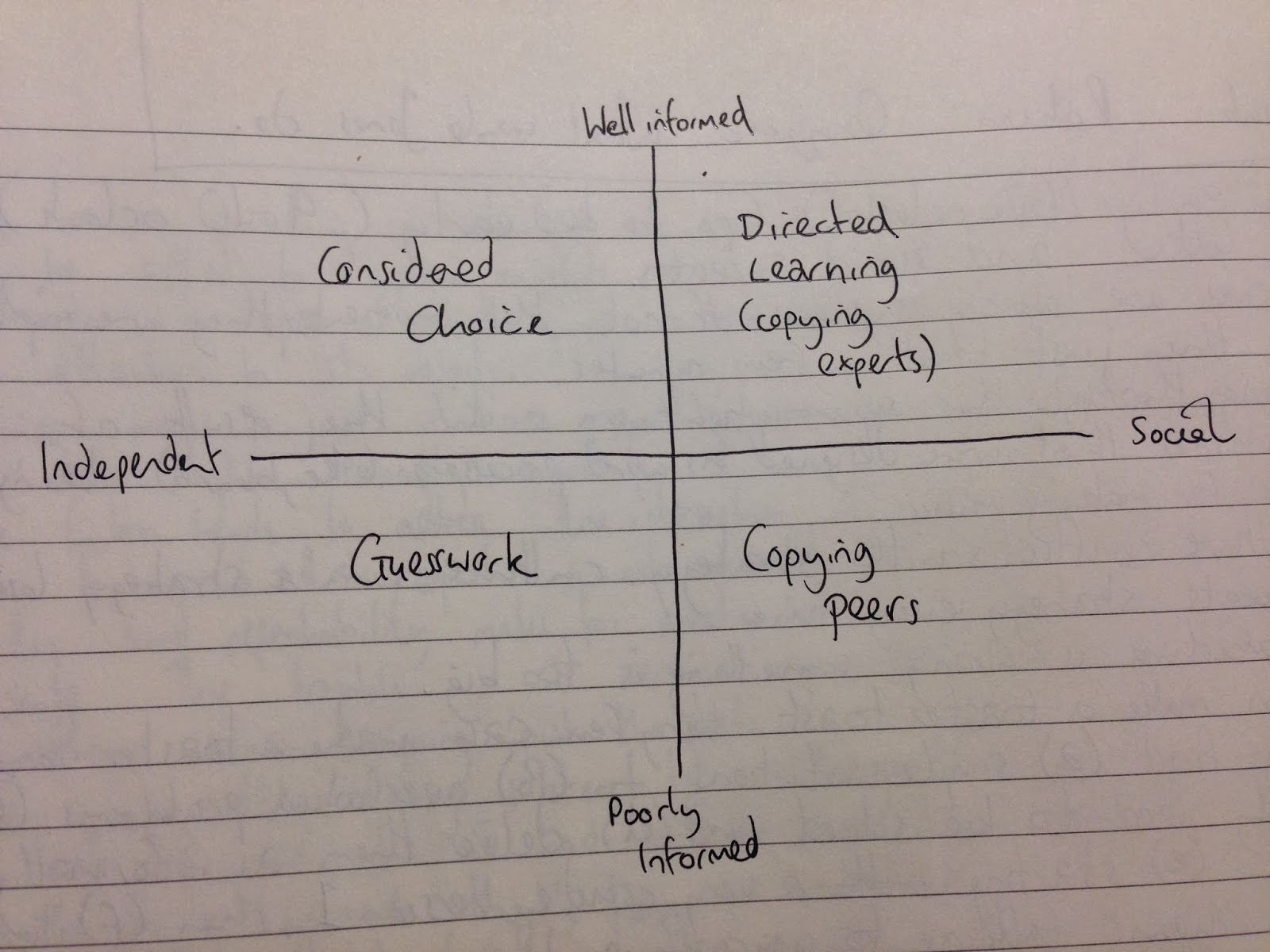
The benefits of targeting influencers will only really work in the top right field (‘expert’)
Each quadrant actually has a different time scale and shape for uptake.

E.g longer time scales for social, shorter time scales for independent…

We need to be able to plot our own categories into the correct quadrant – this will help inform what action we should take in communications, as each product/category has a characteristic data pattern.

For example:


Phil Barden was next up.
His talk was hugely interesting – all about the the use of decision science to help improve what we’re doing.
Decision science is a blend of different disciplines, and can shed new light on consumer behaviour.

We’ve moved from an economic rational model, to an emotional vs rational model. And now we’re moving to an implicit process model.

Much like Kahneman, Phil talked about the pilot and autopilot processes in the way people think.
The autopilot works incredibly quickly, we don’t notice it.
Pilot works slowly – us consciously taking the time to think through something.

The greatest thing a brand can achieve is to be chosen without conscious thought.

In the first four seconds, your autopilot can subconsciously process a number of things.
e.g


When the reward is sufficient to overcome the pain, we’ll buy.
Our autopilot drives our attention and shapes our perceptions.
In fact, we can actually track out autopilot much like we track our pilot.
Explicit tracking (standard brand tracking) is used by most businesses.But very few companies are tracking implicit reactions – and we’re not getting the full picture without it.

These implicit associations will have to line up with our goals, if we’re going to behave in a particular way.

Again, we have explicit AND implicit goals.

For example, we may believe that we buy washing detergent because we want whiter than white clothes. But it may also be for security – to show warmth to our family in exchange for belonging.

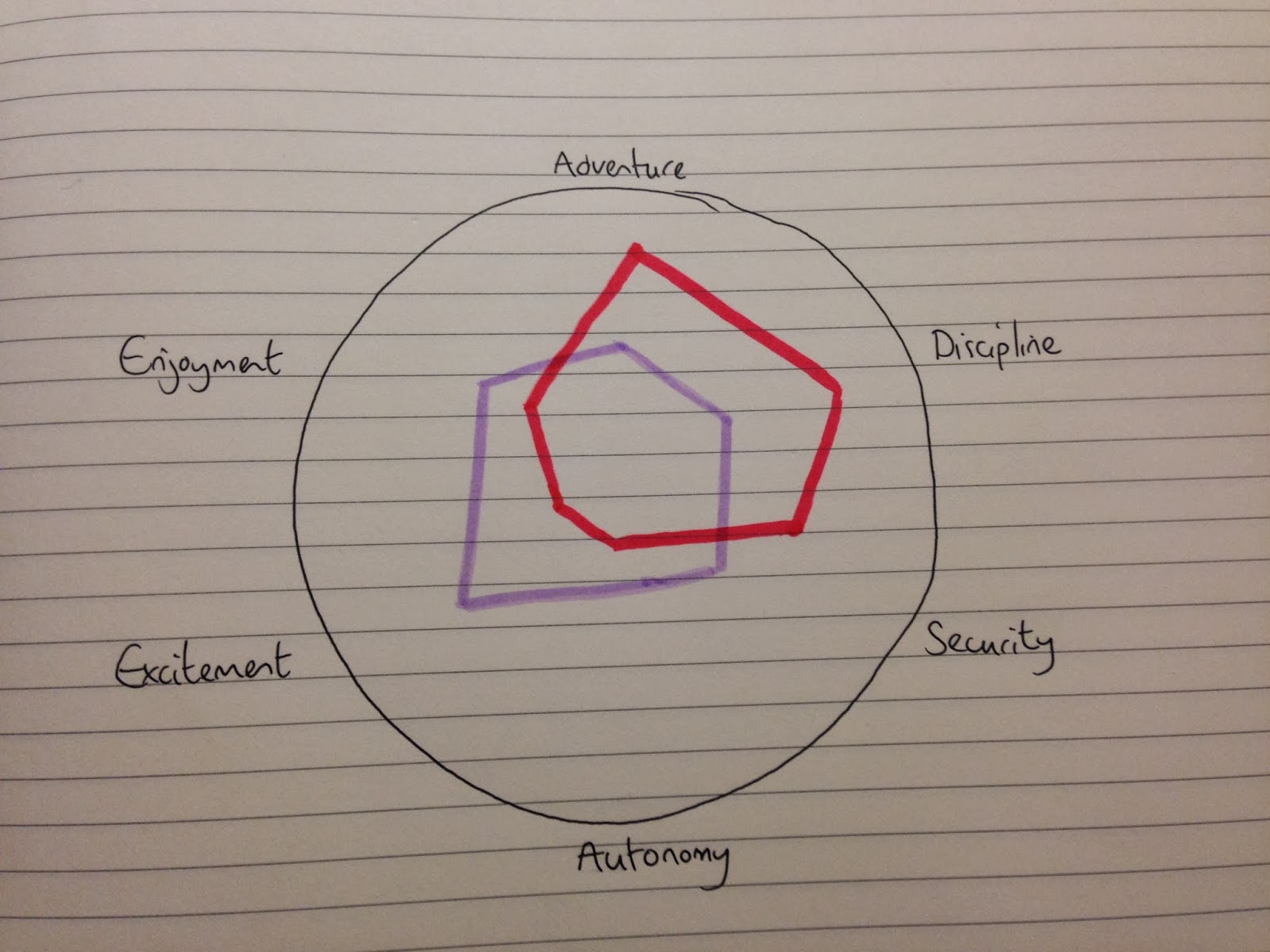
We can map these goals on a map – they broadly break down into:

We can map our brands (and whole categories) against these goals.

E.g difference between Cadbury Gorilla and Cadbury Trucks may explain the difference in success of both films.

Nick Southgate’s talk was fantastic too.
He started by debunking a widely held view: that we want people to pay attention to our ads.
Deliberately pay attention and consciously think about it.

But actually, when we look into what people aren’t consciously thinking, but subconsciously thinking.

It’s much easier to say ‘we want people to think this’ – the brief format works that way.
We can get people to think ‘this detergent washes whiter than anyone.’
But it’s much harder to get people to not think something.

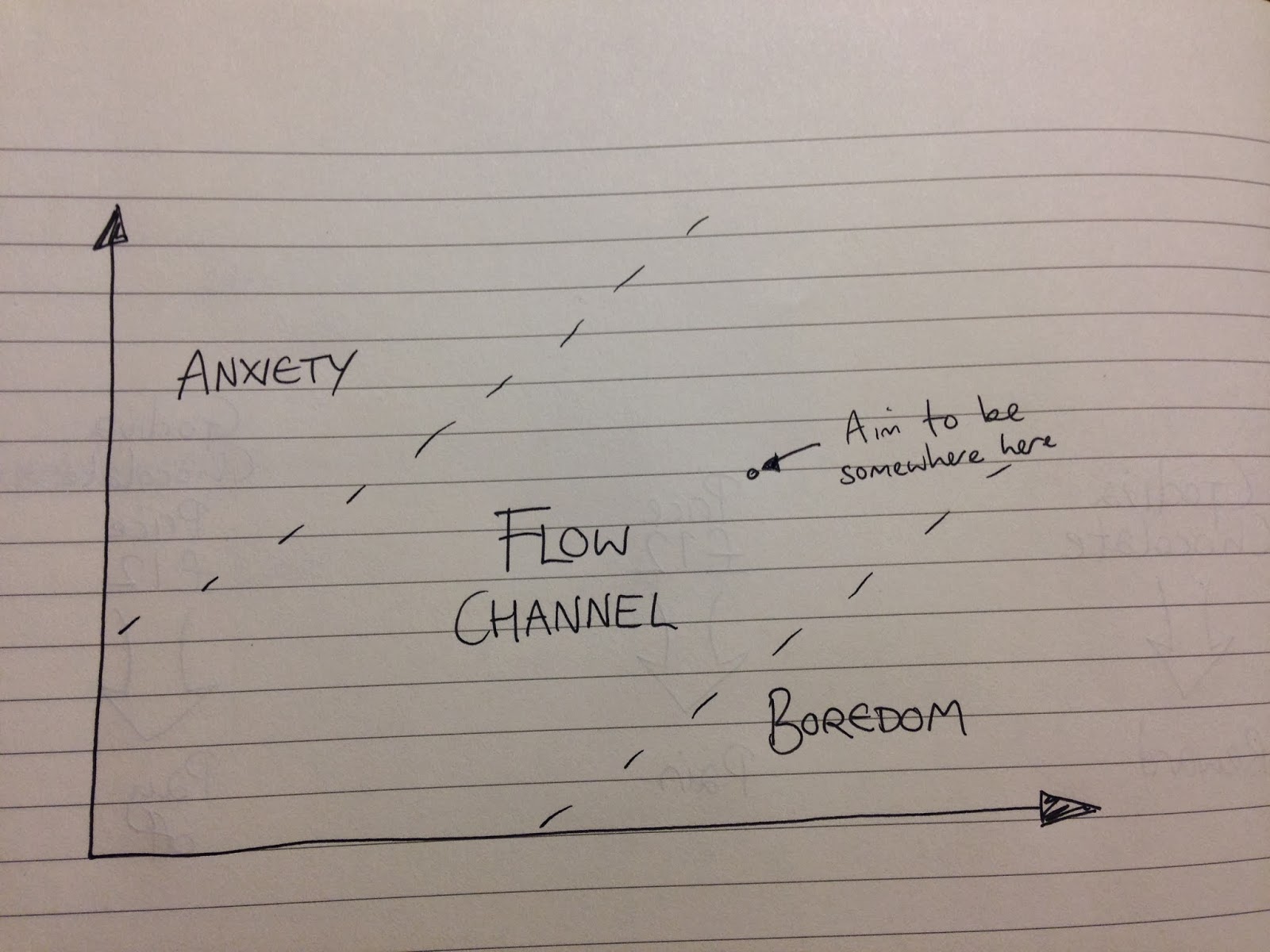
He beieves that you enter this ‘not thinking’ stage when creative operates in the flow zone.

Sitting in the flow zone doesn’t make you feel anxious or confused. And it doesn’t make you feel bored.
Angry birds? It’s in the flow zone. Ikea Chuck out the Chintz? It’s in the flow zone.

The reason why it works so well is that it keys into something that people already feel about something else.

John Lewis for example? You’re not working hard to decipher that advert – you know what’s going to happen. Even if there is a twist, it’s one that is predictable.

A little like genres of fiction or films.
You don’t know exactly what’s going to happen, but you know what’s going to happen.
You know what you’re getting with a rom-com. You know what you’re getting with a horror.

When you come to present work to clients of – make sure you sell the answer and show them the science if they want it.

What definitely doesn’t work is saying ‘Here comes the science bit.’ That is just going to make people say no to work in revenge.

———

All in all, a fantastic day.
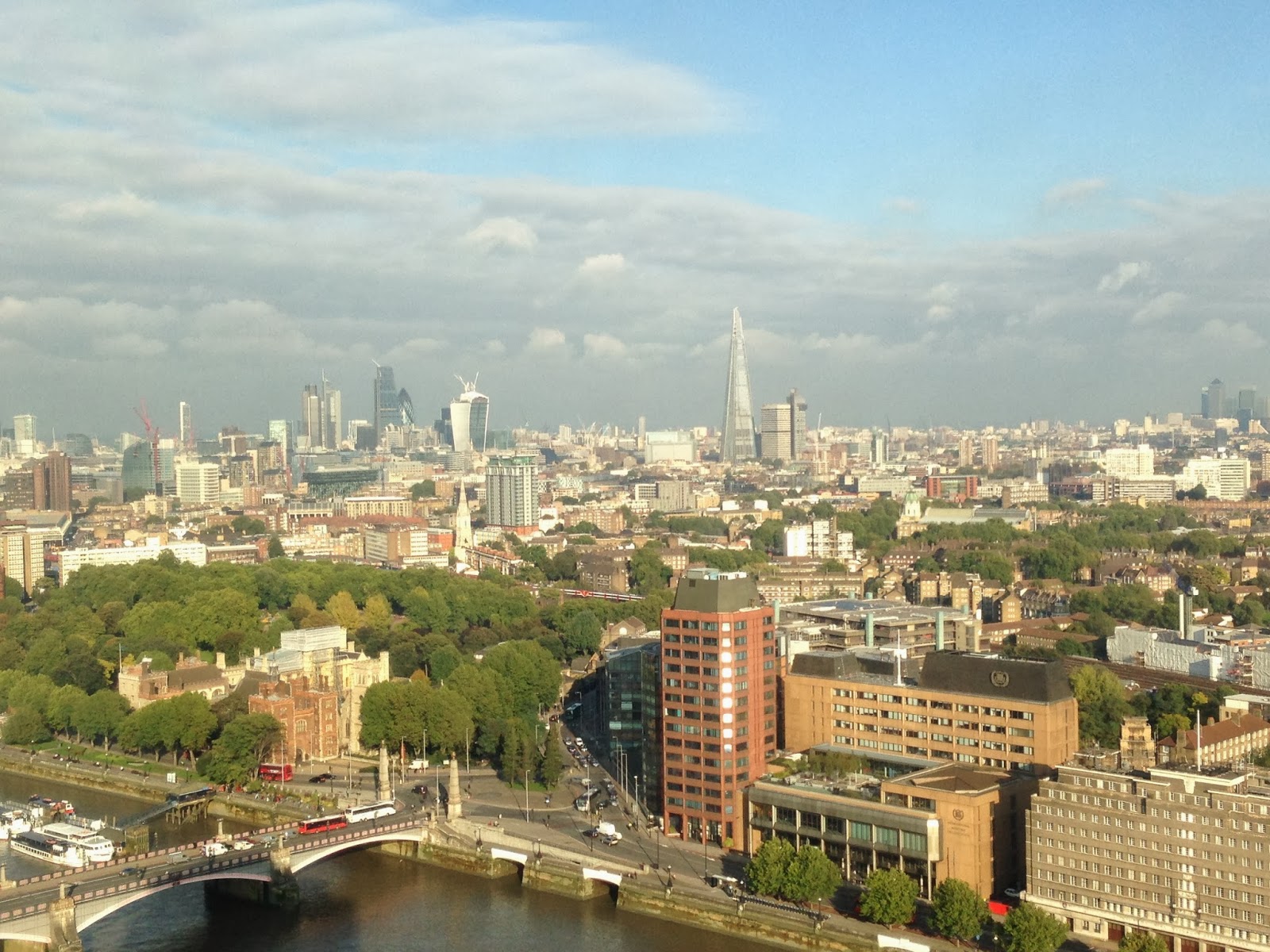
One niggle – why hold it in a place with amazing views like the below, when the talks are interesting enough to hold your gaze all day?! What a waste! Haha.

 

Wow – this museum is great.
There were two main exhibitions within the building – both were brilliant.

The first exhibition was called ‘The Future Is Here – A new industrial revolution.’
It explores the ways in which new technologies are changing the manufacturing and experience of products.


There was a lot of talk about the democratisation of manufacturing, and what it will mean for people.
Fabrication tools small enough to put on a desktop and affordable enough to use at home will open up a world of product-making and tinkering – a world where everyone can get involved.
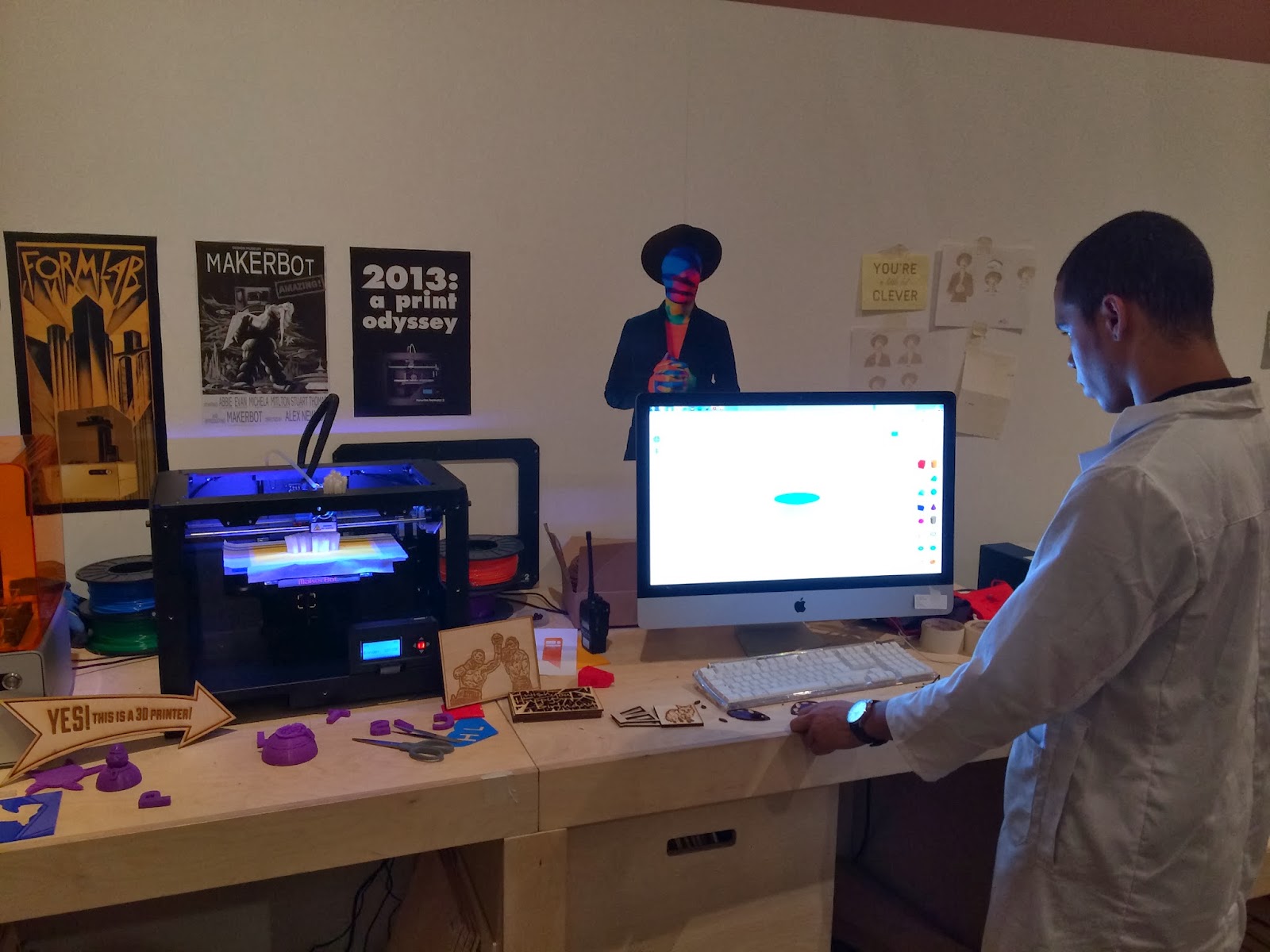
A lot of the technologies that were referenced were actually on show, in the museum’s making lab.

I finally got to see a Makie.me doll in the flesh.
They’re pretty scary looking, but it’s amazing the level in which you can now customise a doll before they’re printed for you.

It’s not only small batch manufacturers that are embracing the potential of mass customisation – some commercial brands like Adidas are including a degree of customisation in products too.
The mi adidas range allows personalisation on a huge level – including the colour of individual elements, the materials and even the finishes.

Manufacturing techniques can broadly be split into three categories.

Additive is the process of adding, layering and combining smaller elements.
Subtractive is the removal of parts or elements from a larger object.
Transformative is creating an object by altering the shape or behaviour of a material.

3D printing is obviously an additive process – building one top of layers.

There are different methods of 3D printing – stereolithography, selective laser sintering, fused deposition modelling and material jetting.

– Stereolithography – uses a laser to trace the first slice of an object on the top of a vat of liquid photopolymer resin (which changes its properties when exposed to light.) In this instance, the resin hardens – forming an extremely thin slice of the object. The slice is lowered slightly and the next layer is created until the object is complete. This has been available as a technique since 1984.
– Selective Laser Sintering – A laser is used to trace the shape of an objects initial slice across a thin layer of granular/powdered material. After that layer has fused together, a new layer of powder is spread over the initial one and the process starts again.
– Fused Deposition modelling – A coil of plastic filament or metal wire is passed through a nozzle heated to a temperature just above the material’s melting point. The nozzle traces out a shape, building up an object layer by layer. This method is used by the majority of desktop 3D printers.
– Material jetting – A liquid photopolymer is emitted by an inkjet-style printer mechanism. After each layer is printed, it is exposed to ultraviolet light, causing it to solidify before the next layer is created. Sophisticated jetting processes emit different materials, allowing different types of finish within the same object.

With a pro in charge of the system, 3D printing really can produce some really amazing structures.

One of the videos in the exhibition featured someone from Digit to Widget (a 3D printer company in London). Interestingly, he said that a lot of their clients are using 3D printed techniques when they could be saving themselves a lot of time and a lot of money using alternative techniques.
It’s not the only answer… there’s more than one way to skin a CAD model.

But making more generally, will soon be a life altering revolution across the world.

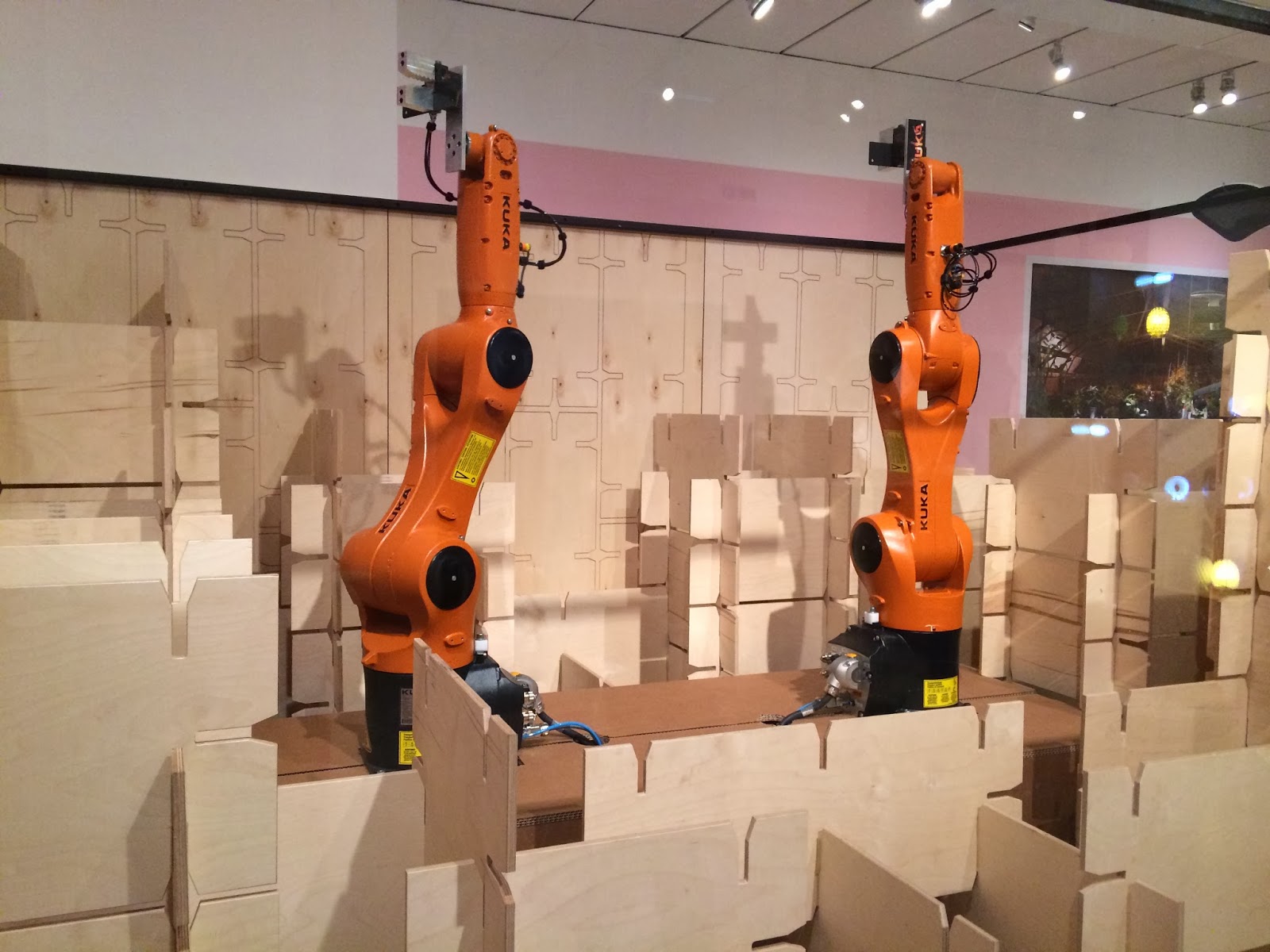
There was a little section on robotics in the room.

The first use of modern robotics in manufacturing was the Unimate machine operated by GM in 1961.
It was essentially just a large robotic arm that would follow step commands.
Innovative manufacturers can use robots to eliminate the need for traditional manufacturing tools like casts and moulds, a fundamental change in the manner in which products are made.

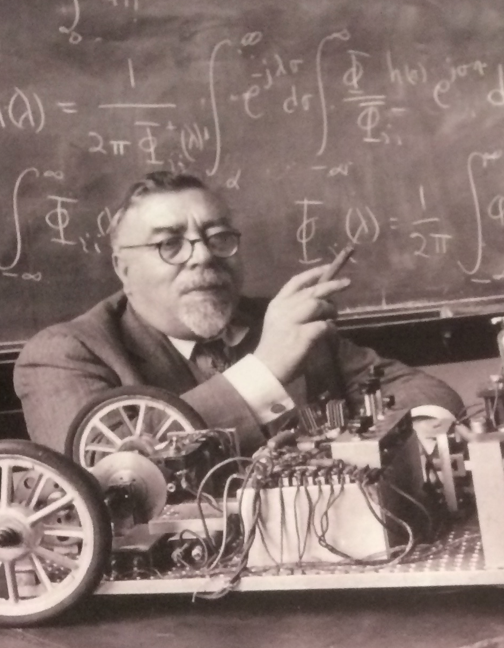
Professor Norbert Wiener was mentioned – a mathematician that became a visionary in the field of robotics. He published a number of landmark academic publications that predicted the emergence of computing and robotics, and explored the potential impact of the machine age on civilisation.
A bit like James Burke now, I suppose.

The second exhibition is called ‘Extraordinary Stories about Ordinary Things.’
The collection is a selection of important works from the last 100 or so years – representing the different design disciplines that have had huge effects on the UK.

There was some interesting debate with regards to ‘taste’. Reformers in the 19th century spent lots of time educating the public in taste, and these ideals also led to the establishment of the Council of Industrial Design in the 1940s. Sociologists state that taste and fashion are instead the means by which an elite set themselves apart from the rest of society. As soon as the masses catch up, the elite change the rules.
So hello, hipsters!

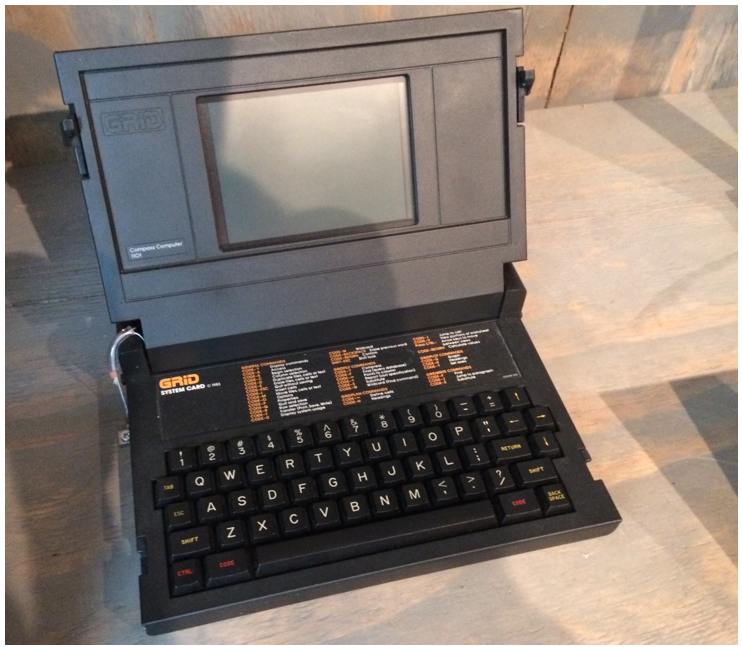
This is the GRiD Compass – the first example of a laptop.

I loved the way Grid systems briefed the the designer (Bill Moggridge) – they asked for a computer that could fit into a briefcase. Simple as that. No weight or colour or design mandatories in the brief, no size jargon – just a clearly defined challenge.

Modernist designers, such as Marcel Breuer featured heavily.
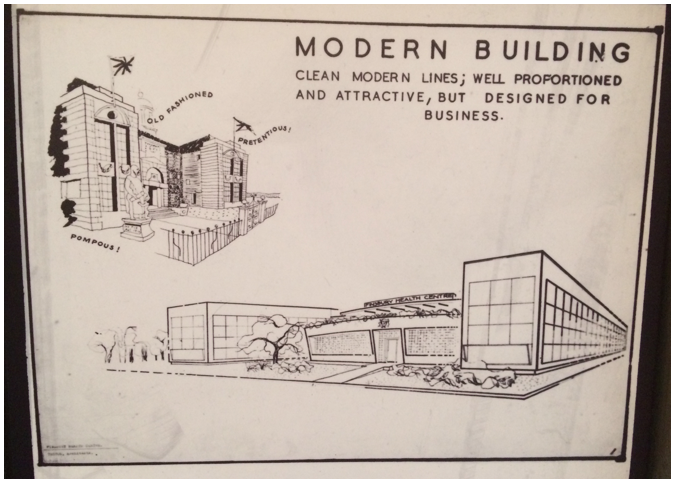
These designers believed that a ‘new style that rejected former tastes could contribute to a better, more forward facing world.’
What’s interesting about all of them is their ability to get other people to adopt their new designs.
Creating a mass change in opinion or action is hugely difficult – but these designers managed to do it time after time.

Perhaps it was to do with posters like these… Haha.

I was amazed to read that during WWII, plans were already underway to rebuild Britain.
Even in a crisis, we’re a forward planning nation.
As the war ended, the Government commissioned whole new towns that were planned and built to modernist design principles.

There was an interesting section on road signage and the guidelines that surround them.
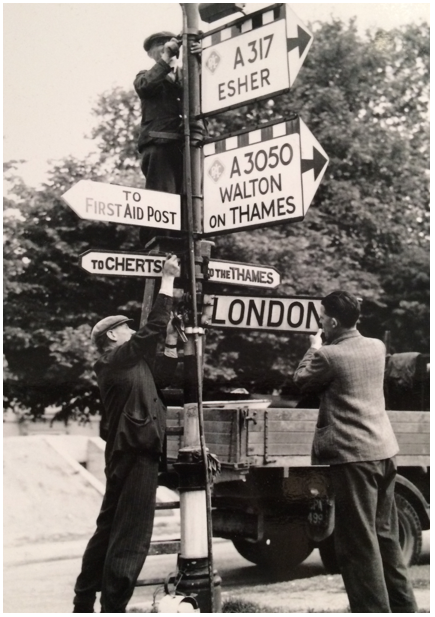
Before motorways were introduced, road signs were a bit of a mess. Each local council produced their own signs according to their own criteria.

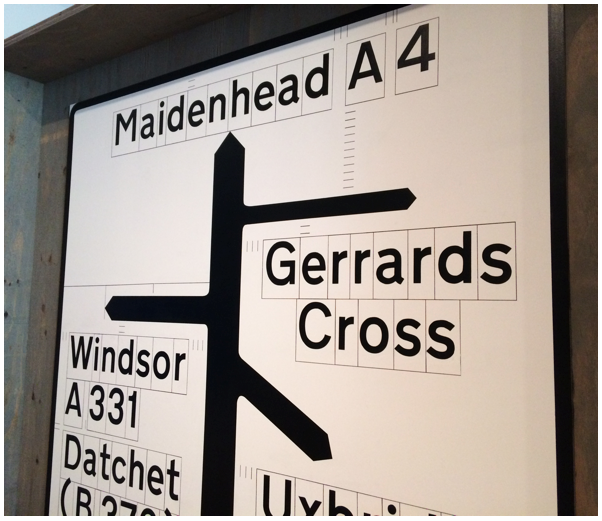
After WWII, plans for new motorways were created and the old system of signage was deemed inadequate for cars driving at speed. Jock Kinneir and his assistant Margaret Calvert worked on the redesign. The signs are laid out according to a really strict system, like on the diagram below.

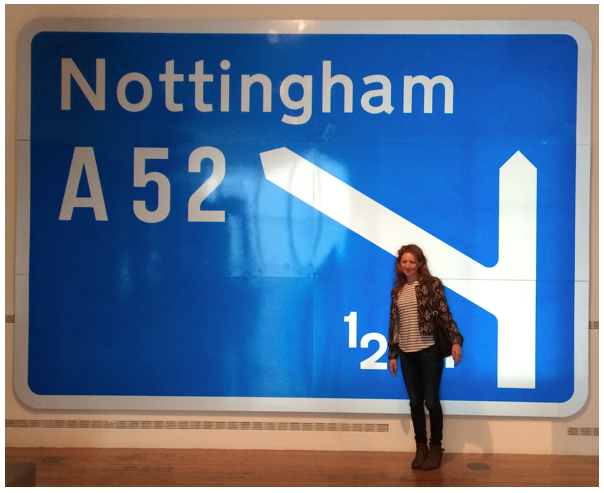
The size, positioning and relationship or all elements were determined by multiples of the width of the capital letter used. The size of each sign is therefore dependant on the information it needed to convey.
This means that some signs end up really really big.

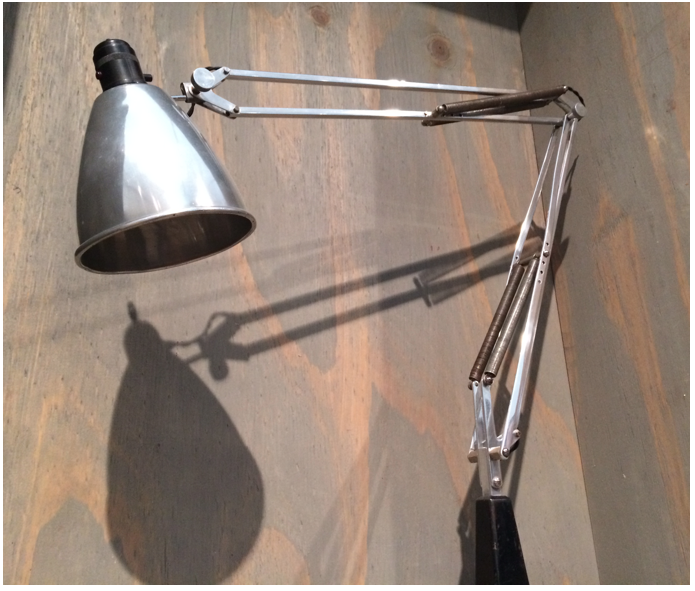
Another section focused on the Anglepoise lamp.
This is an early version of George Carwardine’s lamp in 1932, manufactured by Herbert Terry & Sons.

The lamp has evolved over time – but the core design principles behind it stay the same.
The newest innovation we saw was a flat one – very cool.

There was also corridor section on the rise of plastics.
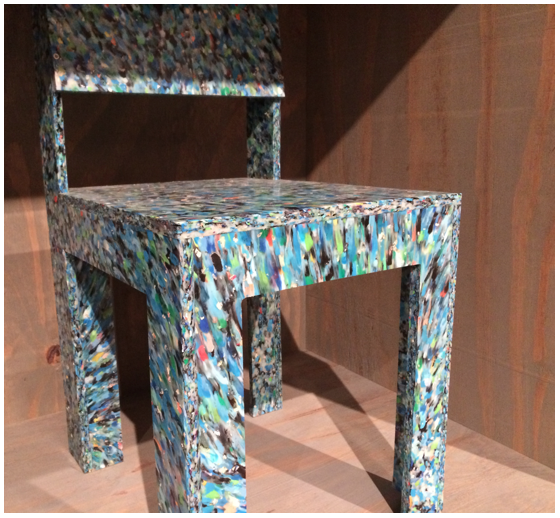
I loved this chair, made entirely of recycled plastic sheets.

Fighting from the opposing corner, a TV set from Jim Nature questioned the proliferation of plastic use. He created a TV using a high-density chipboard casing as a provocative and environmentally-friendly alternative to plastic.

There was also one of the old iMacs on display.
It’s amazing to see how much it’s aged over the years – I remember using one back at school and thinking it was the most futuristic thing in the world. Now though, the buttons and inputs look dated in comparison to newer Apple products.

I thought this Radio-in-a-bag idea was quite a neat idea – it’s always nice to see the inner workings of products.

Top museum – well worth a trip if ever you’ve got a spare afternoon.

FIVE FACTS
#1. Small panes of glass were chosen for the windows in the iconic red phonebox significantly affecting the way it looks. However, they were chosen, not for aesthetic qualities, but because they were cheaper to replace.
#2. The corporate guidelines created by Wolff Olins for London 2012 was pitched as ‘Prescribed anarchy’ – which allowed stakeholders from sponsors to venues extensive freedom of use.
#3. Millions of Bic disposable biros are manufactured every day.
#4. The word Robot is derived from the Czech ‘Robotnik’, meaning ‘worker.’
#5. It’s hard to imagine, but plastic was rarely used as a material until after WWII.

1. Cartoon Museum 

2. Churchill War Rooms 
3. Cinema Museum 
4. Dennis Sever’s House 
5. Dr Johnson’s house 
6. Design Museum 
7. Down House 
8. The Geffrye Museum 
9. London Film Museum 
10. London Transport Museum 
11. Mansion House 
12. Brunel Museum 
13. Museum of the Order of St John 
14. Musical Museum 
15. Old Operating Theatre Museum & Herb Garret
16. Pollock’s Toy Museum 
17. Rose Theatre exhibition 
18. Fashion and Textile Museum 
19. Royal College of Music Archives and Museum of Instruments 
20. Sherlock Holmes Museum 
21. Twinings Museum 
22. V&A Museum of Childhood 
23. Bank of England museum 
24. The Stephens Museum 

A day after we touched down from Italy, we decided we had to do something quintessentially British.
Well what could be more British than visiting the Churchill War Rooms.

The museum itself is split into two parts.
The war rooms and the Churchill museum.

We hit the war rooms first.

The first room you stumble upon is the War Cabinet room.
The majority of meetings of the war cabinet during 1940 were held in here, as were almost all of the defence committee meetings.
Churchill sat on the far side by the red box. 25 could sit in this room during one meeting.
Puts some PPMs to shame.

Walking down the corridor behind it, you see a number of things.

Firstly, the dock – a sub-underground basement that all but the most senior of staff used to sleep in, if on duty. Rats, insects, constant bright lighting and a lack of flushing toilets made this a particularly undesirable place to sleep – and lots of staff took the risk every night after work and decided to head home.

Further along the corridor is a sign holder, set to Fine & Warm.
This was to let everyone know what the weather was like above ground.

George Rance famously changed it to ‘Windy’ whenever there was an air raid in progress above ground.

There was actually a little plaque about George Rance further on down the corridor.
To avoid arousing suspicion, all equipment for the cabinet war rooms was sent addressed to George Rance – whose job within the Office of Works included ordering furniture for the government departments – the perfect cover.

One door along the corridor, Room 63, had a toilet lock on it.
A widespread rumour between the war room staff was that is was a flushing toilet – only available for use by the PM.

In fact, it was the transatlantic telephone room – which housed Winston Churchill’s hotline to the President of the United States.

Here’s a mess reciept –  officers could order “simple food such as beans on toast” in the war rooms. In the last six months of the war, drinks were rationed to two large whiskies and two large gins A DAY!

Perhaps because of the booze – staff found time for an occasional joke too.
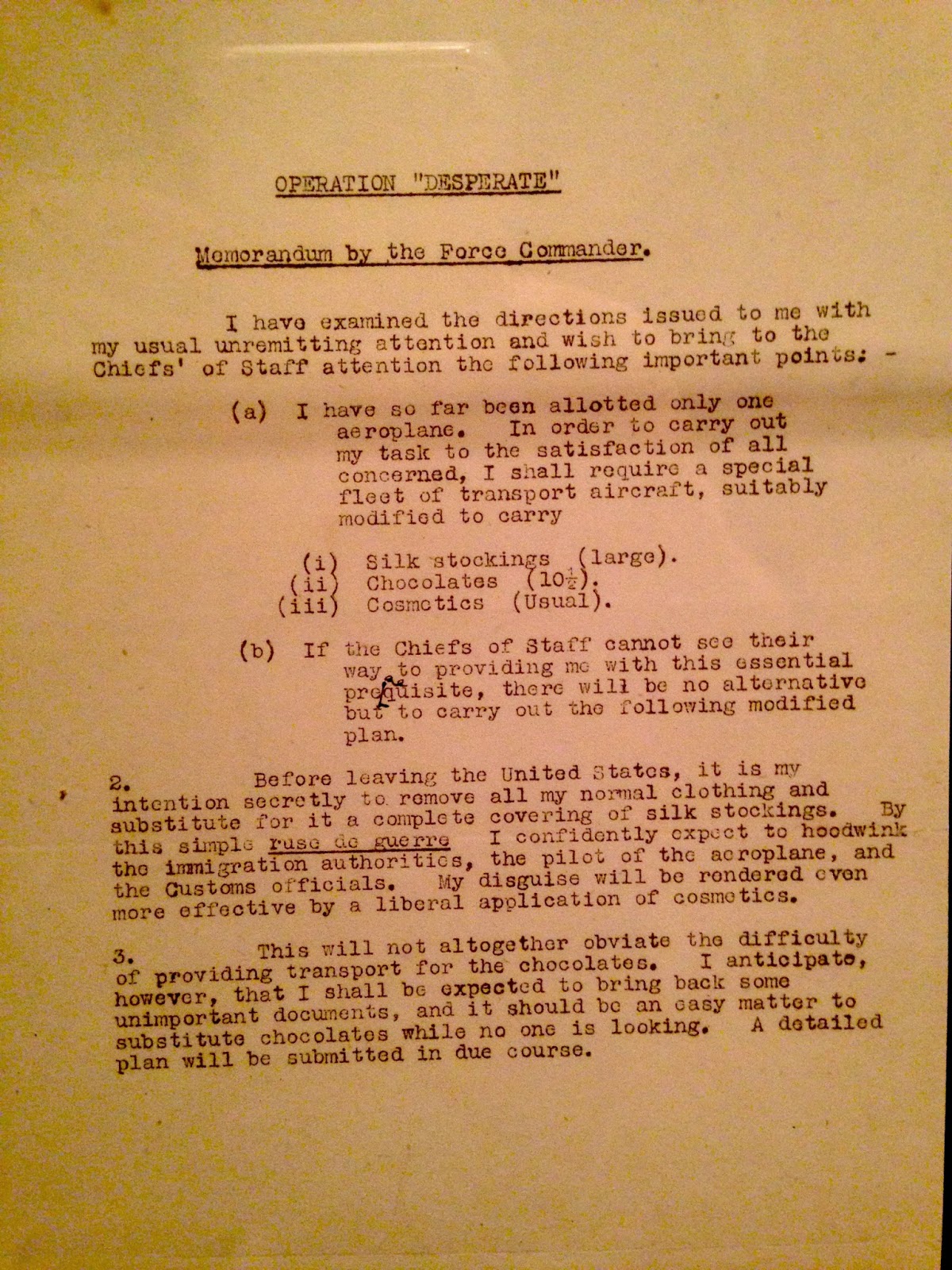
‘Operation Desperate’ was a tongue-in-cheek scheme that the staff undertook, which plotted to obtain American stockings and chocolate.

There was an interesting story about Dennis Wheatley, who worked as a ‘Deception Planner’ in the rooms. He was a popular thriller writer, and used his talents to produce cover plans for Allied operations. His work included a plan, codenamed ‘Bodyguard’, to deceive the Germans about the place and date of the Allied D-day invasion of Europe.

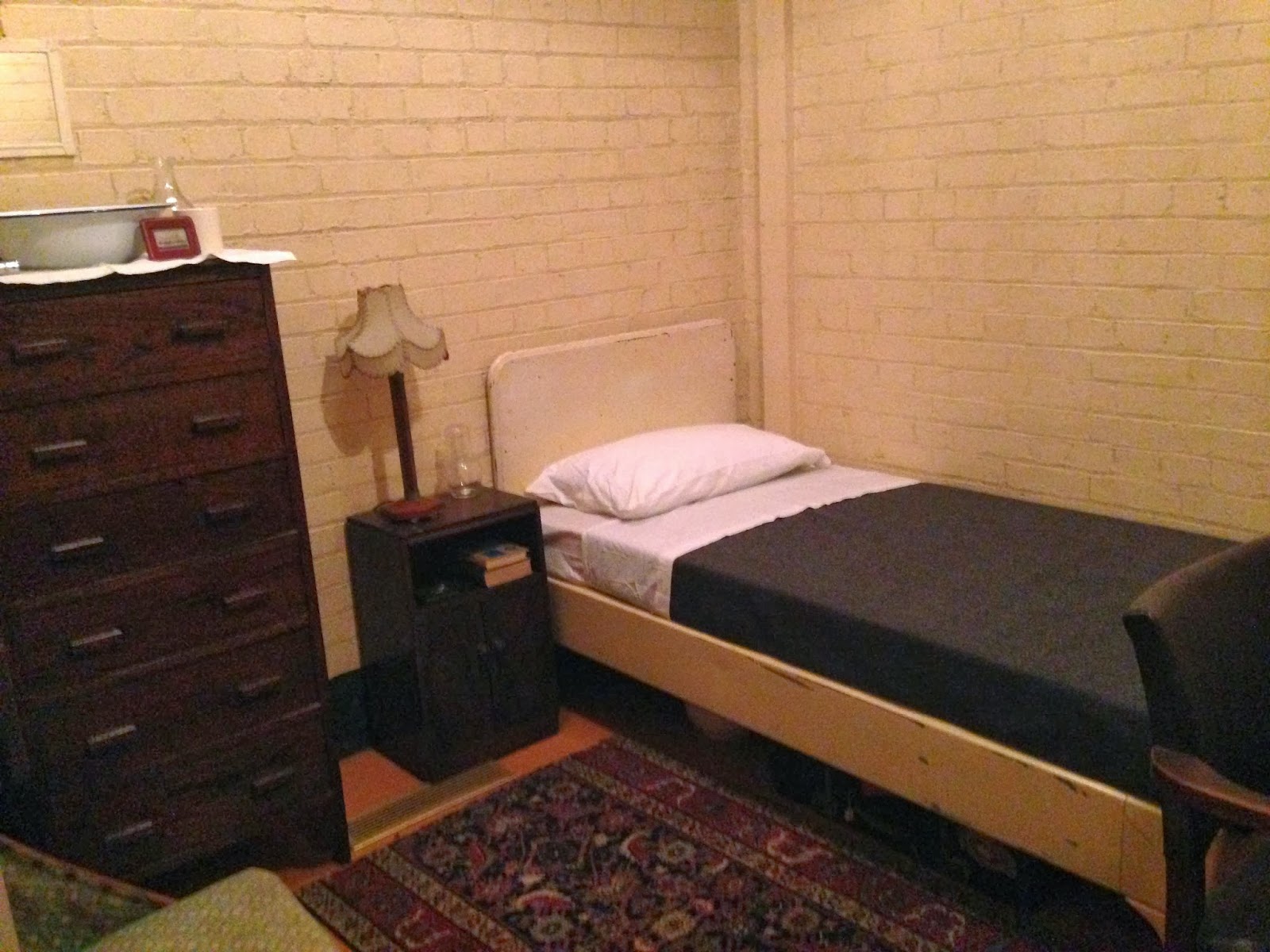
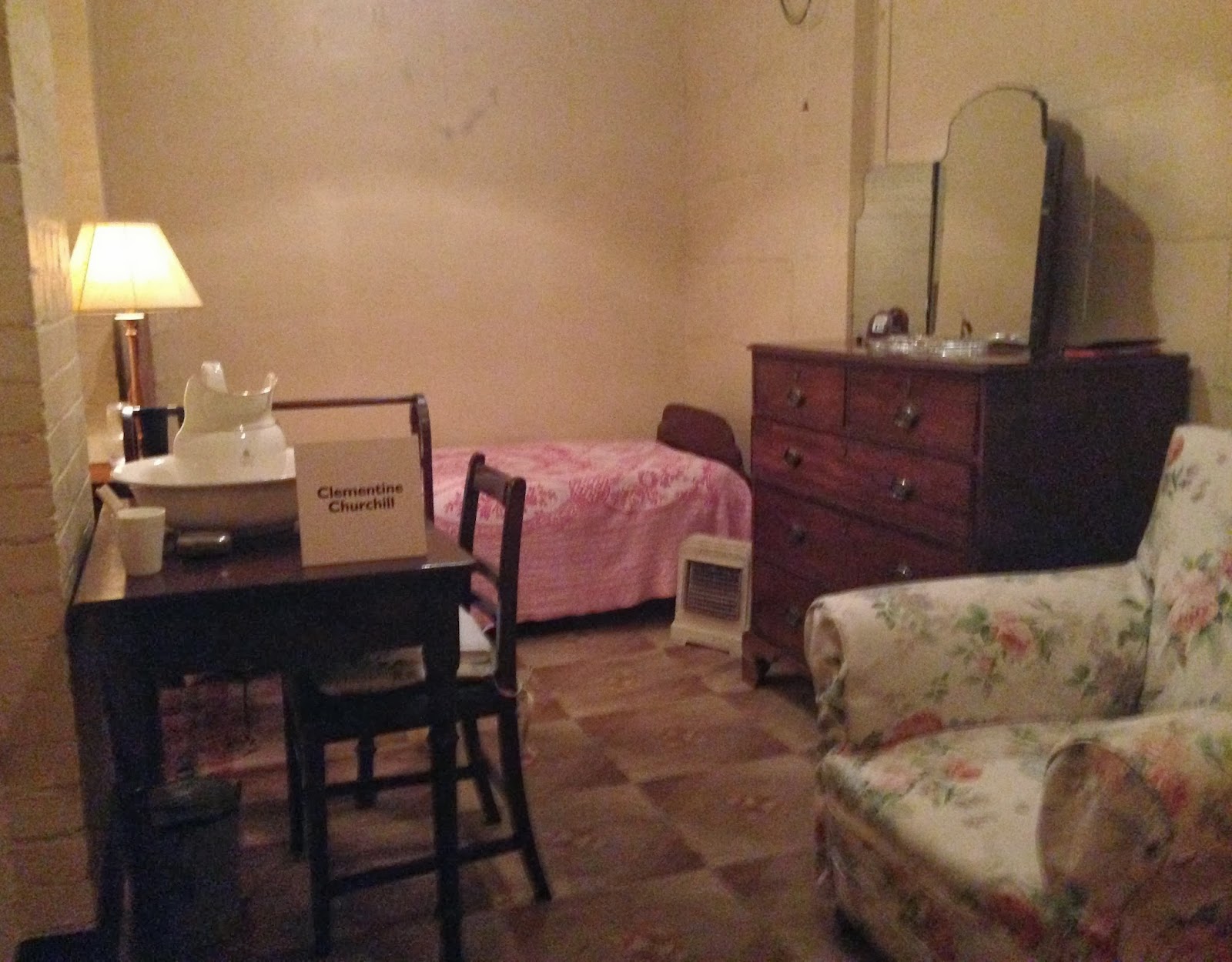
Here’s an example of the senior staff bedrooms.
Pretty basic.

Clementine Churchill’s room had a little more colour.

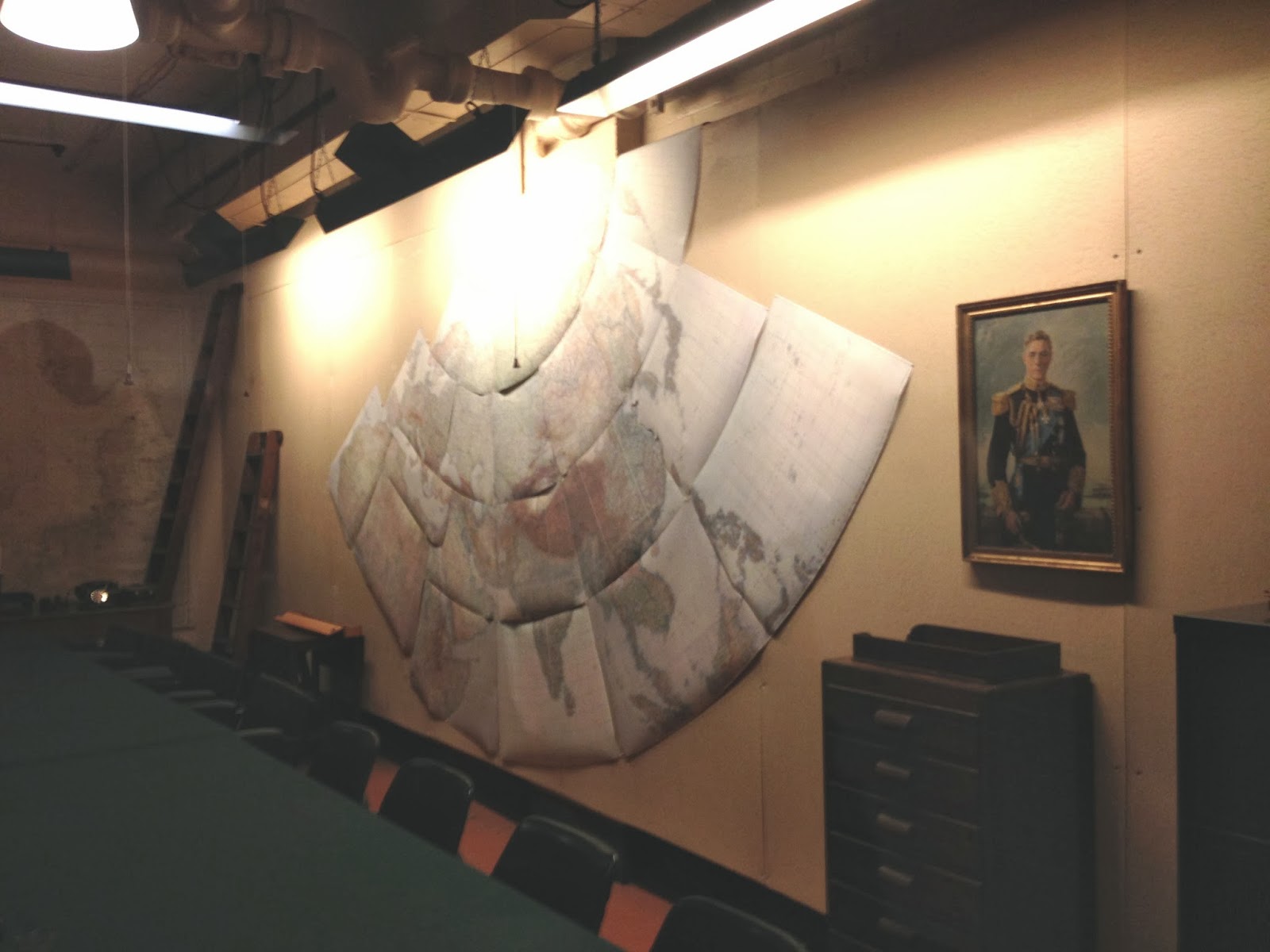
Second big meeting room: The Chiefs of Staff conference room.
Churchill was often represented by his right hand man, Hastings Ismay in these meetings.
Some of the most important decisions with regards to WWII were made in this room.

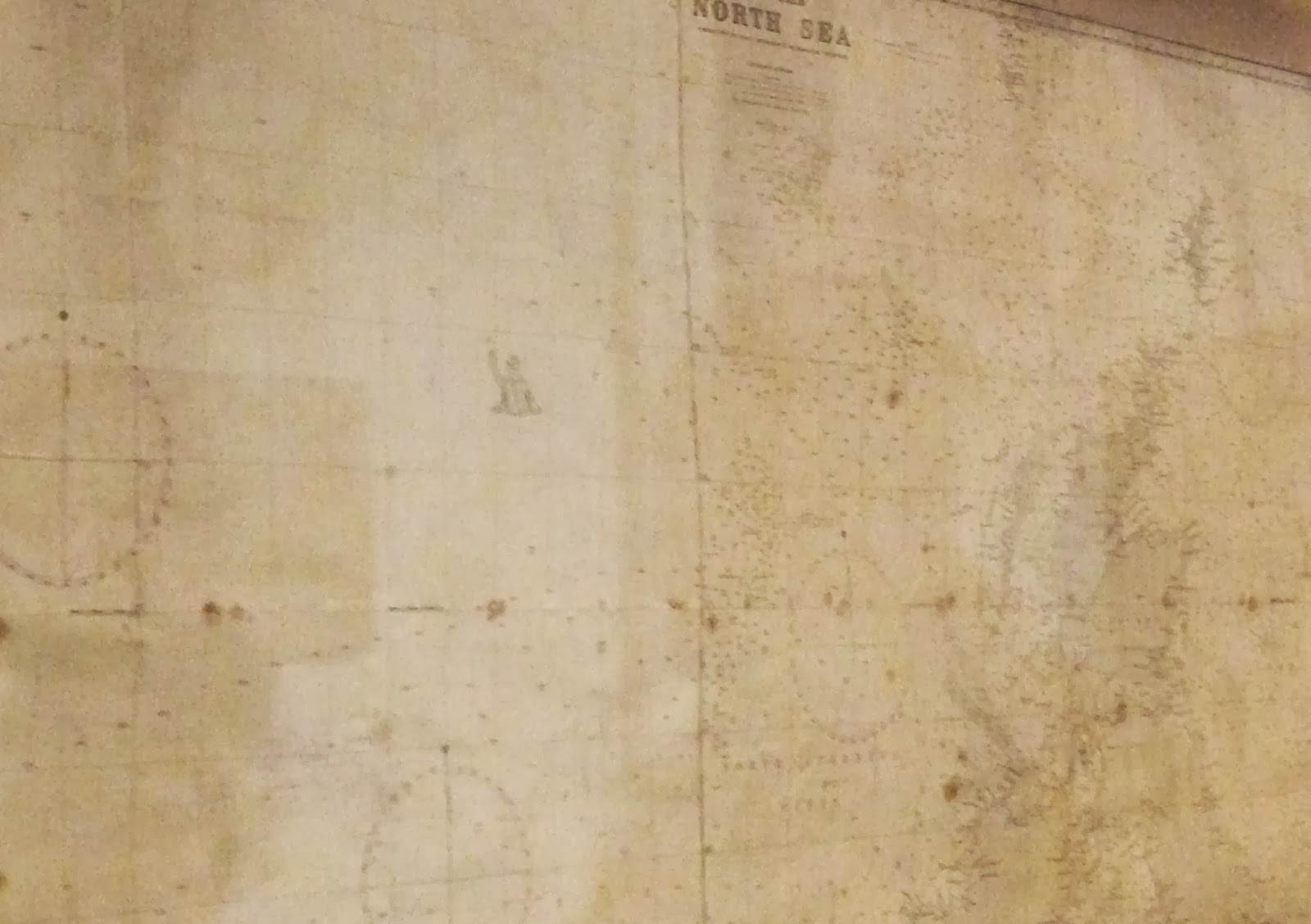
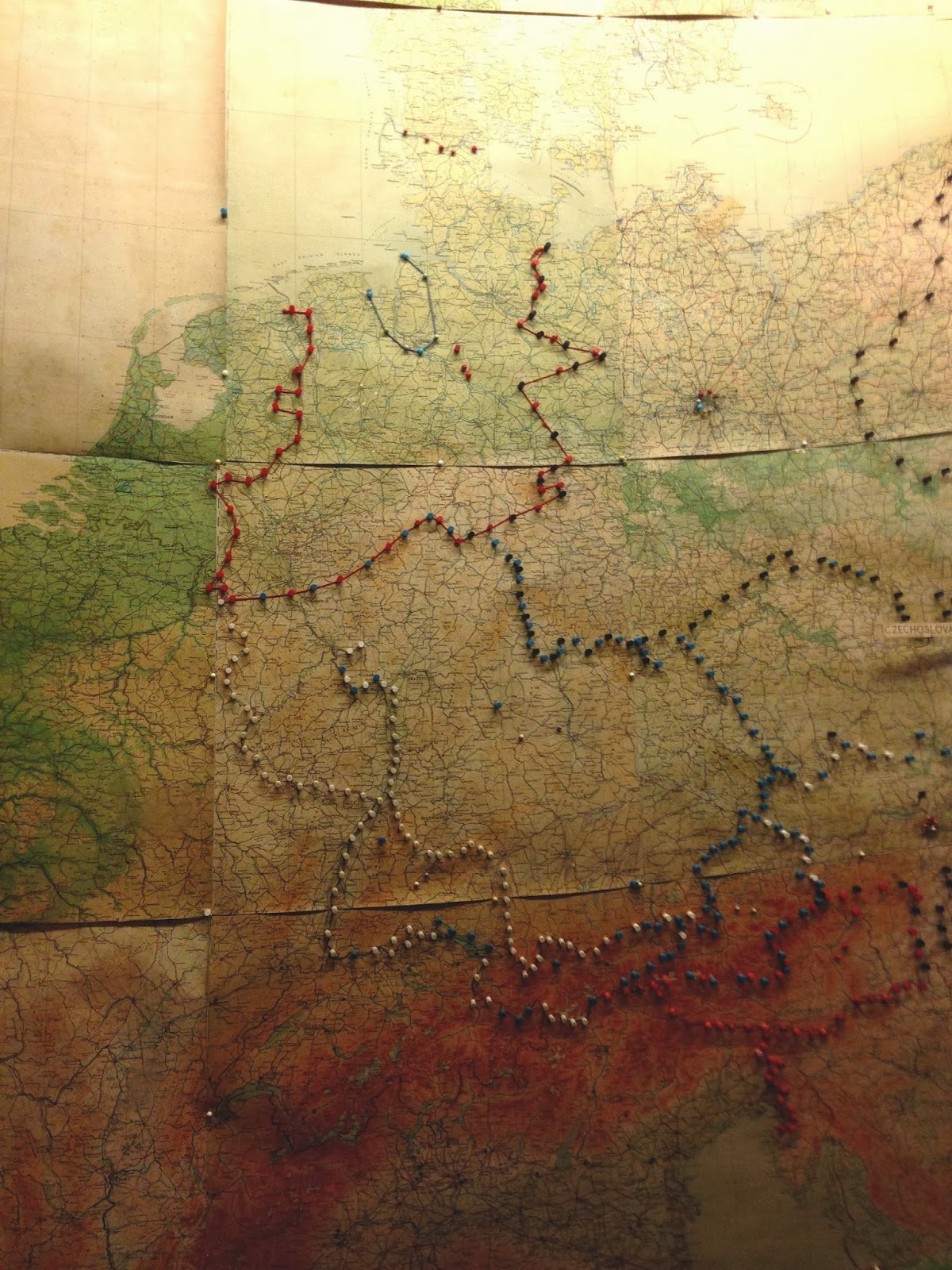
They had some beautiful maps on either wall.

I love how this one has been pasted together.

The audioguide pointed out the Hitler graffiti on this one.

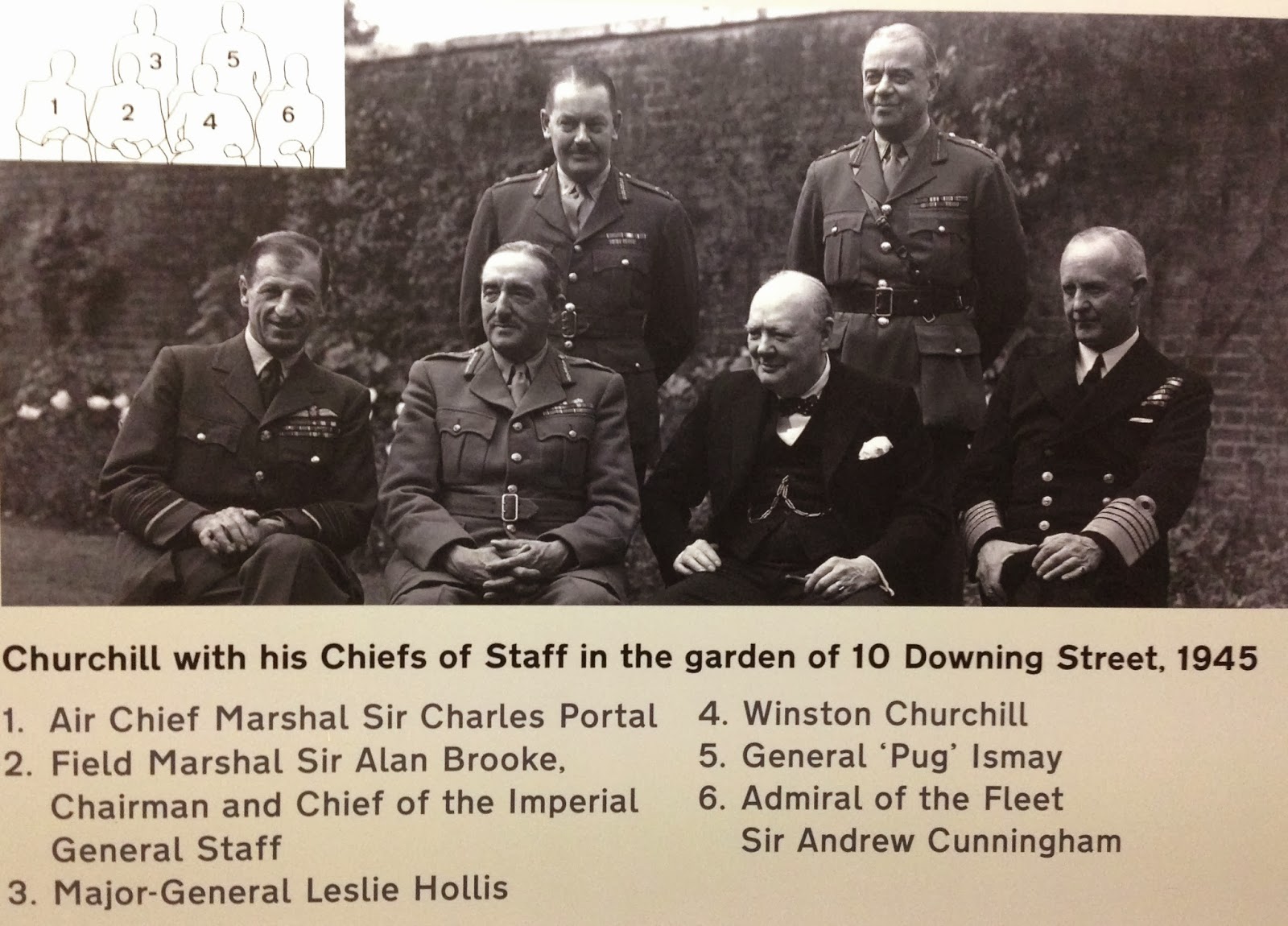
Here’s the five Chiefs of Staff with Winston Churchill in the garden of Downing Street.

Here’s the kitchen where the PMs meals were prepared daily.
(The guys head in the photo wasn’t part of the original installation…)

There was a type-pool around the corner.

One of the PM’s typists spoke of the daily struggle doing her job:
First you had the fact he had a cigar in his mouth, and his speech impediment. He was continually pacing so half the time he was facing away from you. And above all that, sometimes what he was saying was so interesting that you’d want to stop typing and just listen.

We passed through Room 59, which housed the Joint Planning Staff.
The Joint Planning Staff would analyse all information available and create strategic options, on which the Chiefs of staff would make crucial decisions.
What an amazing job.

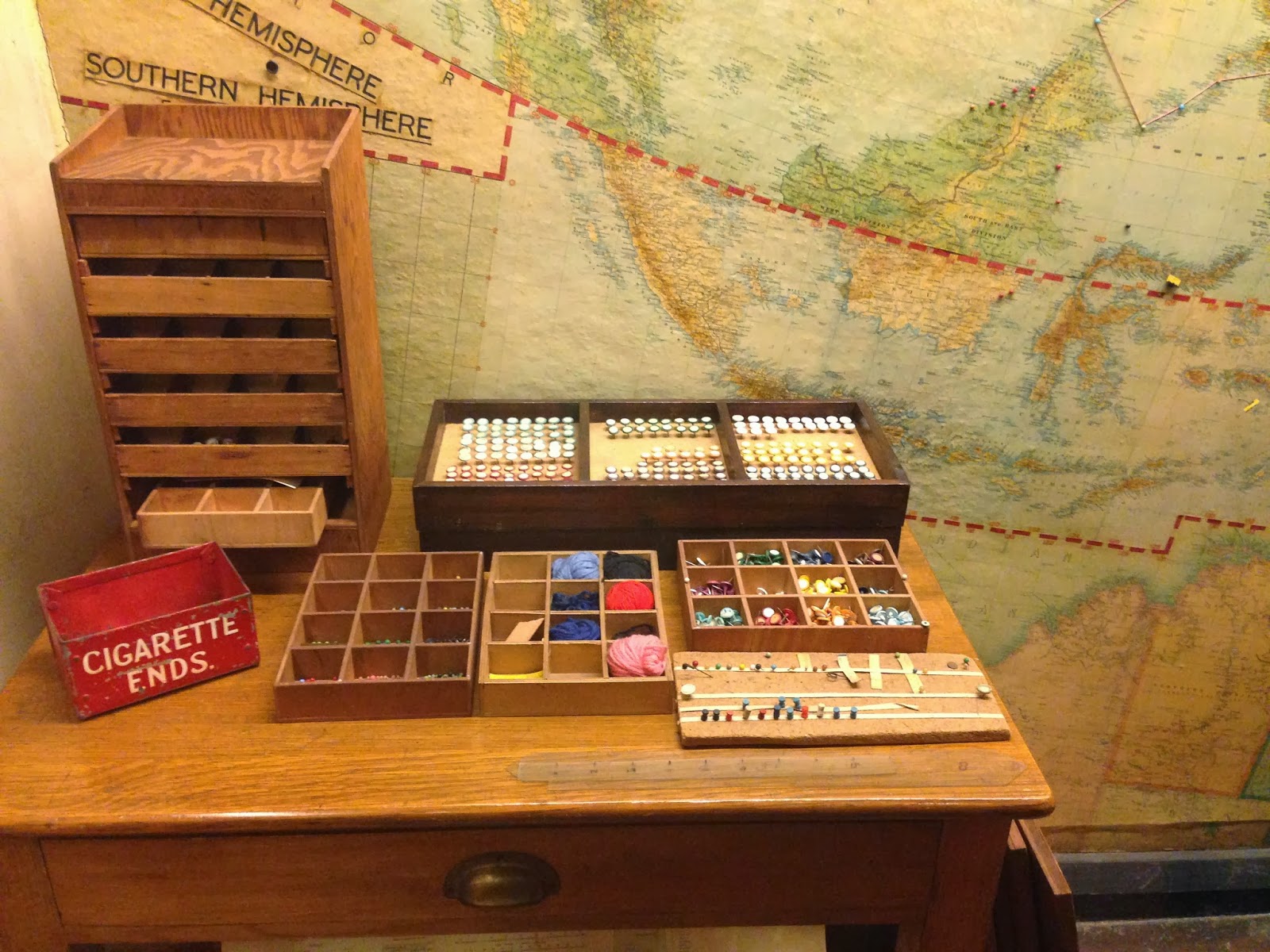
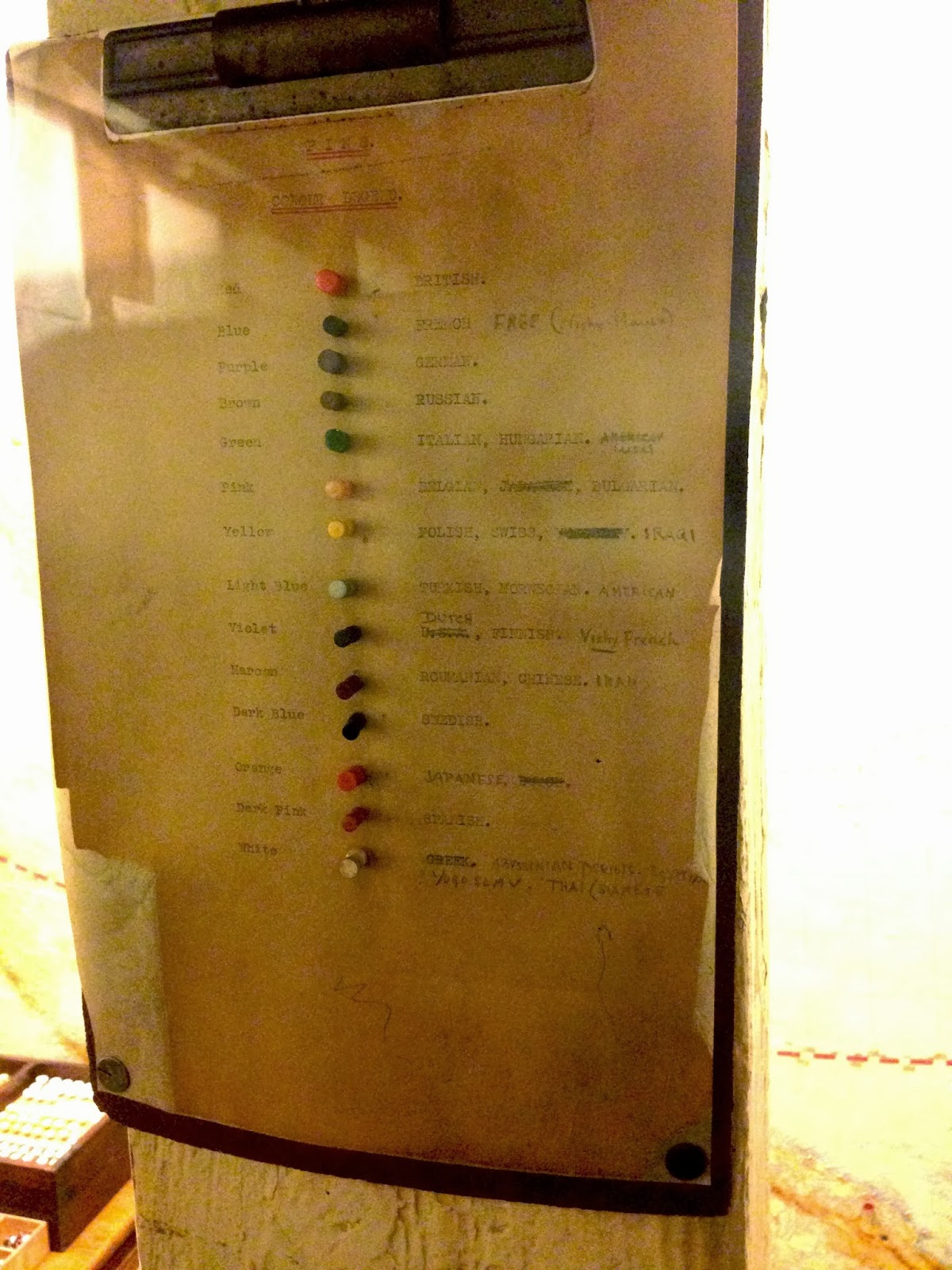
And then we hit upon the map room.
The map room was manned day and night throughout the war.
The latest information on all fronts was collected, sifted and presented on maps. Summaries were then created for the King, the War cabinet, the Chiefs of staff, Joint planners and the Joint Intelligence committee.
This room was amazing.

The maps were beautiful.

Even the map stationary was beautiful.

And there was a entire bank of telephones through the centre of the table – where information could be relayed from all across the globe. The telephones were referred to as the beauty chorus.
The ivory one on the end connected directly to the PMs Downing Street office.

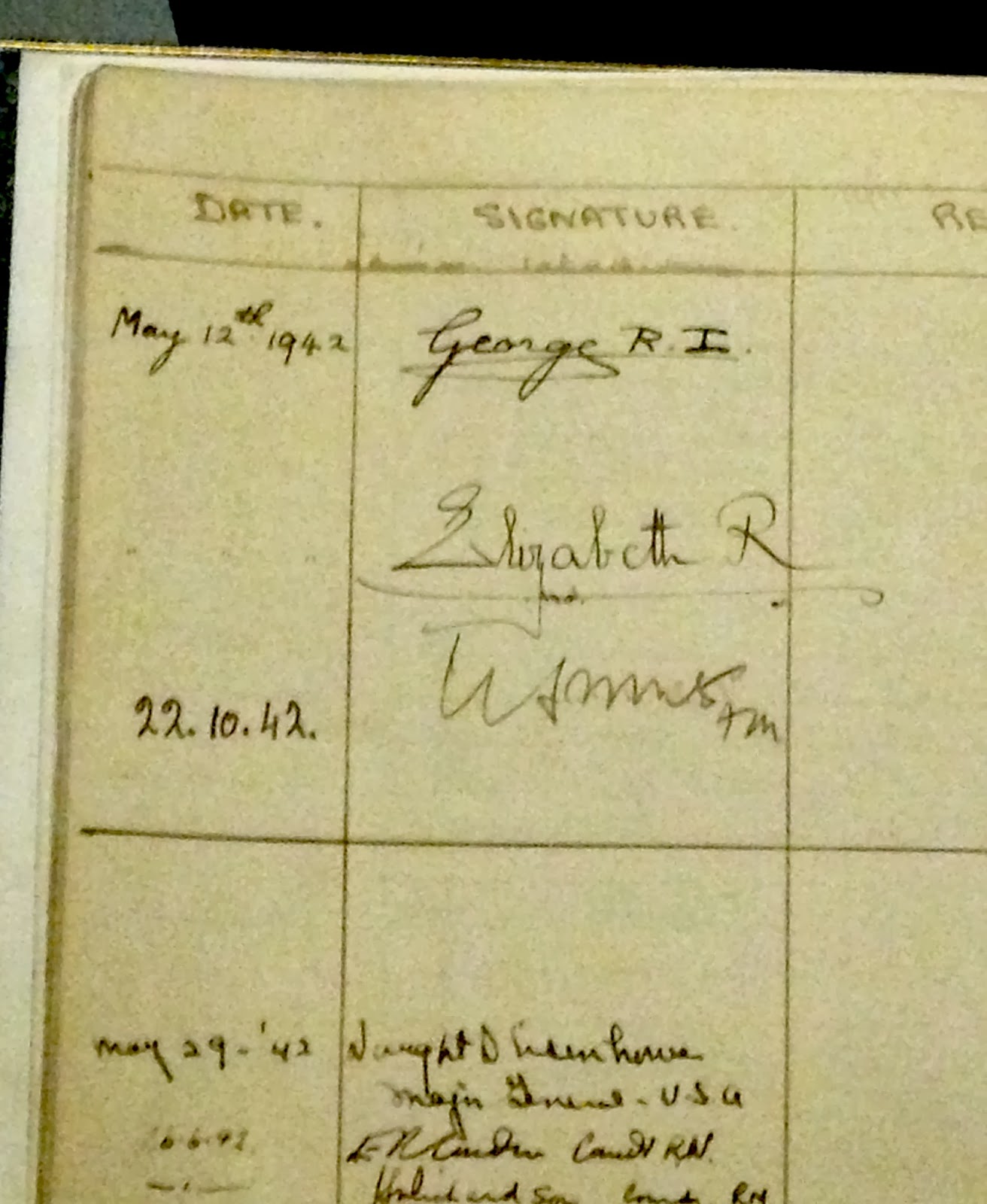
Rather neatly, you can see Queen Elizabeth and King George’s signatures in the visitors book for the cabinet war rooms.

The cabinet rooms were finally closed down on 11th May 1945. Here’s the note from Edward Bridges and Ismay to staff.

Now that’s quite enough for one museum… but we still had the Churchill museum to go around.

There were some choice quotes of his on display…
– ‘It is no use leading other nations up the garden and then running away when the dog growls.’
– ‘I must write to Ivor Novello and tell him to produce a good war song… but this time it will have to be Stop the Home Fires Burning.’
– ‘He has all the virtues I dislike and none of the vices I admire.’
– ‘A sheep in sheep’s clothing.’
– ‘An empty taxi pulled up at 10 Downing street, and when the door opened, Attlee got out.’
– When accused of sleeping during someone’s speech ‘I wish to god I were.’
– ‘There’s less to him than meets the eye.’
– When receiving an honoury degree ‘No one has ever passed so few examinations and received so many degrees.’
– They may say I lead them up the garden path, but they have found delectable fruit and wholesome vegetables.

I thought it was really interesting how attuned to the nuances of language Churchill was.
He decided to rename the Local Defence Volunteers, The Home Guard – as he thought the former was uninspiring.
He also requested the wartime Communal Feeding Areas be renamed Restaurants, as the former was suggestive of communism and workhouses.

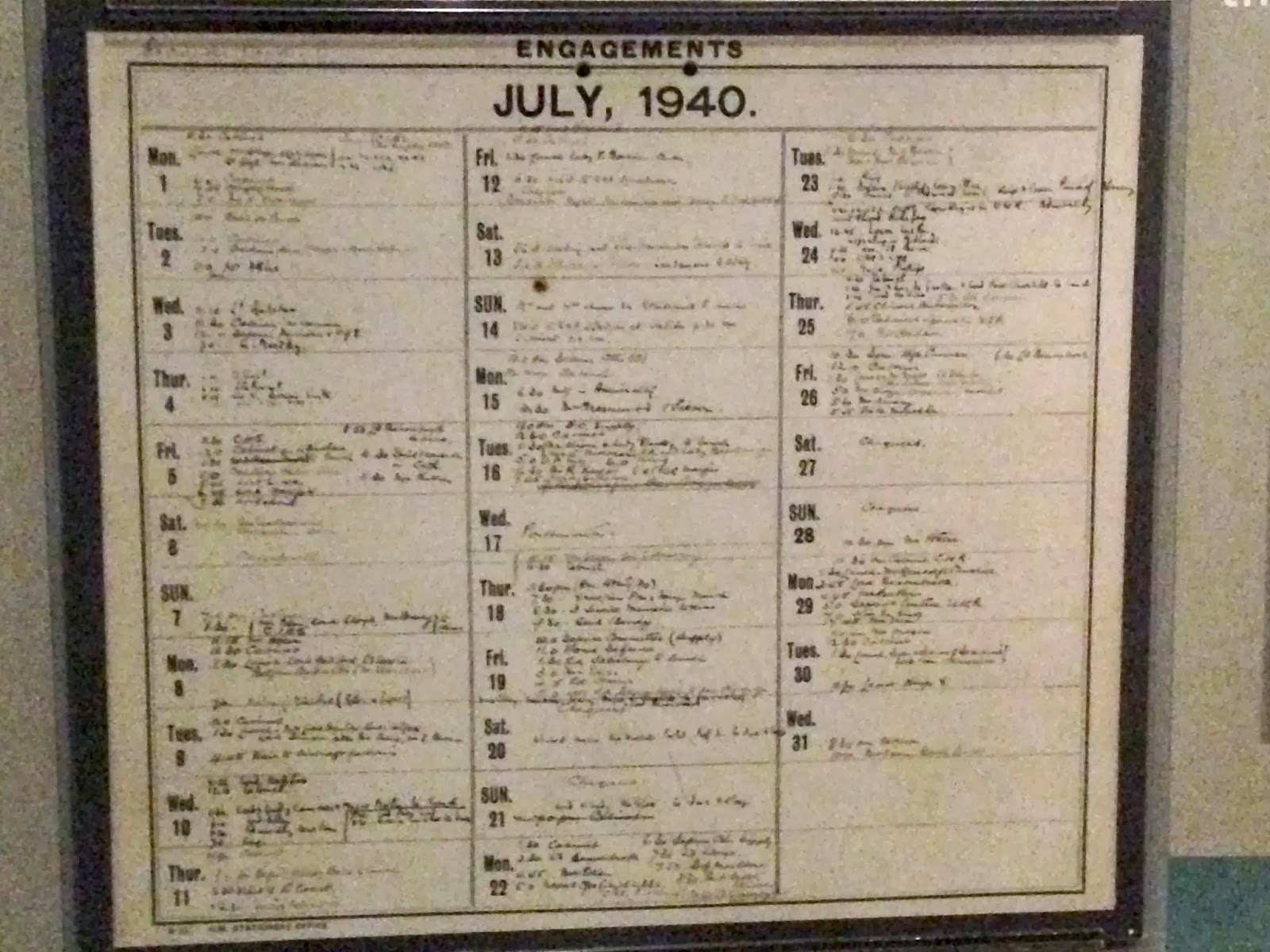
I loved this monthly engagement planner he used – like a chunkier calendar.

Notes on Churchill’s working day were quite incredible.
At 8am he would wake up, and would work in bed on government papers. His secretary would often join as he dictated letters.
At 10am he would rise and bathe.
He would have appointments late afternoon, before sitting down for lunch at 1.30pm with invited guests.
On Tuesdays, the King would come to dinner.
At 3pm he would have an afternoon nap, and at 4pm he would rise and bathe once more.
At 4.30pm he would have more meetings and do more work until 8pm.
At 8pm he would have dinner. Champagne and wine preceded and accompanied dinner, usually prepared by Mrs Georgina Landemare, Churchill’s personal cook. Despite rationing, Churchill would often eat oysters, soup and sardines, followed by roast venison stuffed with pate and truffle sauce. There would then be dessert – stilton cheese, baked tart or ice cream.
At 10.30pm he would have more meetings, and wouldn’t break until midnight.
At midnight, he might watch a film or play a card game.
At 1.30am he would head to bed and read the next day’s papers (supplied to him via an early pressing.)

There was a fair bit about young Churchill, and Churchill growing up.
And some interesting bits about his election campaigns too – but this post is miles too long already!

FIVE FACTS

#1. Churchill would normally light his first cigar shortly after breakfast. He smoked about eight a day.
#2. Churchill was always dressed by his valet, Sawyers.
#3. His favourite champagne was Pol Roger and his favourite brand was Hine.
#4. Churchill was 5 foot 6 and a half.
#5. Churchill referred to his bouts of depression as either the ‘black dog’ or his ‘brown hours.’

1. Cartoon Museum 

2. Churchill War Rooms 
3. Cinema Museum 
4. Dennis Sever’s House 
5. Dr Johnson’s house 
6. Design Museum 
7. Down House 
8. The Geffrye Museum 
9. London Film Museum 
10. London Transport Museum 
11. Mansion House 
12. Brunel Museum 
13. Museum of the Order of St John 
14. Musical Museum 
15. Old Operating Theatre Museum & Herb Garret
16. Pollock’s Toy Museum 
17. Rose Theatre exhibition 
18. Fashion and Textile Museum 
19. Royal College of Music Archives and Museum of Instruments 
20. Sherlock Holmes Museum 
21. Twinings Museum 
22. V&A Museum of Childhood 
23. Bank of England museum 
24. The Stephens Museum 

Whilst in Venice, we popped along to the Peggy Guggenheim collection.

Here’s some snaps.


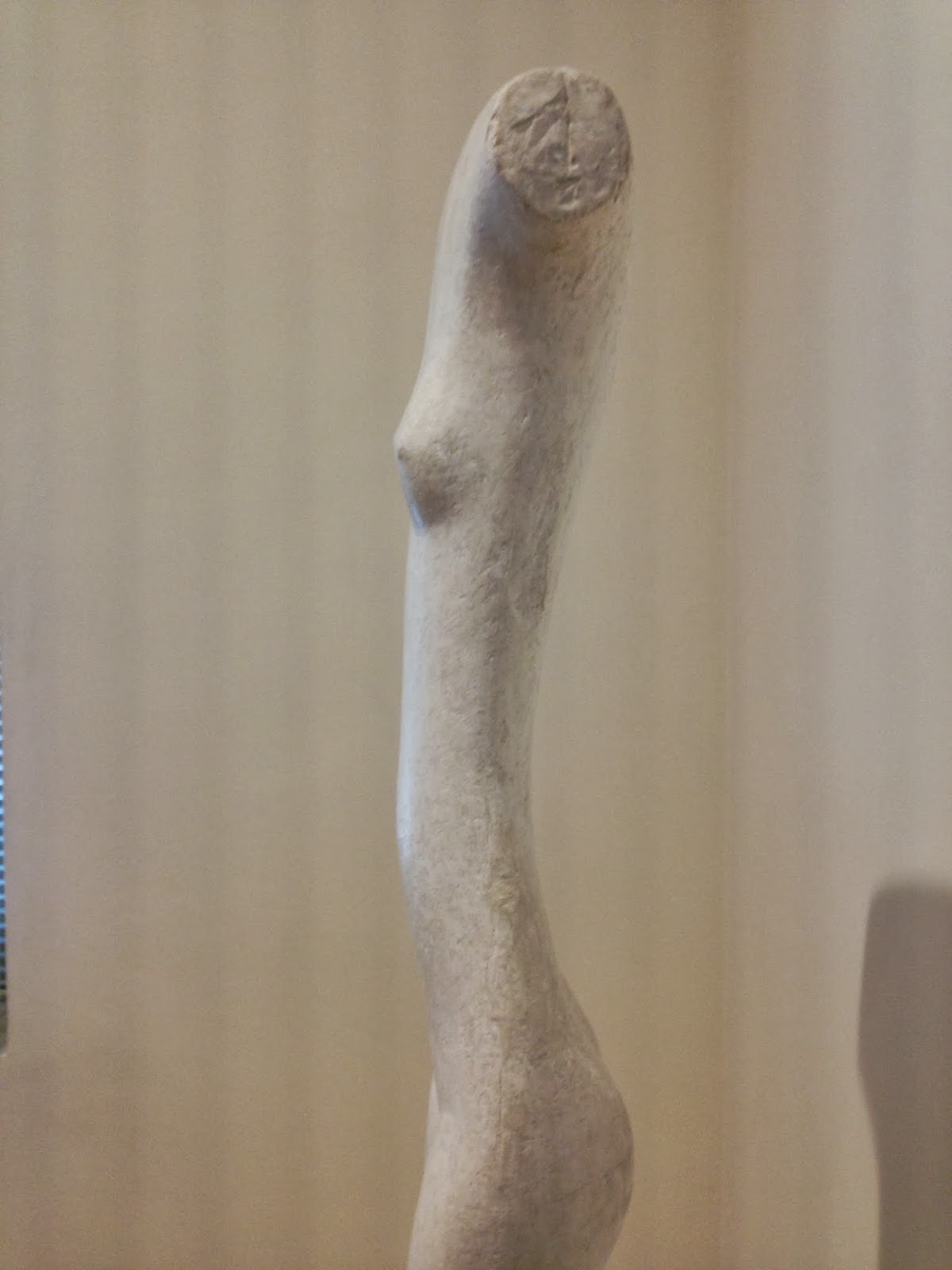
Below is Femme qui marche – Alberto Giacometti.

Next are two satirical comic strips, produced to publicise Picasso’s outraged position against the senselessness and horror of war. They were originally designed to be mass produced as postcards.

Eyes in the Heat – Jackson Pollock

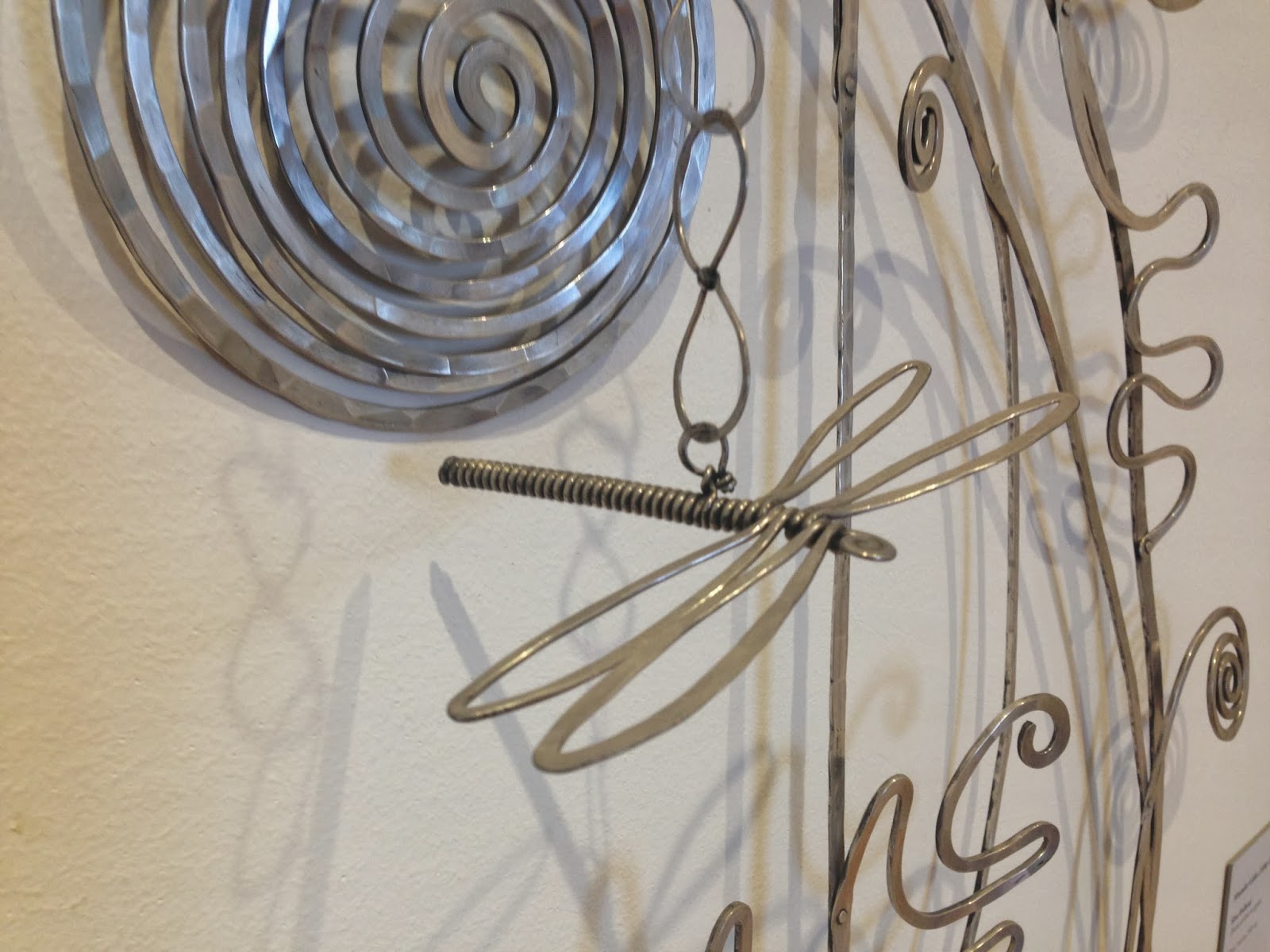
Alexander Calder – Silver Bedhead
As you can see from the photo, Peggy Guggenheim really did use this as her own bed head in the house.

The bed head was beautiful – I loved this dragonfly.

Pipe, verre, bouteille de Vieux Marc – Pablo Picasso

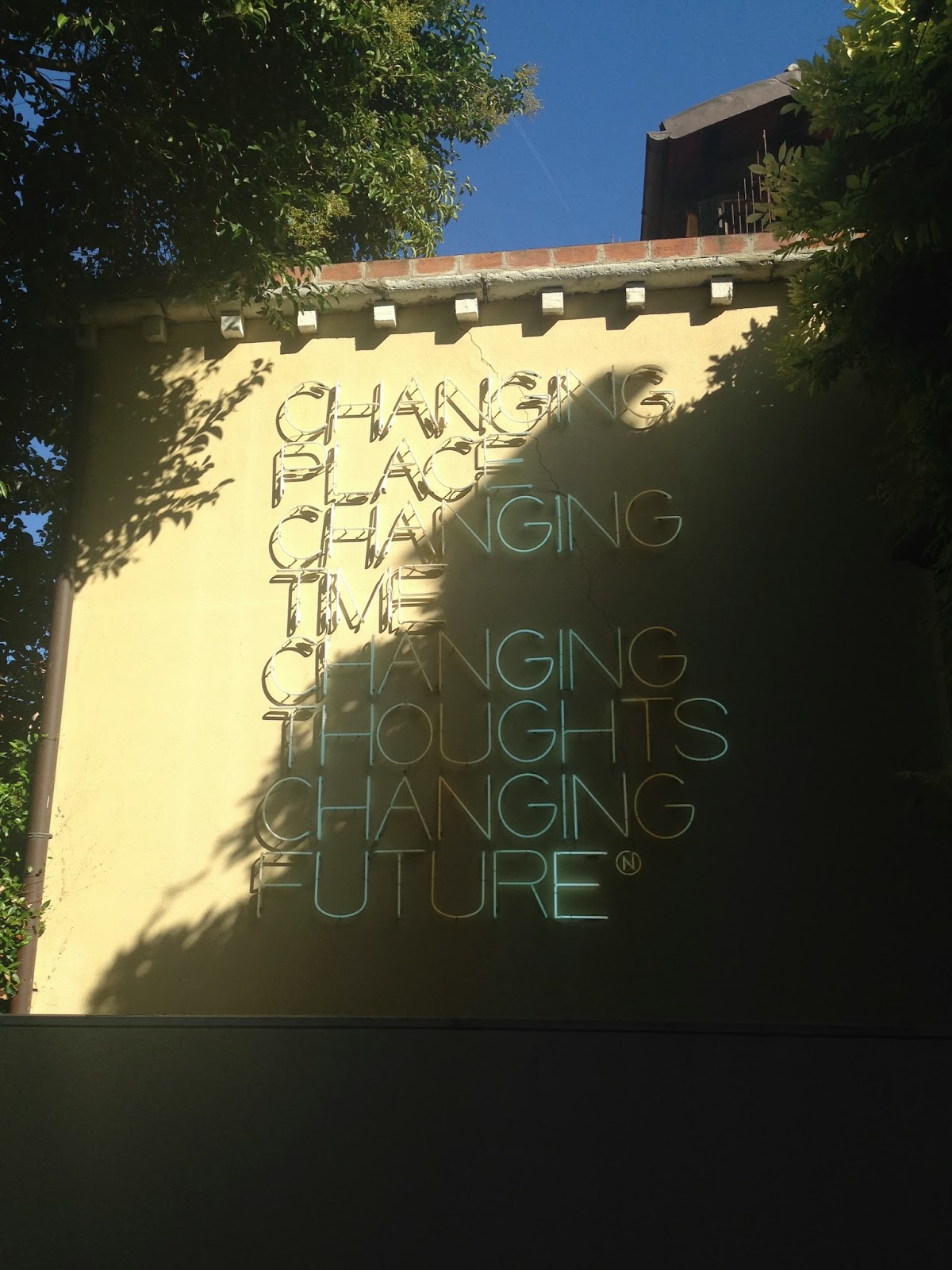
This next piece would look at home in most London creative agencies…
Changing place, changing time, changing thoughts, changing future – Maurizio Nannucci

I knew Wist and I would be fairly geeky on our holiday in Italy, but visiting two Leonardo Da Vinci exhibitions couldn’t have been predicted.

Here’s the summation of the first one…

Firstly – Leonardo and his machines.

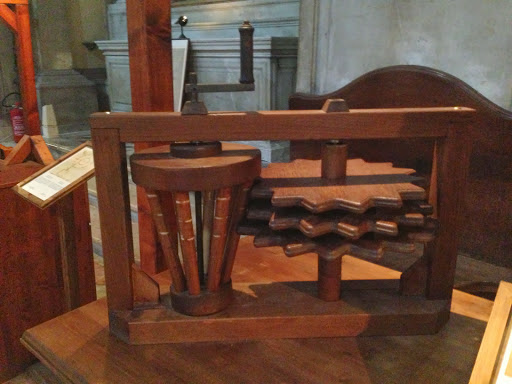
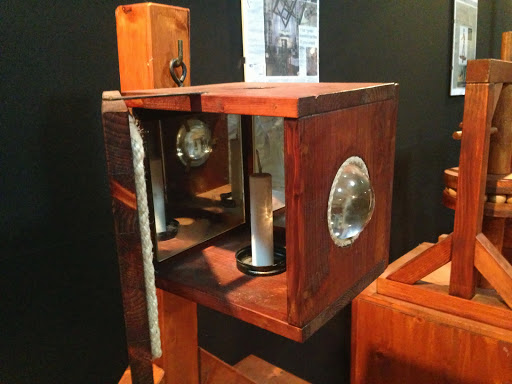
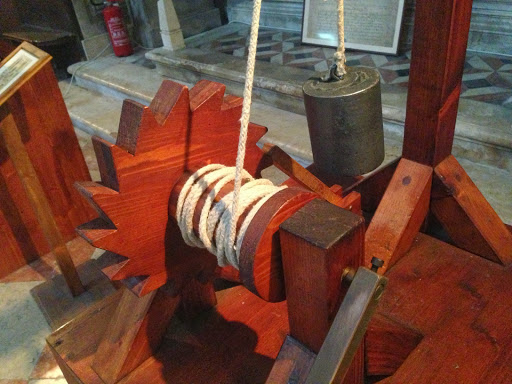
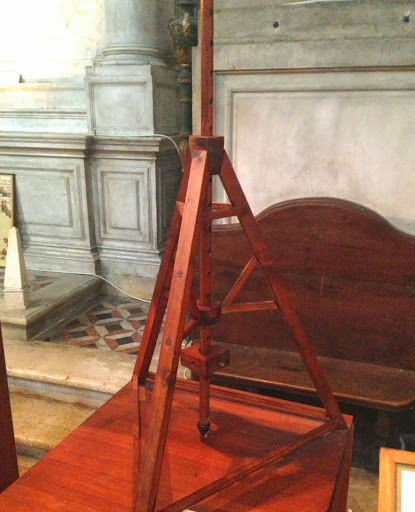
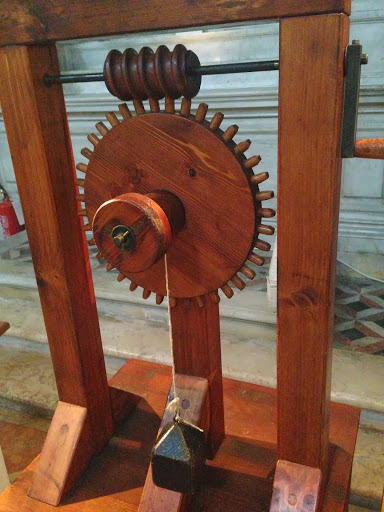
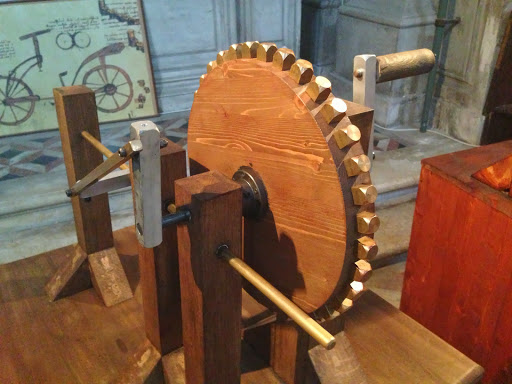
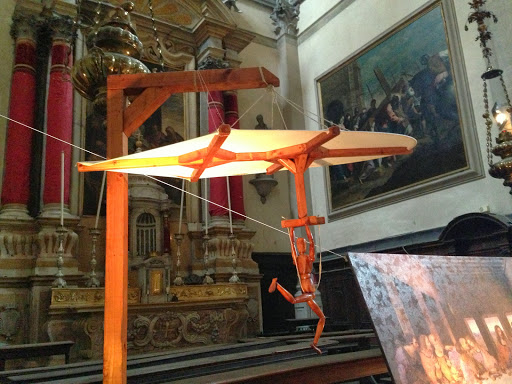
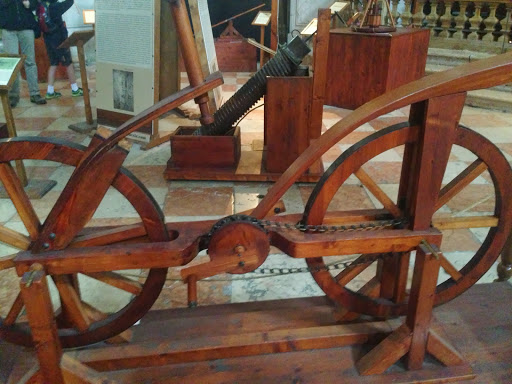
This exhibition was full of working examples of LDV’s sketches and inventions.
It was great to see some of them up close, and it was a nice intro to LDVs sketchbooks.
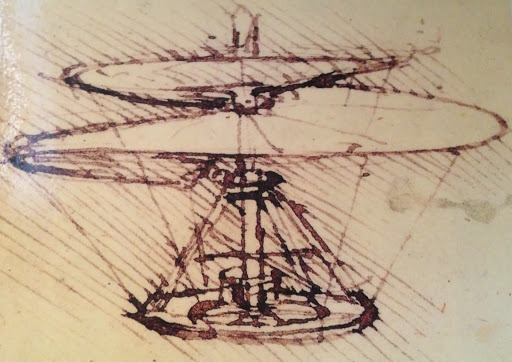
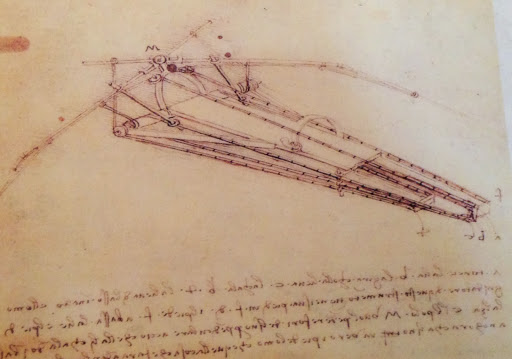
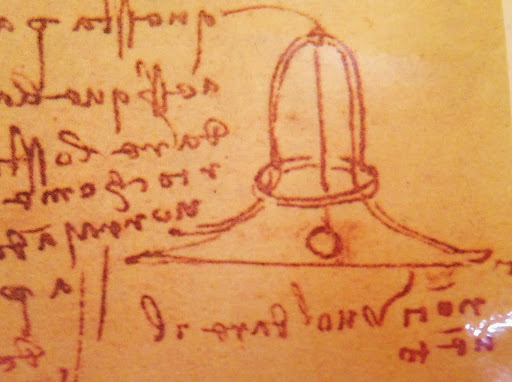
Here’s just some of them…

– The Cam Hammer

– The jack

– The gearshift

– The floodlight

– Ball bearings

– The autolock mechanism

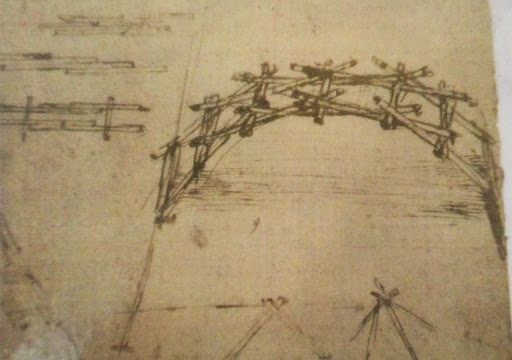
– Arched bridge

– Vertical drill

– Helicoidal-thread screw gearing

– Continuous motion to alternate motion

– Bicycle

– Aerial screw

– Hang glider

– Flapping wing machine

– Flying machine

– Clinometer

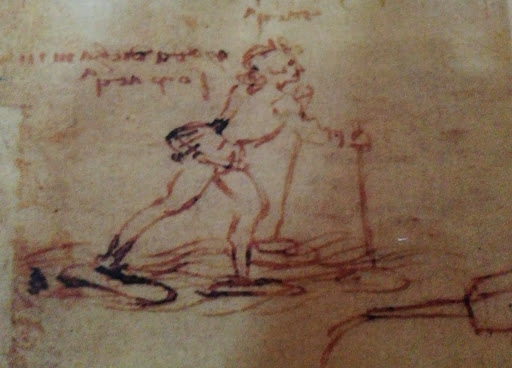
– Water skis…

– Column lifter

– Excavating machine

One talented man.

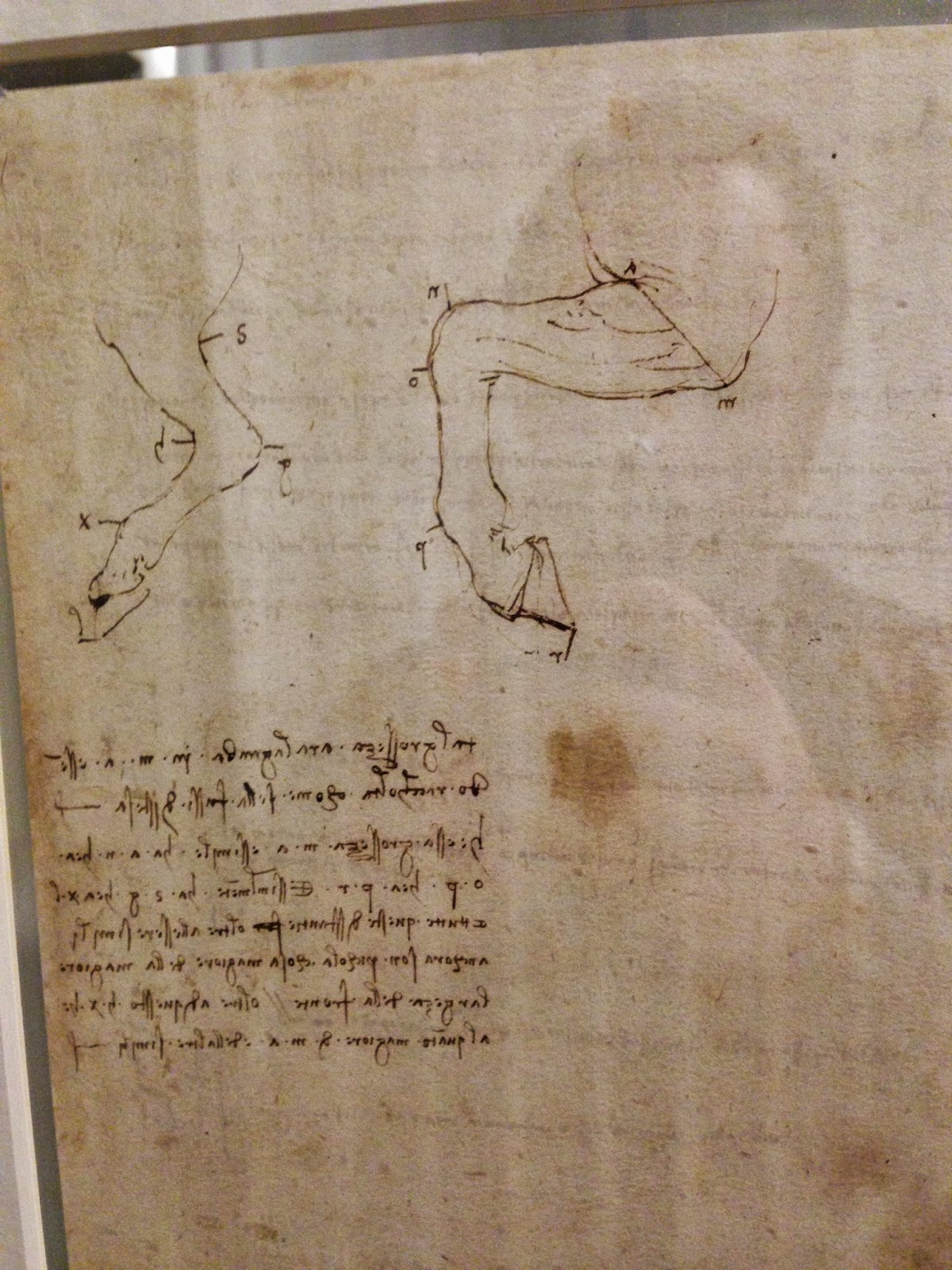
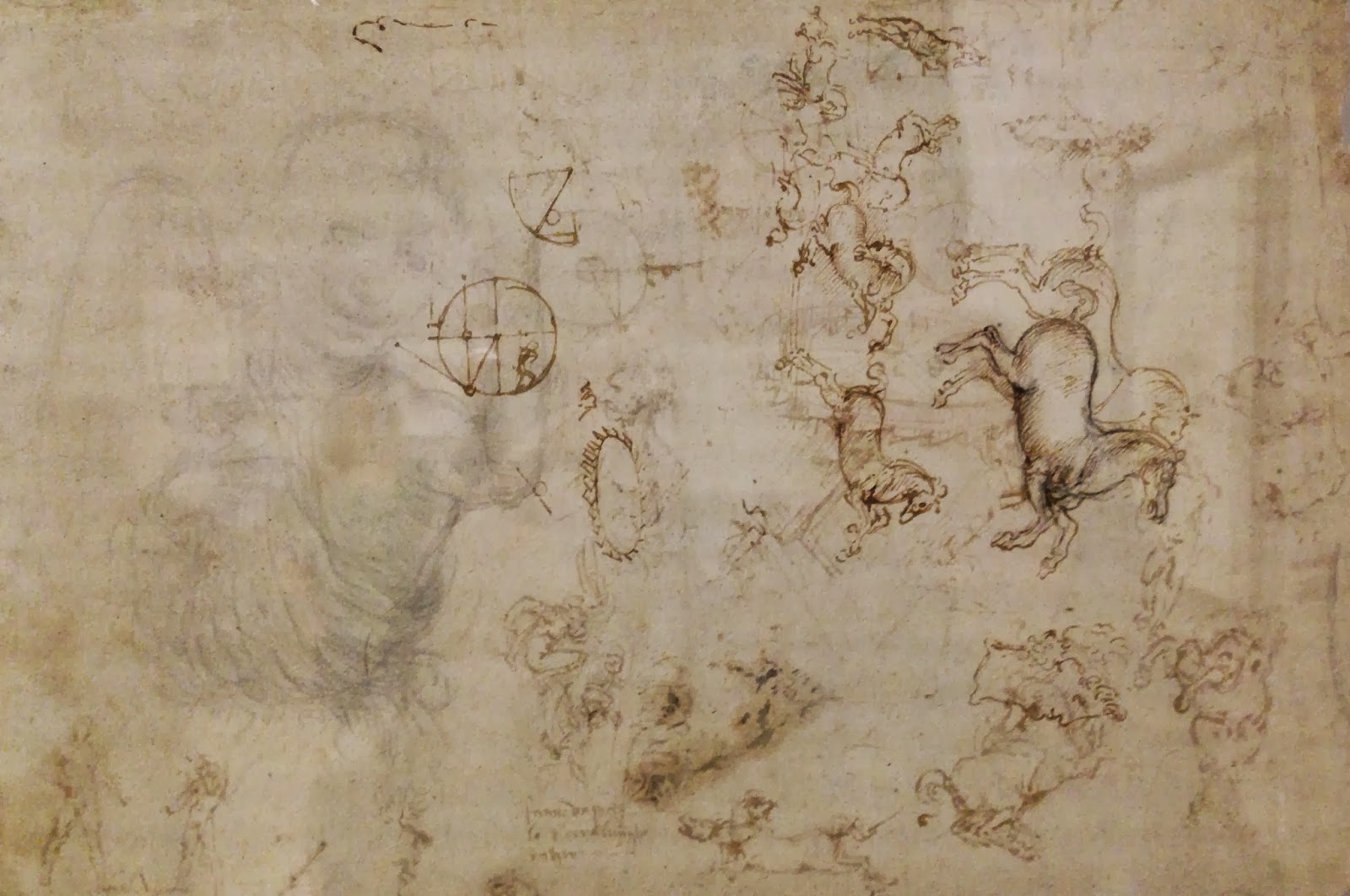
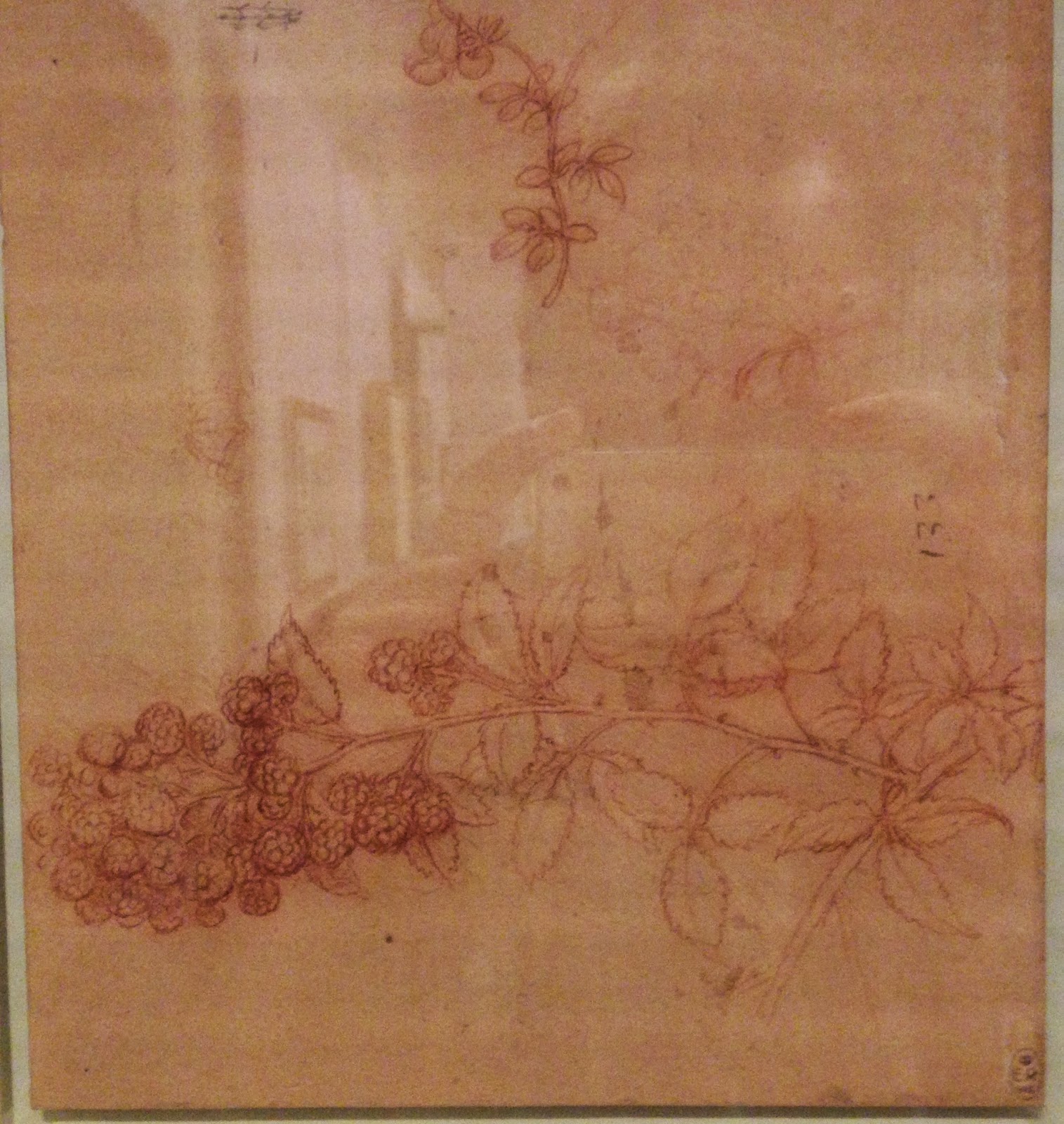
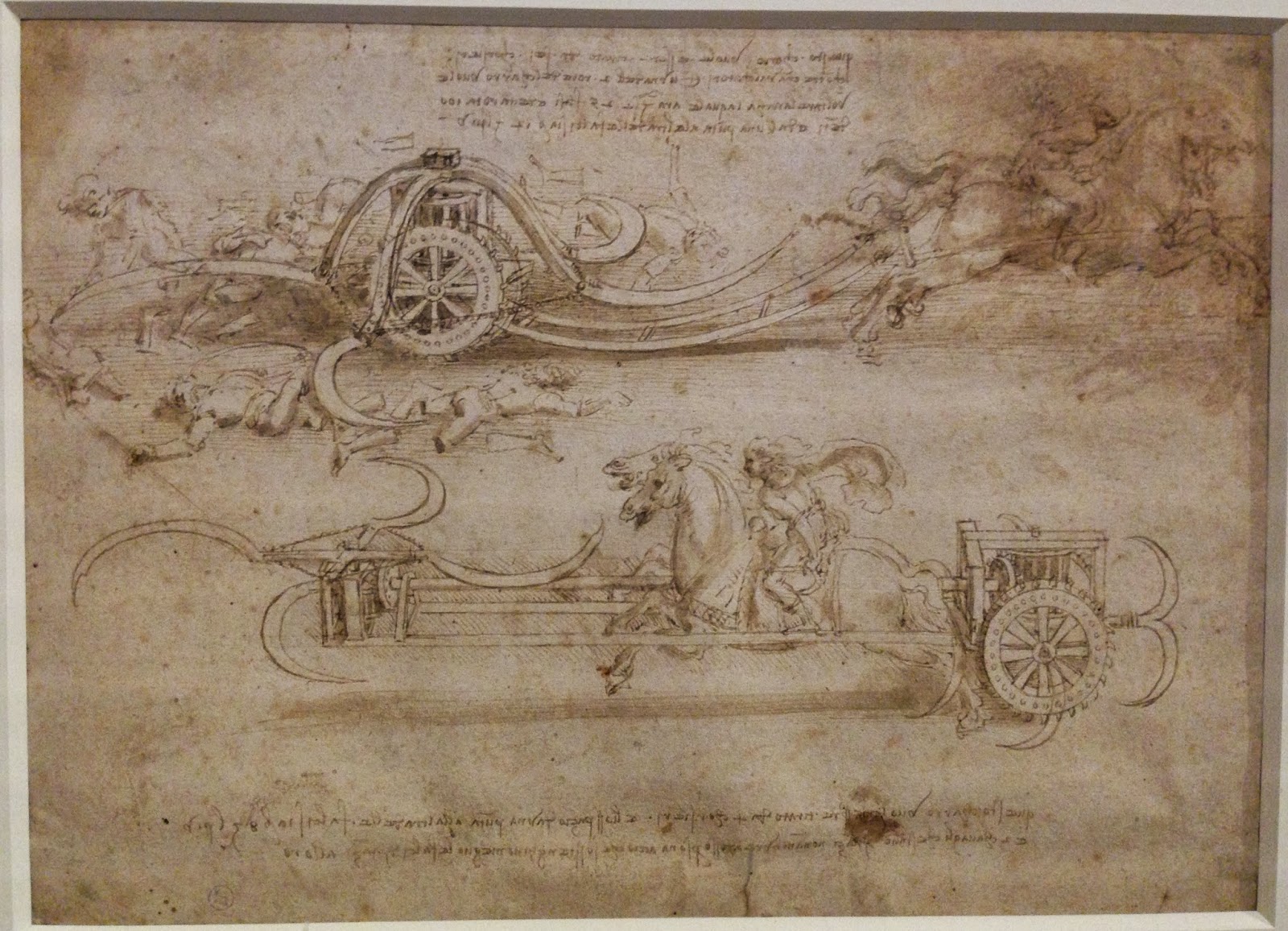
The second exhibition for Leonardo Da Vinci was at Gallerie dell’Accademia.

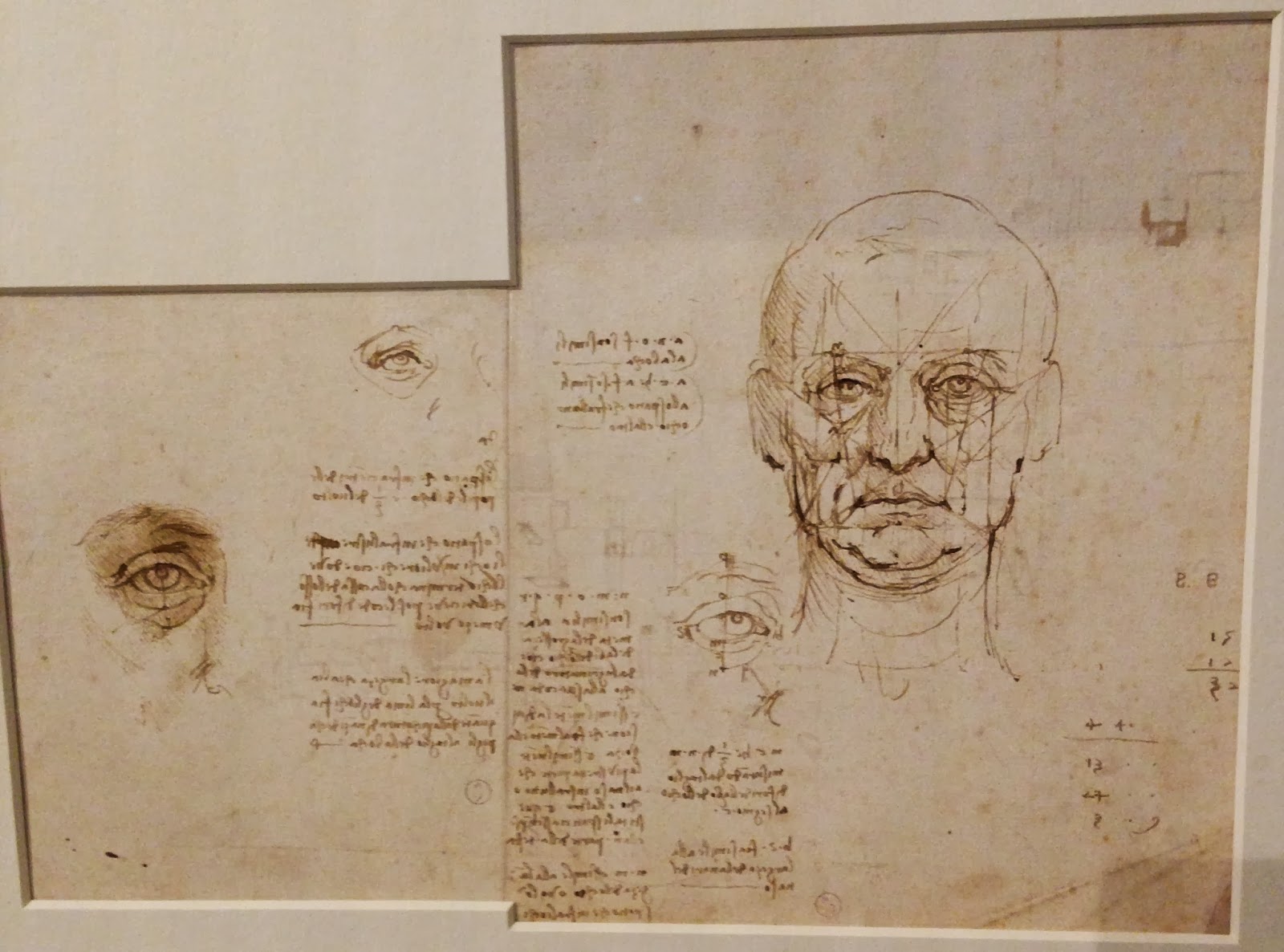
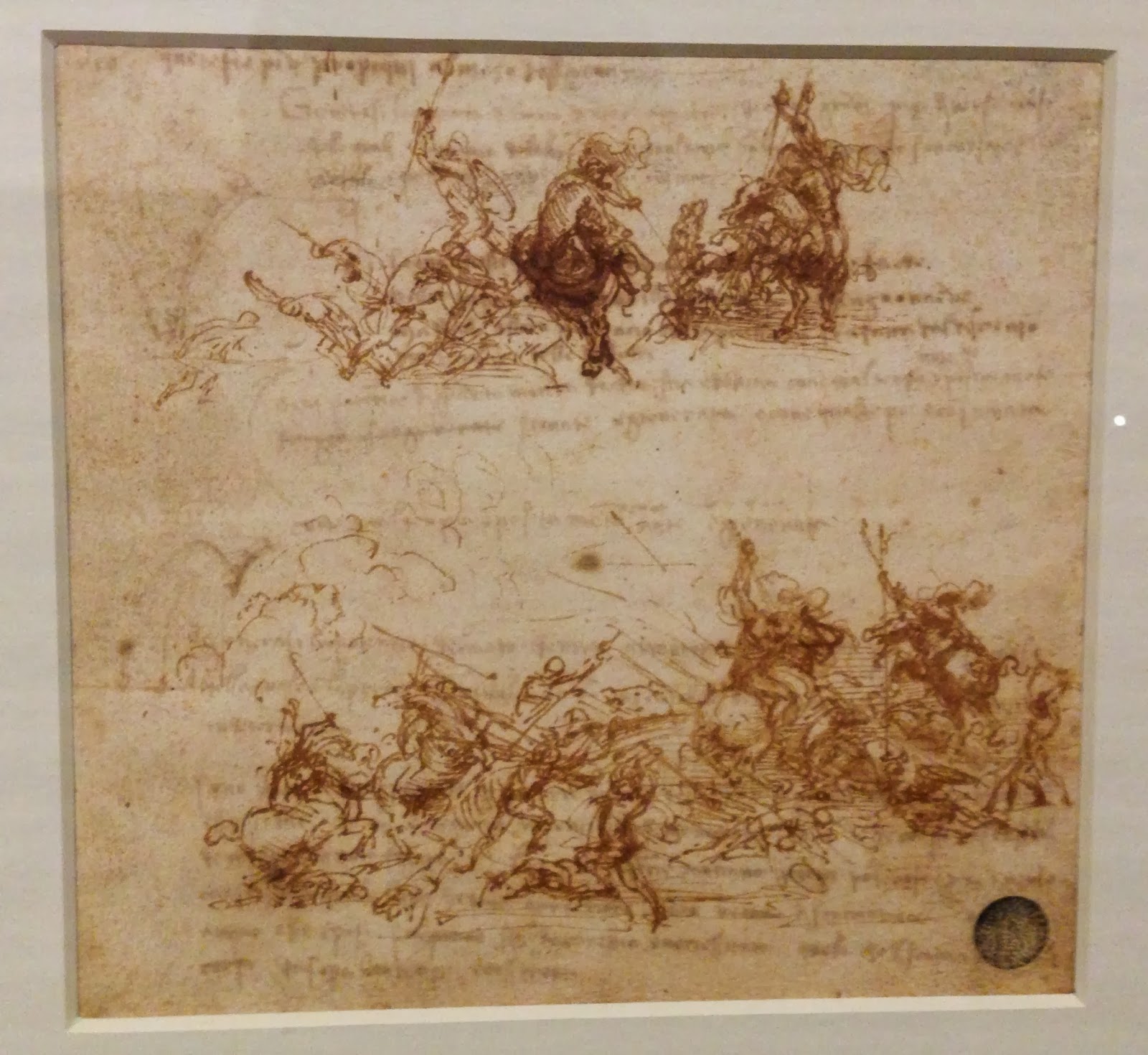
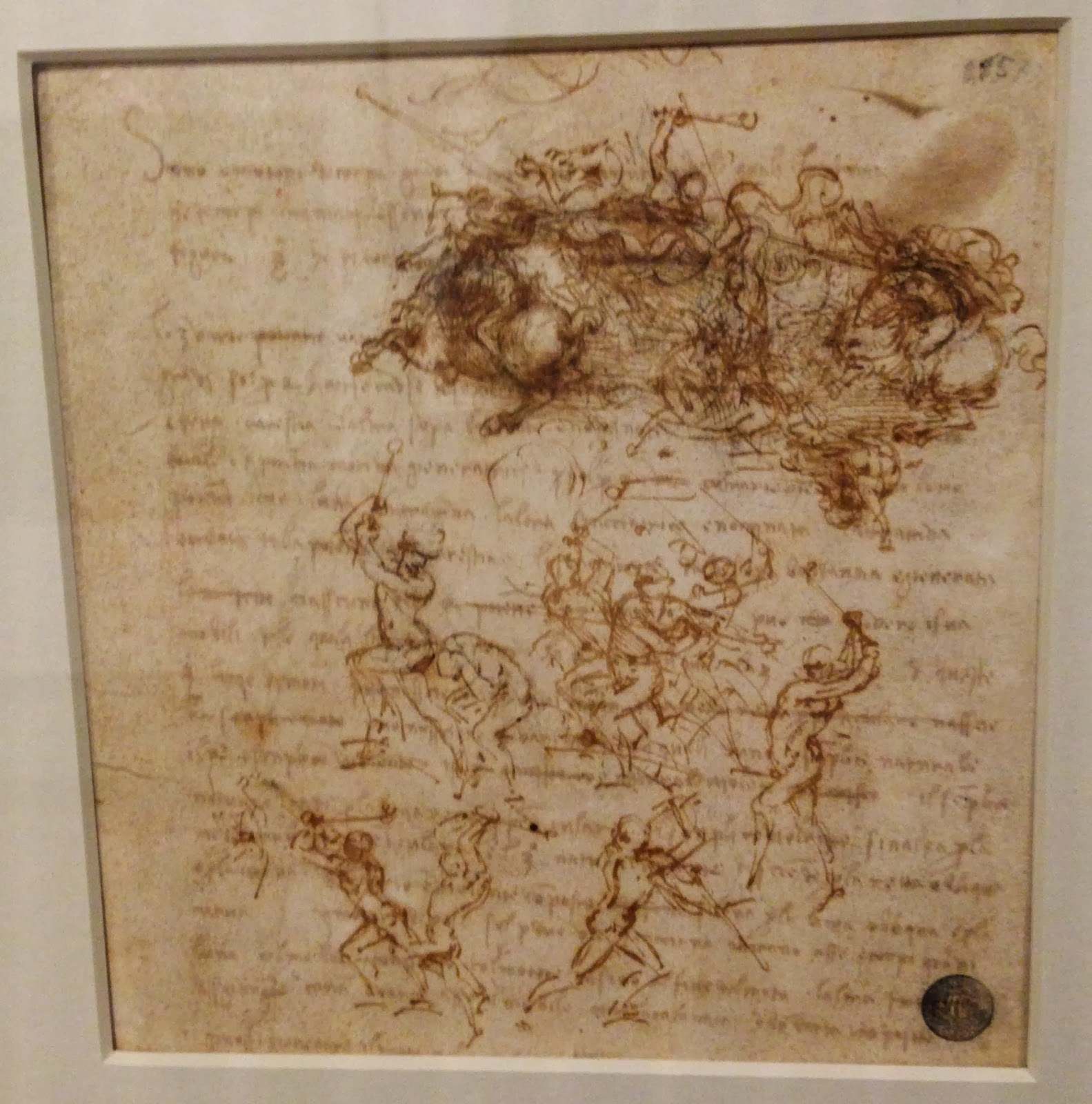
52 of his drawings were on display. Essentially they were doodles.
But the most impressive doodles I’ve ever seen.
His work with human form was insane.

And perhaps his most famous piece of the work on the human form.
There was a fair bit of horse and battle pictures – amazingly detailed for such throwaway notebook sketches.

Plantlife…
And geometry, machines and buildings too…

The shading and light on every picture is incredible. These are particularly impressive.

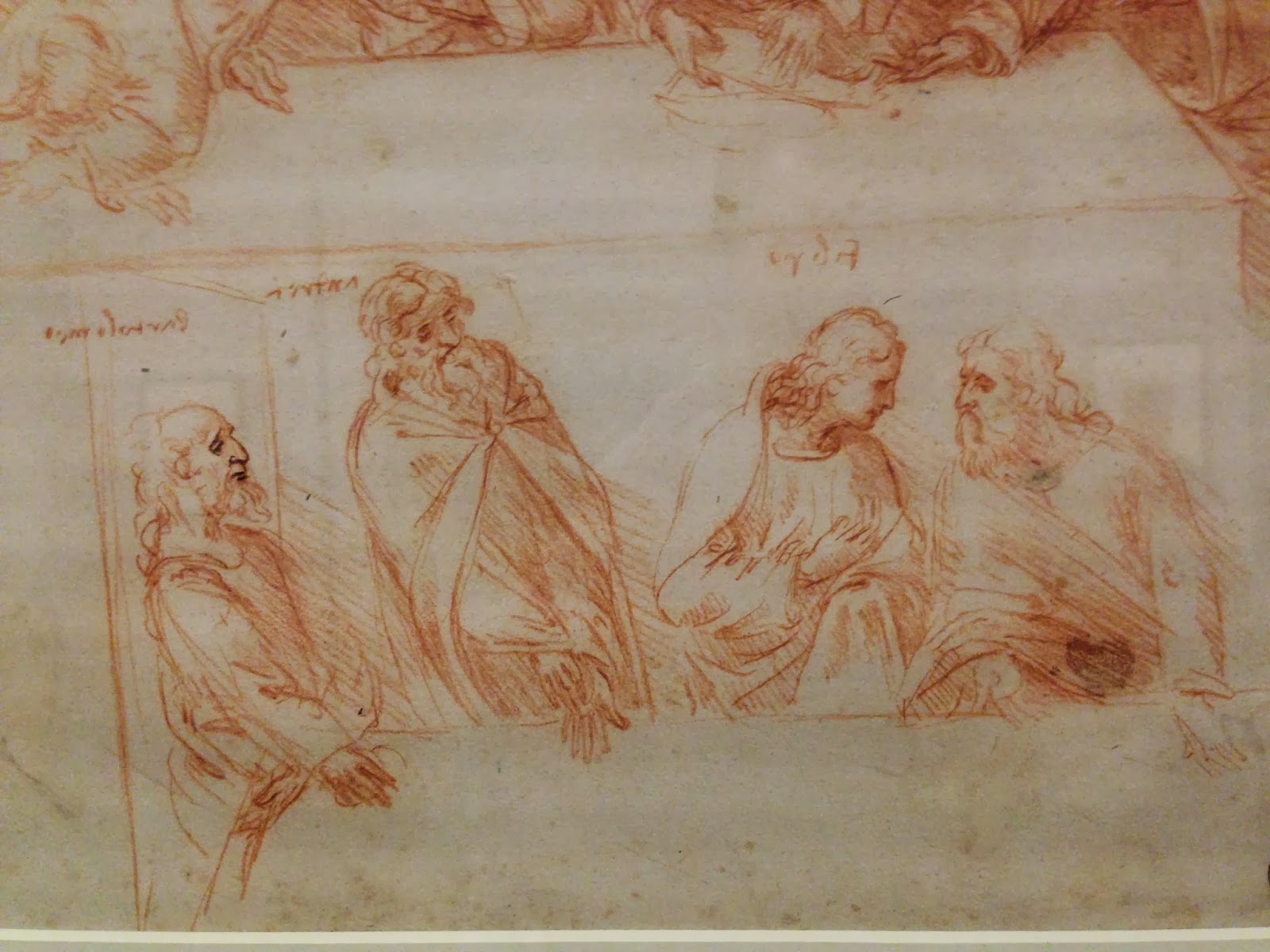
Amazingly – they also had some initial sketches of The Last Supper at the exhibition.
Truly incredible exhibition.

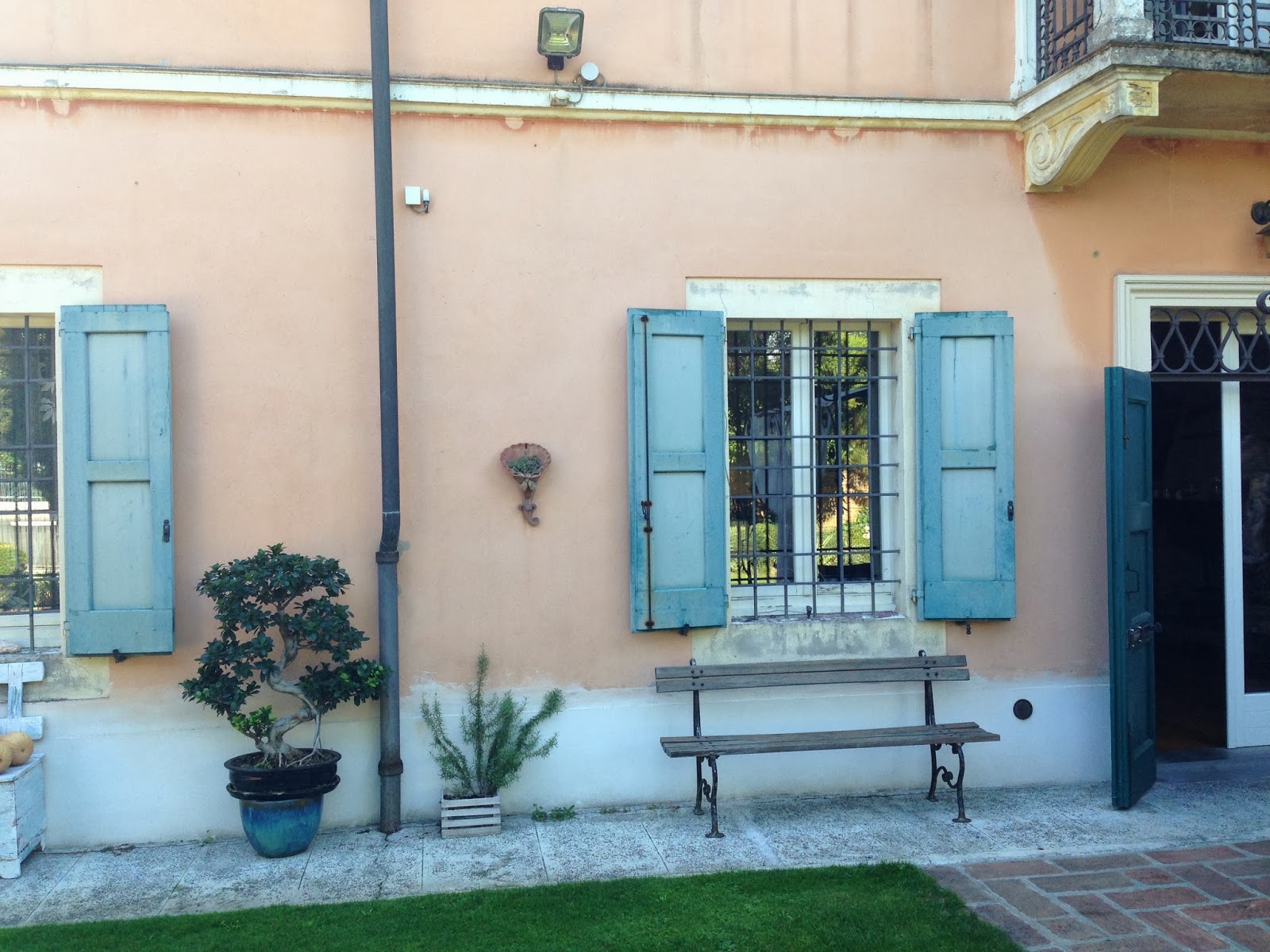
We headed to the outskirts of Modena to Acetaia di Giorgio – one of the few remaining traditional balsamic vinegar producers in Italy.

We assembled in the garden of the house with several other curious minds and waited for the tour to begin.
The tour started and we climbed several flights of stairs to the side of the house, into the attic.
There, Giovanna talked to us about how balsamic is produced, how to tell if a balsamic vinegar is traditional and about some of the awards that their vinegar has won over the years.

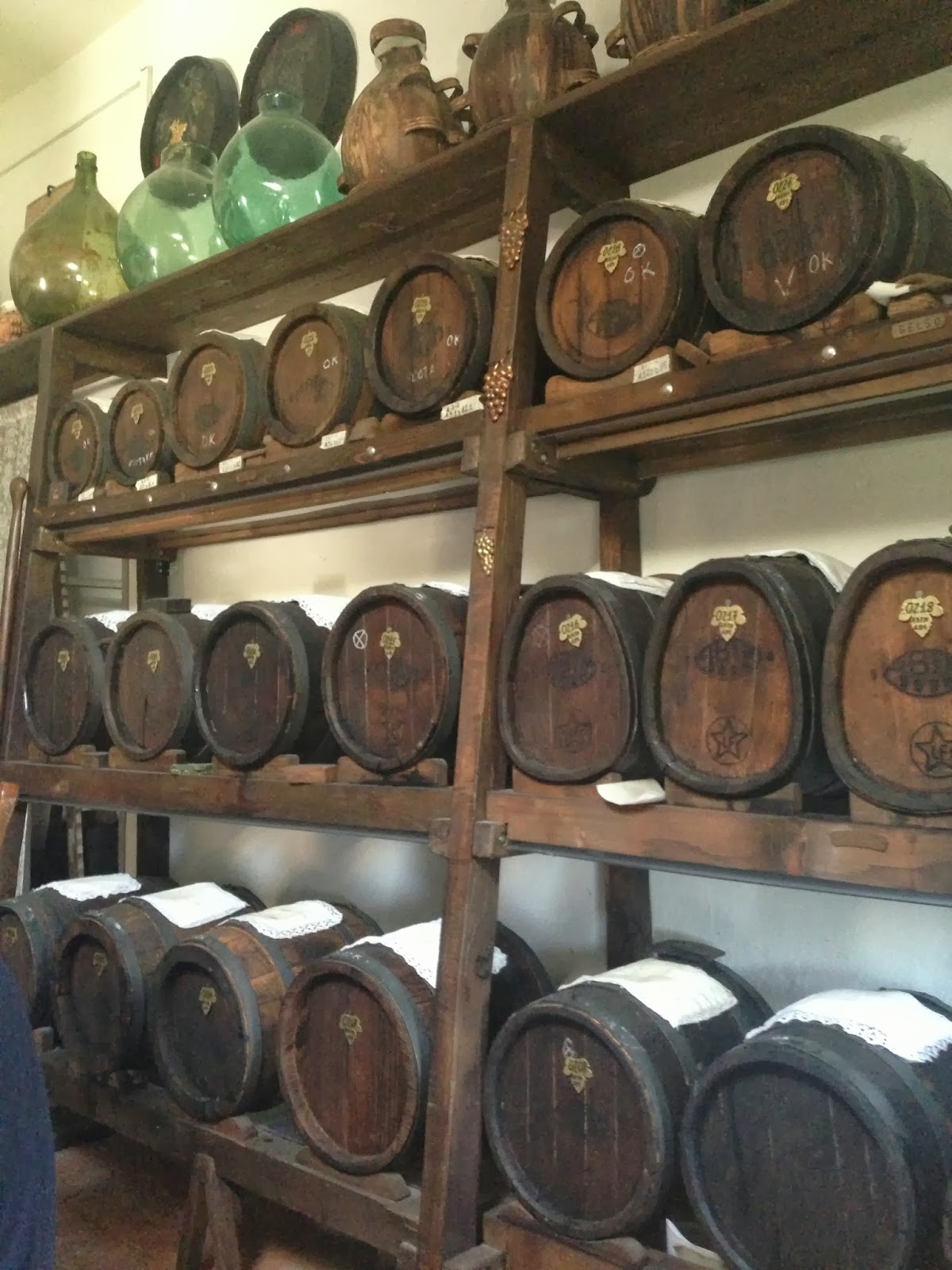
Barrels are organised into batteries. A battery generally consists of between 4-6 normal barrels and 1 mother barrel.

Each battery will produce around 2-4 litres of balsamic vinegar a year.
Not much at all… So they cram the attic with as many batteries as possible.
It also explains why it’s referred to as black gold…
The batteries work in quite a wonderous way.
Each barrel has an open top (covered with a doily) allowing alcohol to evaporate from the vinegar.
The volume in each barrel therefore reduces.
The smallest barrel (number 5) is used to siphon off the vinegar into bottles.
The barrel next to it (number 4) has to top up whatever is taken for bottles, plus whatever has evaporated from number 5.
Barrel number 3 has to top up what has evaporated from number 4 and what has been taken from number 4 to refill number 5.
Barrel number 2 has to top up what has evaporated from number 3, plus what was used to top up barrel number 4.
And then the mother barrel tops up number 2, to account for evaporation and what has been lost to fill up number 3.
The mother barrel is filled up from a different mother barrel entirely.
Only manufacturers of traditional balsamic vinegar can bottle their vinegar in this shaped bottle.
If you receive any vinegar in a different shape, it’s not traditional.
Traditional also seems to be a pretty closed loop now.
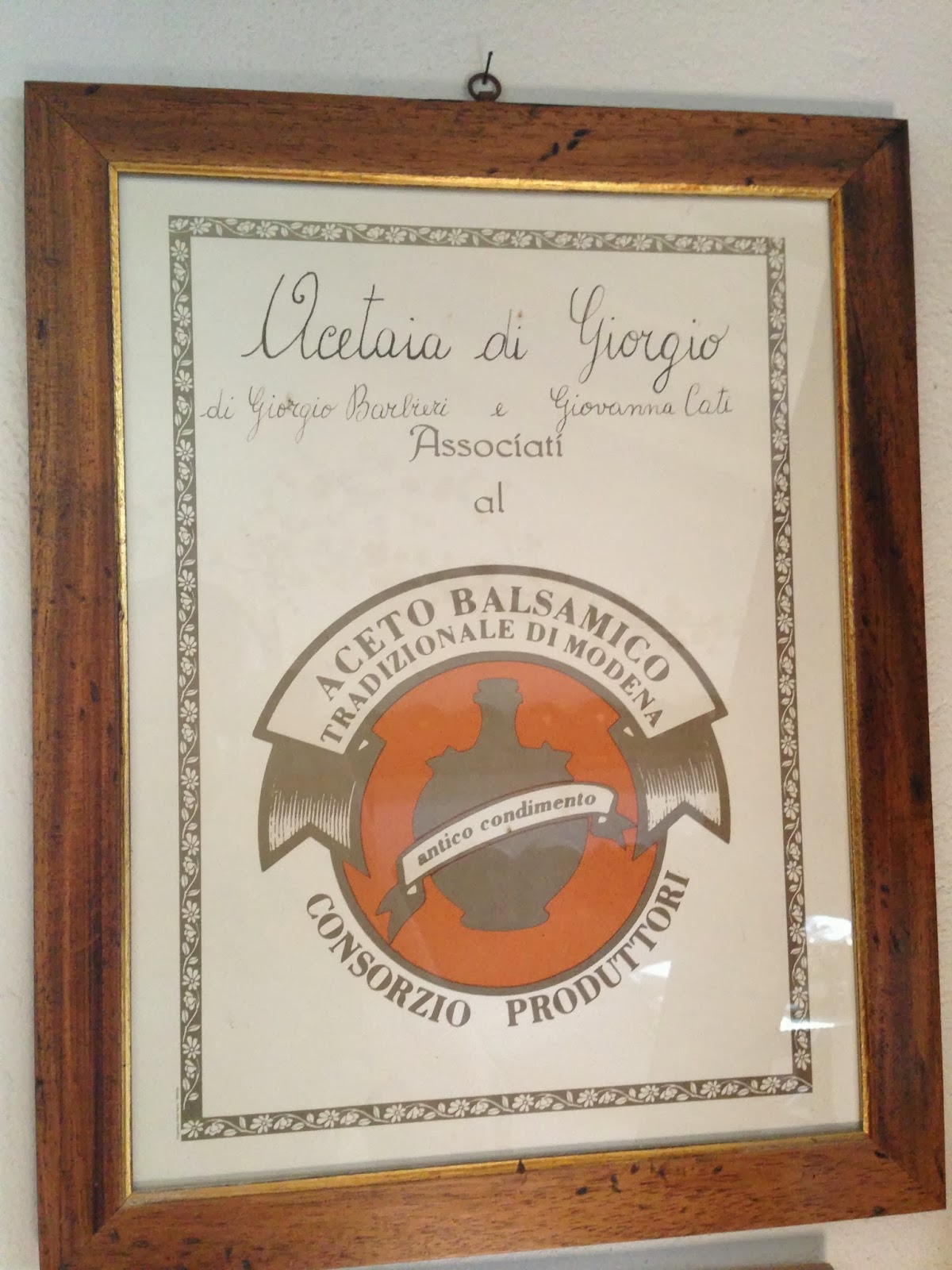
Modena City Hall judges every vinegar manufacturer each year – to determine whether they should be a member of the  Aceto Balsamico Tradizionale di Modena consortium.
It’s an exclusive club, and for that reason it’s effin’ expensive to buy too!
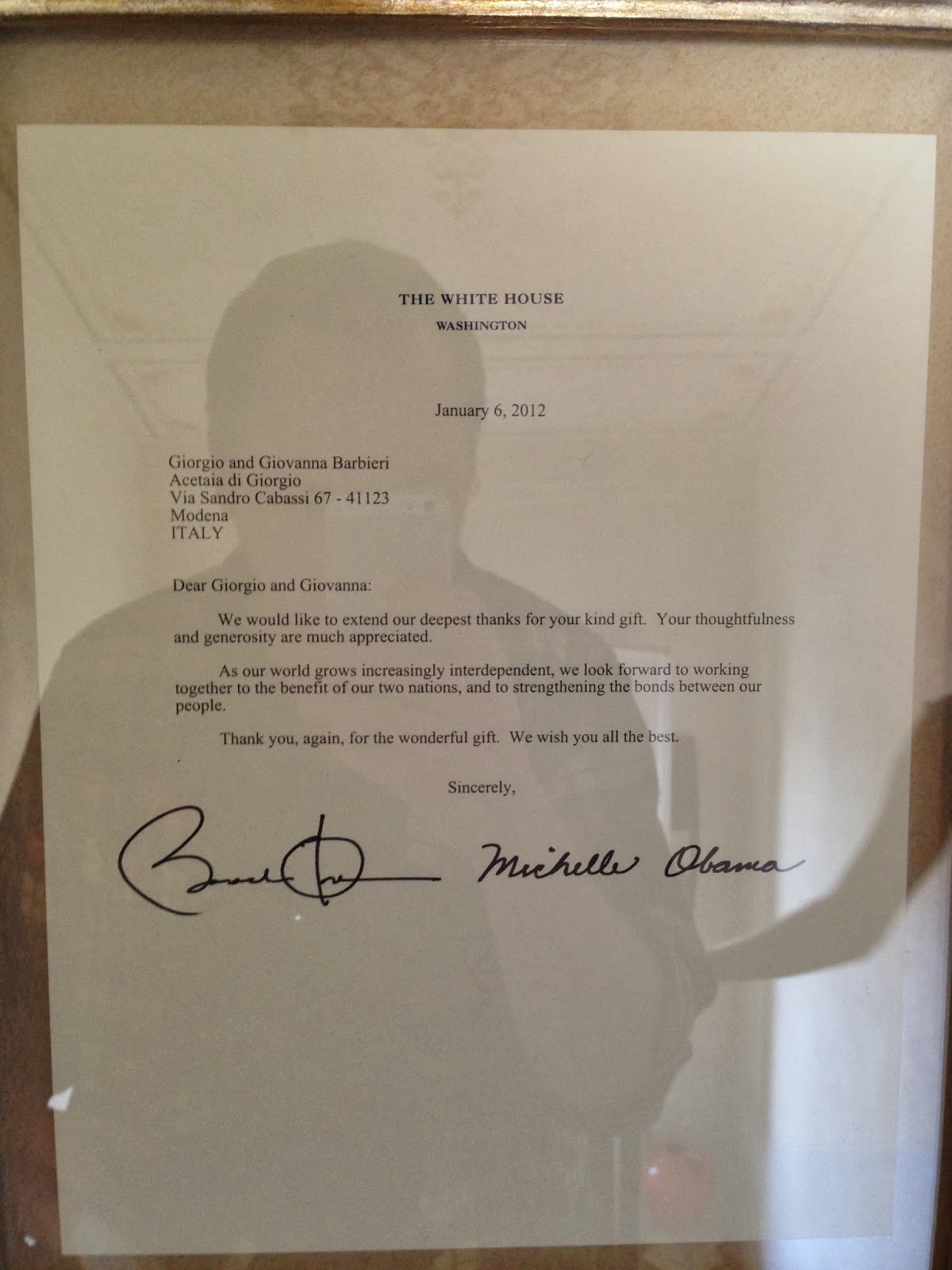
There was even a nice thank you note from the Obamas displayed near the entrance.
Really well worth the visit if ever you’re in Modena.

Whilst in Modena, we took the time to visit the Ferrari museum.
The museum itself is based on the grounds of Enzo Ferrari’s old house.

It’s had a substantial overhaul in the last few years, and the new museum buildings are quite striking.

Like many of the great people I’ve learnt about in museums over the last few months, Enzo was fanatic about keepings scrapbooks and diaries.
I loved what was written in the cabinet containing his diaries:
“There were references that only he could understand. Phrases, timetables, personal details: Enzo Ferrari’s personal diary guarded a whole world, it was like a king’s treasure chest. An iron will emerges between the lines, the force of an ideal that was never abandoned. And it was no coincidence that, folded between the pages filled with notes, Ferrari kept an Italian flag. Italy was present in every gesture. His native land. And also his deepest motivation.”

Ferrari convinced his own mother to sell their family home to buy several cars, which he converted for racing. In 1929, his company Scuderia Ferrari was born – backed by Alfa Romeo.

Ferrari would often hold his company strategy meetings in his ‘Error museum’ – a room full of parts that had given way during races.

He had the most beautiful fountain pen.

And the coolest glasses in the world.

If I’m honest, most of the museum was a bit too tech-spec heavy for my liking – you really had to know your cars to get into it.
But considering petrolheads must make the pilgrimage from all across the globe to the site, it’s not too surprising really.


A couple of weeks ago I went to my first dConstruct conference.
It’s a brilliant one day event full of clever people talking about new technology and how it will affect people, culture and the world around us.

This year, the theme was Communicating with Machines.
The theme was pretty loose, and most people didn’t actually talk all that much about it – but there was some interesting IoT nuggets.

Here’s a quick synopsis of what I remember from the talks.
They’ll be online shortly I’m sure, so you can listen to all of the really important bits that I’ve forgotten…

First up – AMBER CASE, a cyborg anthropologist. Started Geoloqi.
Defined a Cyborg as ‘anything that attaches external appendages to themselves to deal with new spaces.’
Talked a lot about a really interesting guy called Steve Mann, who started experimenting with wearable technology in the 1980s. (Interestingly, one of the things he pioneered was ‘diminished reality’, not augmented reality, where billboards etc are cancelled out by the technology – and instead display useful things like ‘remember milk’ and ‘your bus is 2 mins late’)

By 1998 he had his tech down to the size of sunglasses.
But creating ‘input’ was always the issue. Increasingly difficult to break away from the mouse.
We’ve gone from solid buttons (blackberry style) to liquid buttons (iPhone style)… Perhaps next, buttons in air? Problems being battery drain and privacy.

She went on to suggest that calm technology might be next in line. Processes that happen in the background, ambient notifications etc. Essentially, there when you need it and not when you don’t.
Geoloqi started to experiment with location based ambient notifications. Leaving messages around the city, which could then be picked up when you were in that area. Messages such as ‘This bridge is 40 years old’ or ‘My mates and I are in class writing you this message.’

Wikipedia has GPS Coordinates on wikipedia – these could even line up to where you are.
‘Don’t Eat That’ – an app that shows location based results on restaurant inspection scores.
Location based tech could work as part of home automation. E.g House could say hello when you arrive. Could let you know hyper-local weather trends (e.g when to head out for a bike ride.) Could let you know when your next bus will arrive.

Interesting testing procedure when developing tech. Rather than pay lots of people to run all over town, instead created a real world Pacman game. People ran all over the city because they WANTED to, and allowed them to test their tech.

And if we have location data, then what about if we correlated that with food data, stress data, who I’m with data, time of day data, productivity data, happiness data, ambient noise data, amount of sleep data etc? The quantified self.

The hardest bit about all of this will be getting platform owners and fragmented data sets to work together. Who will do it? Google? Apple? Microsoft?

The best tech will probably be invisible.
It will also probably help take things that are already invisible, and make them visible. e.g Harvard Happiness Challenge – did experiment where rated happiness every half an hour. Worked out that she wasn’t happy at work. So quit.

All devices should be aiming to make us superhumans.

Next up was LUKE WROBLEWSKI.
Luke’s talk was perhaps the slickest animated keynote I’ve ever seen.

He talked about infinite inputs (interesting topic considering Ambers data sets above.)
He talked about how in his lifetime he’s had mouse-mac, clickwheel-iPod and touchscreen-iPhone.
Each time a new imput has come out, there’s been new interactions to learn from a developer point of view.
And it takes AGES to learn again…

Usually you can’t just adapt what you already have (look at the generic desktop calendar widget on a mobile phone vs Google Mobile Flight tracker.’
Or Amazon desktop store, vs Amazon mobile store, vs Amazon Flow (simply take a picture of something you want and it scans through Amazon and finds it for you.)

We’ve had accelerometer inputs, magnetometer inputs and we now have full 9 axis motion and orientation sensing.

Inputs are becoming hugely advanced. Samsung ‘Smart-stay’ used the front facing camera, and checks to see if you’re looking at the screen. If you’re not looking, it pauses whatever is on (e.g Youtube) until you look back.
Google glass even has the beginnings of a bone transducer for sound.

Where next?
Disney Imagineering Touche project? Perhaps.
Capacitive touch sensitive. Objects like a table can suddenly sense whether there’s an arm, or a hand, or two hands, or two arms on it. A doorknob can tell whether it’s been grasped or just touched etc.
So soon everything will be an input.
And what then. Well, we’ll have to start learning a little bit faster!

NICOLE SULLIVAN talked about trolling.
Tenuous link to communicating with machines I think – more communicating via machines – and unfortunately I didn’t make too many notes in this one.

She talked about there being different types of troll: jealous troll, grammar nazi, biased troll and scary troll.

Interestingly she also talked about something Project Implicit, run by Harvard at http://goo.gl/2601D
Well worth a look.

SIMONE REBAUDENGO was up next, and talked about the Secret Lives of Connected Products.

He used a line I’d heard previously from John Lasseter, about how ‘a products main goal is to be used.’
And suggested perhaps this might mean peer pressure could develop between products.
He then showed his toaster project, which was great.
The toaster handle is very cute.
It’s also extremely competitive – picking its workplace depending upon the number of people there, what the space is like, whether there are any other toasters in the vicinity etc.
The toaster can tweet to try and drum up toasters from the office, or get excited when someone comes close.
It can even decide to leave if it’s not used enough.
It’s quite an interesting concept when a person doesn’t demonstrate their buying power with a product, but instead demonstrates their keeping power.
Essentially Simone was saying that connected products shouldn’t just be connected. Instead we need to start looking at the relationships between connected products. And by doing so, we’ve got a much better chance of making sense of it all.
Lunchtime came around and we got to have a play with some of the things in the foyer.
The Happiness machine (an internet connected printer that prints random happy thoughts from across the internet) and the Noisy Table (a ping pong table that makes sounds and music as it’s played) were great.
And then I popped off to Brighton Pier for some fish and chips.
After lunch, we had the delights of SARAH ANGLISS.
Sarah is a musician – using physical, automated and digital instruments to make her music.
She talked a bit about the Uncanny Valley – an interesting phenomenon that shows as machines etc get closer to looking like humans, we stop being empathetic and start fearing them.
She also talked about how some of us are obsessed with the uncanny – audiophiles are continually chasing musical nirvana, and are always one piece of kit away. They want a perfect copy of what was recorded.
I found it really interesting when she talked about infrasonic sound – tones that are so low that you feel it rather than hear it. Often used in church organs etc – it can often make you feel ‘at one with the music’ and ‘absorbed.’ Fascinating.
I can’t remember exactly why, but she also talked about the Italian Castrati – singers that were castrated before coming of age, to preserve their vocal range. Weirdly it also messed with their hormones and they generally grew to be very tall, very slim and very good looking.
She finished with one of her own compositions – very ethereal.
KEREN ELAZARI talked about hackers and hacking.
She referenced Arthur C Clarkes three laws at the start of her talk.
I love the third one… ‘Any sufficiently advanced technology is indistinguishable from magic’ by Arthur C Clarke.
The second one is equally brilliant: ‘the only way of discovering the limits of the possible is to venture a little way past them into the impossible.’
She talked about the Singularity University, which brings people together from all over the globe to use technology for good.
And a little bit about hackers and the hacker manifesto.
MACIEJ CEGLOWSKI was a hilarious speaker.
He talked about fan fiction – one of the main customer bases on his site Pinboard.
It’s a genuinely hilarious talk and well worth searching out.
He stuck up for fans, because they a)  are SO NICE b) fight censorship c) fight for privacy d) never sold out e) transgress  f) improve our culture
And he shared some top tips for developing.
The first of which was ‘Social is not a syrup.’ You can’t just add it on the top.
In fact, it’s not even a noun.
The second was that ‘You shouldn’t make it too easy’. His pet theory is around commenting. If you make it sufficiently difficult to comment, then you only get the people that are actually interested commenting.
The third was ‘Stop futzing with it’. Too true.
And the fourth was ‘Shut up and listen’. When developing Pinboard, he started a google document for potential users to write down any functionality that they’re like to see. In the end… he had a 53 page document. But it allowed him to work out what was most important to people.
DAN WILLIAMS spoke about the ramifications of communicating with machines everywhere.
Particularly vehement about Scenetap – a camera on the door of every club that records venue demographics (num of girls, boys, potential economic class etc.)
He found it shocking because it doesn’t offer an opt-out.
Apple stores are the same – camera as you enter.
In fact cameras are everywhere.
And under the data protection act, you can legally request the video images of yourself.
Which has given birth to the brilliant Manifesto for CCTV Filmakers.
He also spoke about the new recycling bins in the city, which have had an amazing scope creep.
First they were bins, then they were advertising sites, now they actually watch people walking past and can track them all along the street. The annoying bit being of course that they don’t function well as a bin!
Essentially it comes down to how we find ways of explaining with regards to data collection – as currently it’s just not happening.
Finally then, ADAM BUXTON spoke.
He was genuinely hilarious.
He talked about how twitter is like acid – it magnifies your personality.
And talked about his history with technology.
I think it’s worth rooting out the video to watch his presentation – as he used the slides brilliantly as a counterpoint to what he’s saying.
And that’s it. Looking forward to next year!