Archive

Uncategorized

A friend’s friend’s band – the Great Last.
Regardless – I’ll be as objective as possible.

Turned up too late to see the first two bands.
You wouldn’t have noticed – the room was bare, except for around ten people hugging the bar at the back of the room.

The Great Last came on and requested everyone moved forward, which we dutifully did.
The band played a short set – they sounded like the dirty little lovechild of Arctic Monkeys and Kaiser Chiefs. They have all the minerals – arrogant singer, tight drummer, locked in bassist, confused-by-own-pedals guitarist and decent keyboardist. Decent enough for Friday 13th at Camden Barfly.

The Blood Sport headlined.
I liked them – their keyboardist/guitarist was very good, the bassist exceptional, drummer equally brilliant and a confident singer. They sounded quite eighties, but in a good way – and played for a decent enough amount of time. The quality of songs let them down – there wasn’t anything that stuck out as a hit – but there was enough of a bite there to see them going somewhere soon enough. They just need to keep writing. And work out how to end songs (fade outs just don’t work live!)

This gig review is never going to be objective – I must confess I used to play in a band with Andy Oliveri in years past.
Nevertheless, a review is still in order.

The venue – small, intimate, covered in fairylights, organic cider in bottles. A nice place to see some nice folk.

First up – Drew Worthley.
Mid-set chat was warm-hearted, light and he came across as a good guy.
If only he’d managed to drag that across into his music.
Whilst technically good, his performance felt wooden and his lyrics were cheesy than a budget Mills & Boon knock-off. The only way a solo singer-songwriter can rally the audience up is if share something of themselves. Unfortunately, with Drew it felt like he was projecting what he wanted to be, not who he was.
He needs to get back to his roots – and play from the heart – not from a Clintons Valentines card.

Second up – O.Chapman
Oliver Chapman was closer to the bullseye. A young, talented guitarist with a distinctive voice and strong lyrics. The songs were stark and bare, but it suited the intimate venue and made the audience really sit up and listen.
He brought a bassist on for a couple of tracks – again a very gifted player but unfortunately for me, it just didn’t sit in the mix. Electric bass should really only sit with drums.
If Oliver didn’t want a kit on stage (only the most expressive and talented of drummers could have played without ruining the vibe) then he should have gone without the bass.
And he should have signed up a cellist instead. It would suit his music, could have provided real lift to his tracks and would have added to the mix instead of breaking it.

Headline – Andy Oliveri
Andy came out and played a corker.
His voice has come on in spades since I last saw him, and his guitar work was second to none.
His mike technique was better than the previous performers, and you could visibly see the sound engineer relax as he realised he wouldn’t have to push the system so hard with this artist.
The songs were great – you can tell he’s writing a lot at the moment. Some felt a little more fleshed out than others – I must admit I’m a bigger fan of Marigolds and Balance on a rope to My Father’s Son.
But it didn’t matter – all were played with skill and emotion.
His harmonica playing also didn’t fail to deliver – beautiful.

It’s not often you stumble across as beautiful a venue as Wilton’s Music Hall.

Tucked away in the east end of London, behind a pub fascia is the oldest surviving music hall in the world.

Half derilict, it’s crumbling state seems to add, not detract, from the warm atmosphere you sense as you enter.

Unfortunately we were too late to see the first support act, but amused ourselves playing table tennis and drinking whisky in the mahogany bar.

Duke Special played with a string quartet – showcasing his new album ‘Under the Darkcloth.’

A masterpiece from start to finish – it has to be one of my favourite gigs of all time.
Duke Specials honesty and originality bleed through his music and the broken state of many of the subjects addressed in the songs are only exemplified by the surrounding venue.

I’d recommend both Duke Special and Wilton’s to absolutely anyone – the entire evening was fantastic.

A very kind friend offered me a free ticket to go see these teen-boppers and I jumped at the chance.
A free ticket to a gig – of course!

Little did I know we’d be surrounded by DIE-HARD Hanson fans…
The first act played – very cute chat to the audience between songs – but unfortunately the songs were fairly predictable…

Hanson came on to rapturous applause. Or at least I think they did.
I pretty much lost my hearing from the sheer volume of middle-aged women screaming until their lungs collapsed. The audience was comprised almost entirely of females. Myself, my friend and a couple of sombre and sober looking chaps (with screaming girlfriends in tow) provided the only masculinity present in the room.

The band were actually extremely tight – some tracks were near mechanical – but you’d expect it after 15 years of playing some of them.

Overall a pretty good gig – I wouldn’t have chosen to go myself but I’m glad I did.

Unfortunately I’ve been a little bit sloppy and left it over a month since I attended this gig before putting fingers to keyboard. Luckily – it was brilliant and I remember it pretty vividly.

The Kashmir Klub reunion, held at Union Chapel comprised 14 artists (each playing 2 or 3 songs) paying tribute to the Kashmir Klub – an old iconic basement club started by Tony Moore in 1997.

Stand-out acts on the night were Jamie Lawson, Tom Baxter and Earl Okin.
Jamie Lawson appeared particularly shy – didn’t even introduce himself – but played a beautiful song ‘I wasn’t expecting that.’ I certainly wasn’t.
Tom Baxter played several tracks – all fantastic. A real talent to be reckoned with.
Earl Okin played upon his odd looks with a hilarious song ‘My Room.’ A very funny act and a surprisingly talented musician.

Two crowdpleasers also didn’t fail to deliver – The Feeling and Nizlopi.
Both played their most famous tracks, much to the audience’ delight.

Great night.

Bush Hall is one odd venue.
The walk from the tube is laden with late night kebab shops, rowdy pubs and 24 hour newsagents.
I arrived early to find the doors shut. If I’m honest the hall didn’t look like it had been open for 6 months – the buildings flanking it had boarded windows and the doors looked like they’d take some weight to budge.
I left to meet a friend and returned a little later.
Upon my return, the doors were (finally) open. I stepped inside expecting to find a run down pub/gig venue.
*jaw drop*
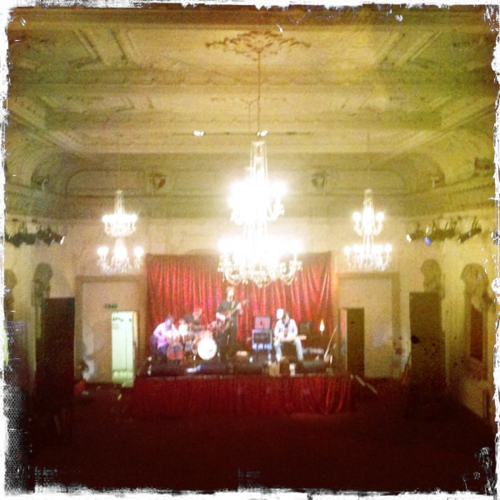
The hall is beautiful. Chandeliers hang from the roof, the ceiling’s ornate, a grand piano sits in the corner: the atmosphere is fantastic.
(Photo copyright: Lotte Mullan)

First up – Sam Brookes.
Sam Brookes has recently released his first album.
He plays guitar like Ray Lamontagne and Fionn Regan have personally tutored him. He leaves space where it’s needed but knows when it needs pushing too. Despite playing without a band, he managed to create a big sound that bubbled beautifully underneath his vocals.
Sam uses his impressive vocal range to his advantage – he skips from powerful gut singing to head voice quickly and easily – it’s a huge skill to use different voice without detracting from the song and Sam has it in spades. Well worth looking up.

Next – Lotte Mullan.
A quick google search on Lotte drags up quite alot – work experience at Sony, a £2m film deal, myspace, herspace, bandmix, bandcamp – she’s quite clearly very adept at self promotion.
So gearing up to watch her, I had high hopes. Which is probably why I found myself a bit disappointed – her voice was spot on, band work great, she held the room well but I just found the whole set a little deflating. It’s a real shame because she’s clearly got a bucketload of talent but something just didn’t connect with me on the night. Shame.

Scott Matthews on the other hand, managed to over deliver.
The first win was a presence of a band. I’d assumed, from watching live videos on youtube, that he’d either be touring solo or with a cello player in tow (who is bloody brilliant by the way.)
In fact – he also brought a tight as tight rhythm section who lifted the entire perfomance immensely.
His music is meant for highs and lows, rise and fall – and with a band backing him, it allows him to do so perfectly. They were brilliant.
The entire band were at ease on stage – he’s vocals are a real force – they flow like strings throughout his tracks without his face even moving. Truly unbelievable.

The Union Chapel has to be one of the most picturesque venues in London. Candles light the upper balcony & the corners of the stage, the stained glass windows are beautiful and the acoustics are perfect for, well, acoustic.
It makes you feel like you’ve arrived at Christmas eve Midnight Mass – but without all that God stuff.
As it turned out, tonight’s concert – Willy Mason, The Staves (main support) and Dan Lefkowitz (first support) felt near religious anyway.
And not just for me. The guy to my right was adamant he was having some sort of divine experience as a consequence of the music.
And I have to say, I believed him. No drunk would move their legs and arms in such a fervent manner.

First up – Dan Lefkowitz – is an out and out folk singer. Dan sounds alot like Bob Dylan, but without the same lyrical clout. He plays guitar well and his harmonica was breathtaking in parts, but I have to admit I just felt something was missing. Perhaps his songwriting just didn’t hold up compared with his musicianship but I have to admit I started counting down the minutes before the next act would be with us.

The Staves are three (very) English sisters that sing americana/folk full of harmonies and middle-class charm. Think Jenny Lewis & The Watson twins, if they’d all grown up in Oxford.
Emily, Jessica and Camilla (obviously) Staveley-Taylor play and sing as one – it was a real treat to hear their powerful vocals echo around the chapel. This really is the kind of venue their music was made to be played in – the acoustic bring huge depth to their performance that you just wouldn’t find elsewhere. The girls were in their element for the entire set and are definitely ones to watch. Outstanding.

After (foolishly) getting up to go to the bar, I lost the fantastic view I had and ended up perching on a pew at the side of the chapel.

With this view.

Not the best I’m sure you’ll agree.

It didn’t matter.

Willy’s fantastically gravelly voice has this amazing cut through – you can imagine him filling any room he plays. It’s distinctive, unforced and plays to the melancholy of his music perfectly.
His guitar really growled and his songs took off in a way I’d never have expected them to from listening to his CDs. Even sans rhythm section, he managed to play with an intensity that many bands dream of and walking out of the gig I couldn’t wipe the smile off of my face.
A truly fantastic singer-songwriter. He really should be so much bigger than he is.

Ax

I’ve had two posts in my head recently that centre (loosely) around the Grand Cafe in Oxford. I’ve decided to combine the two below – it saves me from explaining the Grand Cafe twice…
According to Samuel Pepy’s diary, England’s first coffee house opened on the site of the Grand Cafe in 1650. I’ve walked past the Grand Cafe many times (and visited on several of those occasions, mostly to take advantage of its happy hour…) but the significance of it’s history hadn’t struck me until recently.
 
 
1.
Steven Johnson recently gave a great TED talk called ‘Where great ideas from.’ He begins by talking about the introduction of coffee and it’s effect on the enlightenment – (WIKI: an elite cultural movement of intellectuals in Europe that sought to mobilize the power of reason in order to reform society and advance knowledge). 

Before coffee was introduced and accepted by Britain, the British would drink alcohol at most meal times. Not because we were all raging alcoholics but because it was the healthier choice. Drinking water was risky – A bottle of grog with your cornflakes was the safer choice in the morning as you could trust it not to make you ill. (Oh how times have changed.)

What did this mean for Britain? We were effectively drunk all day. Booze Britain indeed.
The introduction of coffee to Britain was of huge significance as it effectively switched our drinking habits from a depressant to a stimulant. 

Once we’d shaken off the lifelong hangover of before – we were a sharper, more alert and ultimately more innovative nation than we’d ever been before. 

Monumental developments occurred in science, philosophy, mathematics, the arts, literature, politics, education and language.
And in a cod science kinda way, you could claim it all started at Number 84 on the High Street in Oxford. The site of the Grand Cafe.
 
2.
The second reason the coffee house made such an impression on the British age of enlightenment is that it opened up conversation to all. There were very specific rules that those who visited coffee houses had to follow – rules such as 1) no man of any station need give his place to a finer man and 2) If a fight broke out, the instigator would have to purchase the offended a cup of coffee.

This essentially meant coffee house clientele were a particularly diverse bunch – and the room layout promoted conversation and the sharing of ideas.

The Grand Cafe (then called the Angel) alongside other coffee houses in Oxford were referred to as penny universities – they allowed Oxford’s wits and virtuosos to mix with others from all walks of life. They acted as a ‘centre for social intercourse, gossip, and scholastic interest’ – a place where ideas and theories were born,  meddled with, torn down and born again.
In the wake of the NOTW scandal, The Economist published a piece on the future of news. The opening paragraph is below:
‘Three hundred years ago, news travelled by word of mouth or letter, and circulated in taverns and coffee houses in the form of pamphlets or newsletters … Everything changed in 1833 when the first mass-audience newspaper, the New York Sun, pioneered the use of advertising to reduce the cost of news, thus giving advertisers access to a wider audience … The penny press, followed by radio and television, turned news from a two-way conversation into a one-way broadcast, with a relatively small number of firms controlling the media. 
Now … the news industry is returning to something closer to the coffee house.The internet is making news more participatory, social, diverse and partisan, reviving the discursive ethos of the era before mass media.’

There’s been a million articles written on the connectedness of the web and how brands etc have to have two-way conversations with people to survive on the web so I’m not going to jump on that band wagon. 


But I do think if we make sure we provide the right platforms for sharing, we may well be teetering on the edge of the digital age of enlightenment.