Compared with the Sherlock Holmes museum, this offered up the fact-finding goods.

It’s a beautiful looking space.

The Order can trace its history back to Jerusalem.
A hospital was founded there in 1080, to care for pilgrims travelling to the holy land.
Known as the Hospitallers, they cared for anyone, without distinction of faith or race.
The Hospital itself was named after St John the baptist.

In 1095, Pope Urban II declared a crusade to reclaim Jerusalem for Christianity.
These crusaders captured Jerusalem, and set up city states within it. Trading routes across the middle East and Europe brought new goods and ideas to the West.
After this first Crusade, the Hospitallers became a religious and military order under its own charter.
They became known as the Knights of the Order of St John.

The Knights lost the Holy land in 1291, and retreated to their lands in Cyprus.
There they owned rich estates, and funded their hospital work with the profit of mass sugar production.
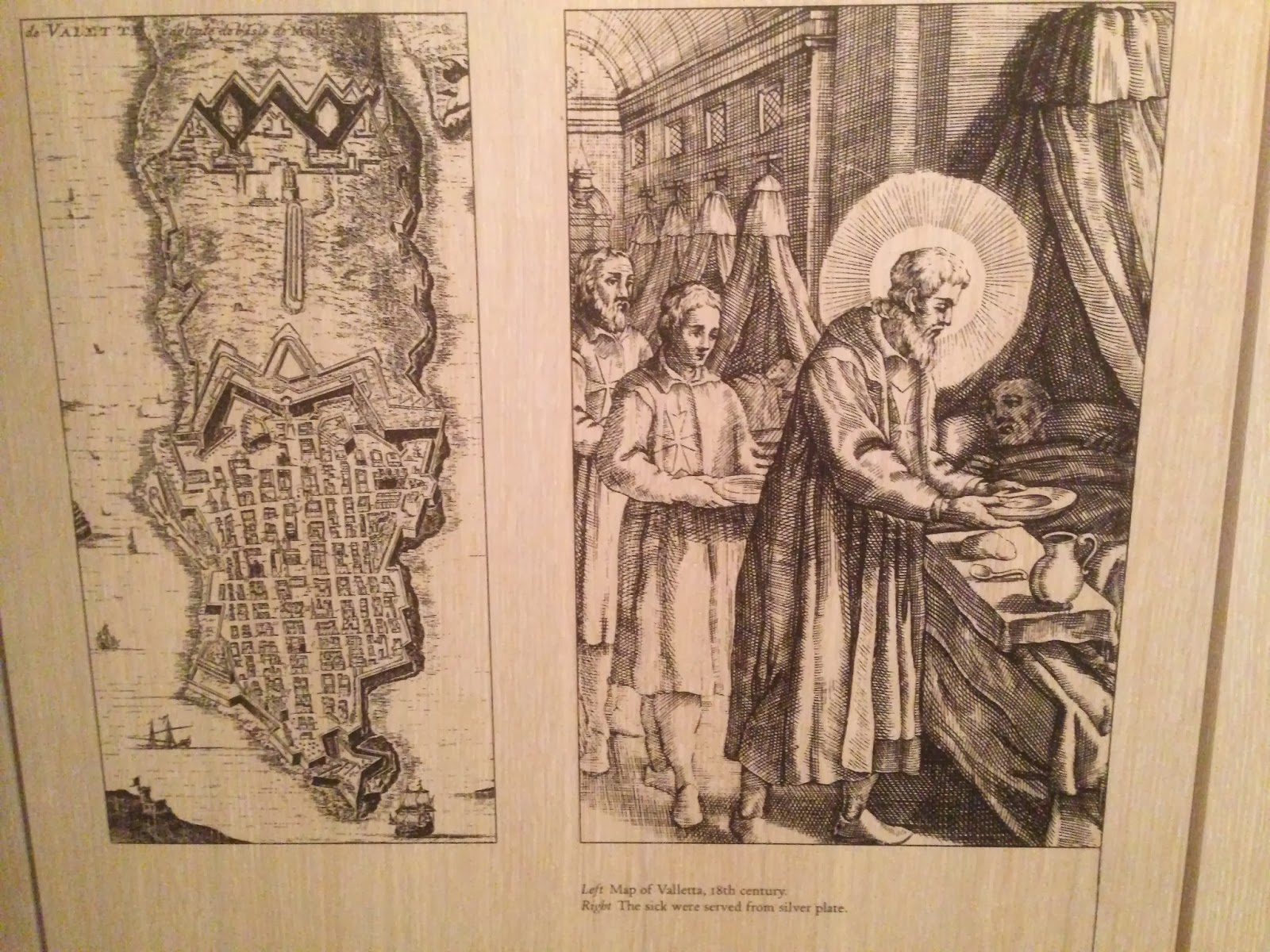
In 1522, 400 ships (under the command of Suleiman the Magnificent, sultan of the Ottoman Empire) forced them to leave and they created a new headquarters in Malta.

As the Order grew, the Knights of the Order were given land across England and Europe.
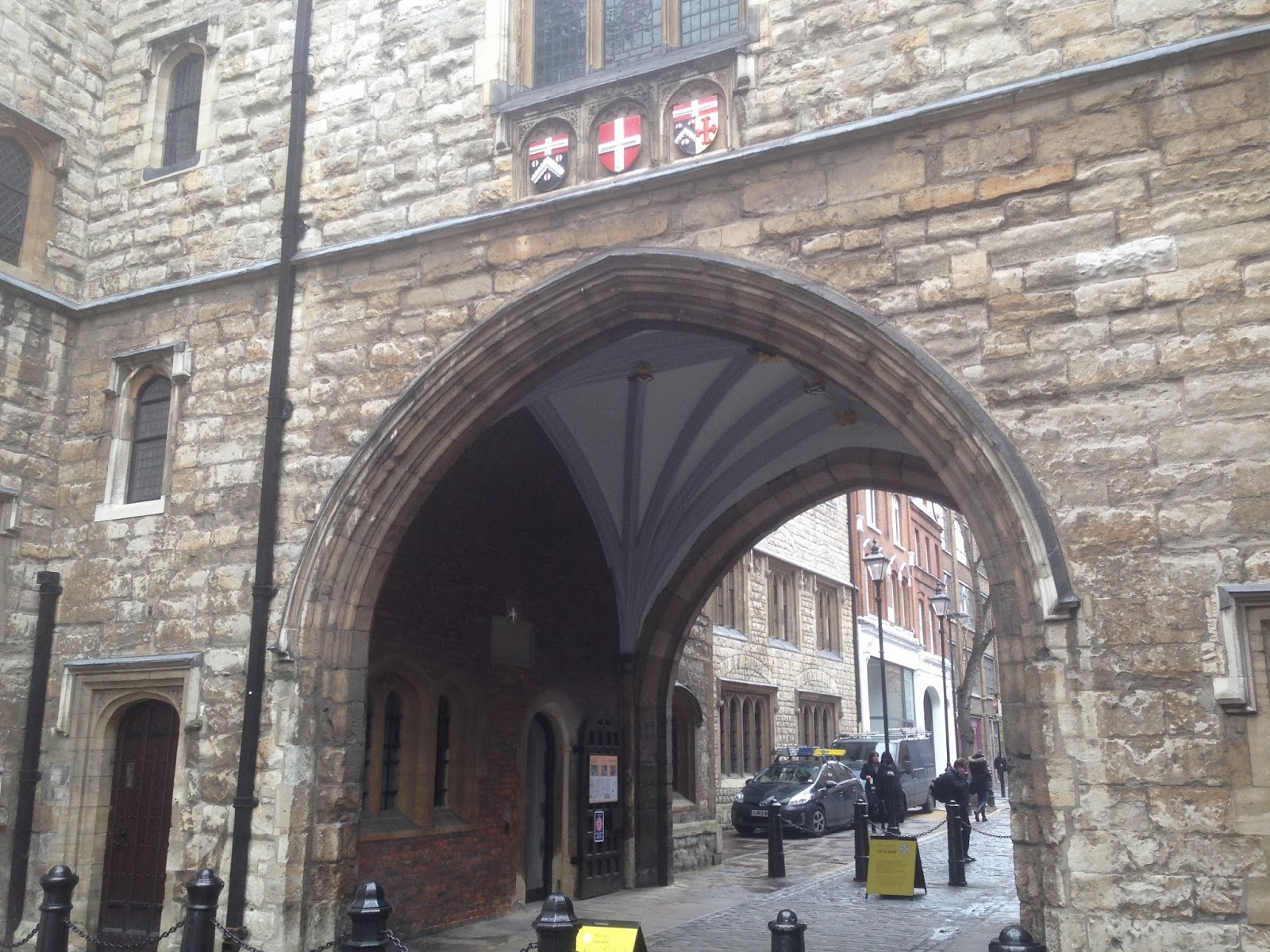
This land was controlled by Priories in each country – and the Priory of St John in Clerkenwell (where the museum now sits) was the Order’s headquarters in England.

When King Henry VIII became head of the church in 1534, he began to close down religious houses. All of the buildings, land and wealth of these religious communities, like the Order of St John, was transferred to the crown.

Although the Knights no longer had a home here in the UK, the order continued (largely unaffected) in the Mediterranean, until Napoleon invaded their base in Malta and they lost their stronghold in the Mediterranean.

In 1888, a new British St John organisation was set up, aiming to help those in sickness, distress, suffering or danger.

Innovative thinkers, such as Peter Shepherd, helped with the set up of the organisation, who was among the first to give medical knowledge to the public though first aid.

Ordinary people formed a trained network, the St John’s Ambulance Brigade, that were willing and prepared to help the cause.

Various membership grades are offered, and support is rewarded with medals like the ones below.


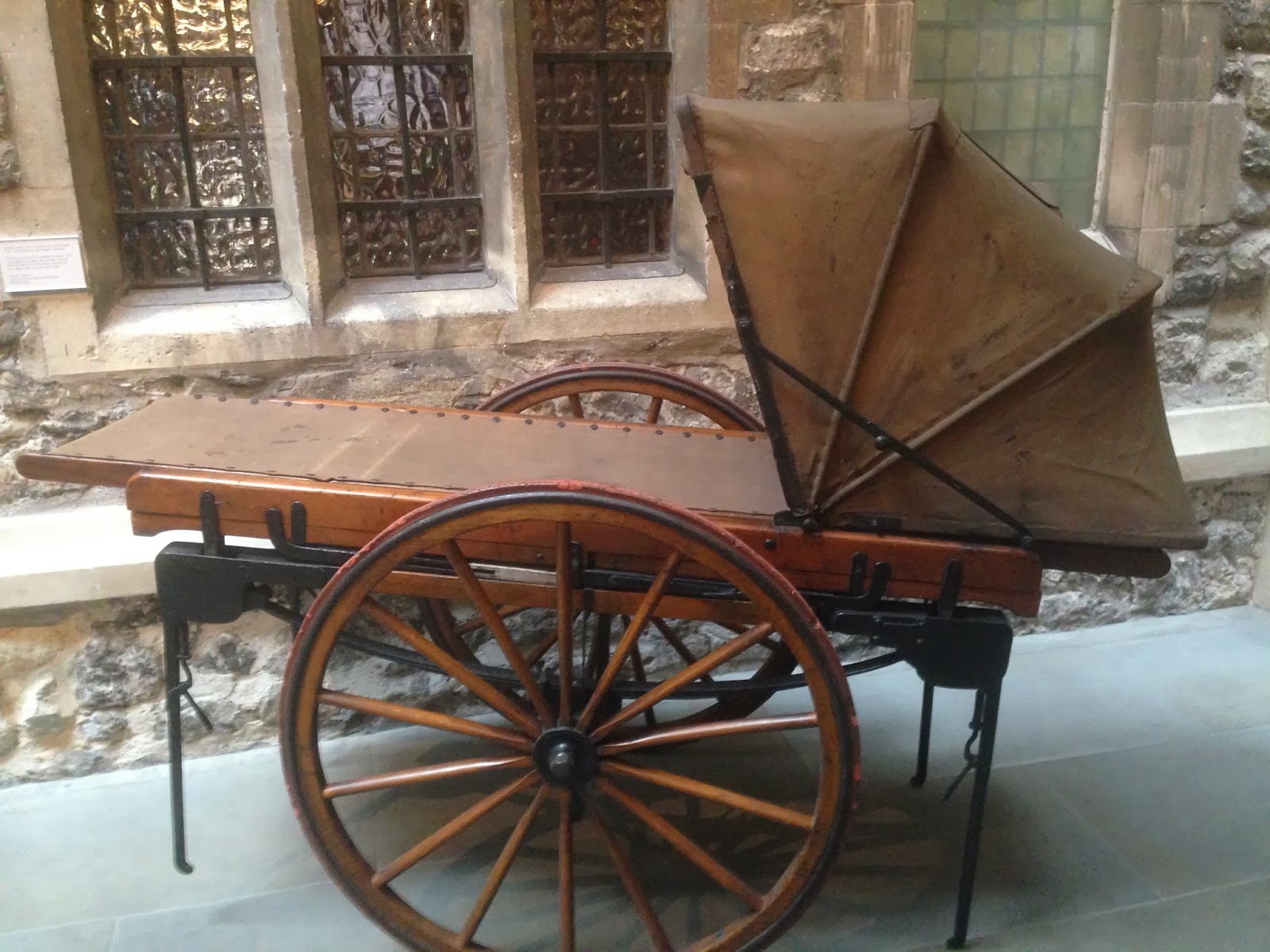
In the late 19th century, they used a litter – a primitive wheeled stretcher – to help their patients.

Now of course, you’re more likely to see them on one of these.

Today there are approximately 30,000 members worldwide.

#1. After the UK Knights dissolution, the priory buildings housed the Office of the Master of Revels (royal festivities.) Thirty of Shakespeare’s plays were licensed on the site.

#2. Christ is believed to be buried in The Church of the Holy Sepulchre, next door to the St John Knights Hospital in Jerusalem.

#3. Charles V offered the Knights the island of Malta as a new headquarters, in exchange for token rent of one falcon a year.

#4. In the 18th century, ‘The Gentlemen’s Magazine’ was published from St Johns Gate. This was the first periodical to use the term ‘magazine’.

35. The youth section of the St Johns Brigade is called the St John Badgers.

1. Cartoon Museum
2. Churchill War Rooms
3. Cinema Museum
4. Dennis Sever’s House 
5. Dr Johnson’s house
6. Design Museum 
7. Down House 
8. The Geffrye Museum
9. London Film Museum 
10. London Transport Museum
11. Mansion House 
12. Brunel Museum 
13. Museum of the Order of St John
14. Musical Museum 
15. Old Operating Theatre Museum & Herb Garret
16. Pollock’s Toy Museum 
17. Rose Theatre exhibition 
18. Fashion and Textile Museum 
19. Royal College of Music Archives and Museum of Instruments 
20. Sherlock Holmes Museum 
21. Twinings Museum
22. V&A Museum of Childhood 
23. Bank of England museum
24. The Stephens Museum 

Housed in a beautiful old building that borrowed materials from ‘Albertopolis’ is the V&A Museum of Childhood.

Outside it looks quite normal.

Inside, it looks magnificent.

The first thing we did was look through the moving toy section.

First stop – the automatons. Self operating, mechanical toys with the ability to perform complex movements.
Some of these expensive automata were actually build for wealthy adults to impress and entertain their friends.

We saw some fantastic toy cars too.

I love the styling on this one. Like an old Roller or Morgan.

And I love the sheer size of this one – that’s one spoilt child!

The walls and curtains at the museum were covered with quotes about play.
Sigmund Freud’s words stuck out to me: “There is little that gives children greater pleasure than when a grown up lets himself down to their level… and plays with them as an equal.”

I was amazed to read that children in the late 1880s were allowed to play with real steam engines, made of brass. The escaping steam would have even made the classic ‘choo choo’ sound.

But real steam engines are positively safe, when compared to spirit burning boats (or putt putt boats.)

I’d stopped to have a look at the model railway for quite a while, along with a number of other people, when Wist popped over. I wasn’t sure whether to be insulted when she told me that she could see me getting into making that kind of thing.
The most worrying thing is that I’d been thinking the same thing before she came over. Uh oh.
In the model maker’s defence – it’s stunningly detailed.

Next up were optical toys.

I loved this telescopic view of the Crystal palace at the 1851 Great Exhibition.

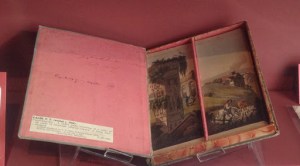
I also thought these toy panoramas were interesting.

An extended version of that was the Juvenile Myriorama (or Panaramacopia) from 1820-30.
These are a set of cards, printed in the UK, showing isolated elements of scenery. You can place different cards next to each other and create new landscapes, as each card fits anywhere in the sequence.

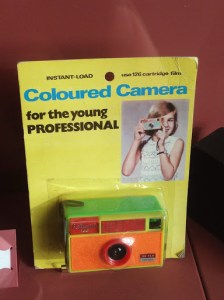
Nice to see young professionals starting so early.

Holly Hobbie – great name, awful gender reinforcement…

If ever you need a strawman argument, just annoy this guy…

Interestingly, he was also known as shock-headed Peter.

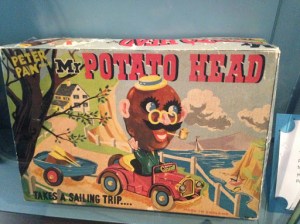
In 1952, Mr Potato Head launched. Somewhat correctly, the toy box only contained the parts and parents had to provide the potato. Eight years later, a hard plastic potato body was introduced, replacing the need for a real potato. Nothing quite beats an actual potato though.

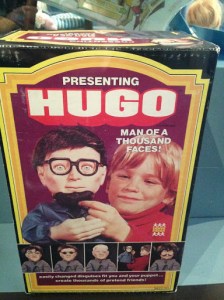
In 1975, someone somewhere decided that kids needed a more versatile face to play with.
Perhaps Potato head just couldn’t show the breadth of emotion with all of his accessories.
Introducing… Hugo, Man of a Thousand faces.

Action man (launched in 1966 as a British version of GI Joe) has seen a number of jobs, due to public attitudes to war – including space ranger and ‘peaceful adventurer’.

This ‘puzzle cabinet’ from the 1760s used to belong to Royal Governess Charlotte Finch. The puzzles housed in its drawers were used to teach geography to princes and princesses. The maps in the cabinet chart the entire globe. The Royal children would rule a country with an international empire and learn about trade flowing around the globe.

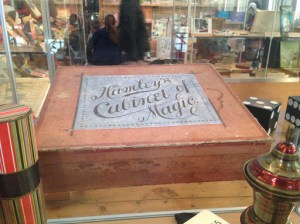
From one cabinet to another. This time, Hamley’s Cabinet of Magic!

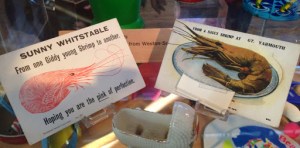
These holiday postcards from Gt Yarmouth and Whitstable were pretty kitsch.

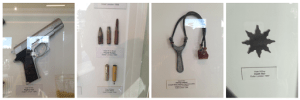
Perhaps my favourite two exhibits were nearest the exit – the confiscation cabinets, and ‘Are you sitting comfortably?’

The confiscation cabinets is a fantastic project by teacher Guy Tarrant. He collected all of the items confiscated from children at schools over three decades. In his words, it evidences the everyday actions of school students. The objects in the cabinets highlight mischevious and distracted behaviour played out in the controlled school setting where children spend the majority of their young lives.

They’re hugely interesting – ranging from the depressing to the distressing.

The second exhibition near the exit was called ‘Are you sitting comfortably?’ – an exploration of ‘design at the chalkface.’

It’s been commissioned in response to what the current government sees as a ‘decade of wasteful extravagance in educational architecture.’ The exhibit draws heavily upon a new study by Salford University that states ‘well designed classrooms can improve the academic performance of primary school children by up to 25%.’

The study hypothesises that there are three principles that would most affect a pupil’s brain function.
These were:
1) How natural it felt to be in the room
2) The extent to which the room felt individual to its occupants
3) Whether it stimulated them

The most significant factors for school design are therefore: circulation through the school, colour, simplicity of design, good light levels, natural light, flexibility, ownership, familiarity of classroom and good ventilation.

This isn’t a new argument.

In the first half of the 20th century, many European inventors were tasked with developing a new school desk. Jacob Happel even wrote of ‘the pernicious consequences of unadapted school desks on the physical, mental and spiritual development of a child.’
However, all of these early models with adjustable seats, worktop heights, flexible backs, footrests and arms were rejected as too complex, expensive and inconvenient and soon gave way to the mass production of more basic models.

The exhibit also displayed new layouts from children at Gayhurst Primary school – who had been briefed to design their ideal classroom. Most of the ideas allowed for more physical activity, computers and fresh air.

This futuristic looking classroom layout was designed by a 6 year old at the Wood School in Manchester. The furniture has been created from sawn branches.
Whilst we were there, there were loads of people that wanted to climb into it, play in it, sit in it.
I’m not sure you could say the same about a grimey old terrapin hut around the back of the assembly hall…

The V&A Museum of Childhood is a great day out – worth a visit to Bethnal Green if you have a spare afternoon.

FIVE FACTS
#1. In 1840 confectioner Tom Smith introduced to Britain the bon-bon – a sugared almond wrapped in paper. In 1847, inspired by a crackling log in his fireplace, Tom hit upon the idea of making his bon bon snap. With this new noise, the bon bon evolved and became the christmas cracker.

#2. The circus trapeze was invented by a performer called Jules Leotard. The tight costume that he wore was subsequently named after him.

#3. The first electric toy car was invented in the USA in 1899. A quick turnaround to miniature form, when you consider the first car was invented in 1886.

#4. Tamagotchi roughly translates as ‘Egg Watch’

#5. The 1978 release of Space Invaders in Japan was so popular, it was responsible for a nationwide coin shortage.

1. Cartoon Museum
2. Churchill War Rooms
3. Cinema Museum
4. Dennis Sever’s House 
5. Dr Johnson’s house
6. Design Museum 
7. Down House 
8. The Geffrye Museum
9. London Film Museum 
10. London Transport Museum
11. Mansion House 
12. Brunel Museum 
13. Museum of the Order of St John 
14. Musical Museum 
15. Old Operating Theatre Museum & Herb Garret
16. Pollock’s Toy Museum 
17. Rose Theatre exhibition 
18. Fashion and Textile Museum 
19. Royal College of Music Archives and Museum of Instruments 
20. Sherlock Holmes Museum 
21. Twinings Museum
22. V&A Museum of Childhood 
23. Bank of England museum
24. The Stephens Museum 

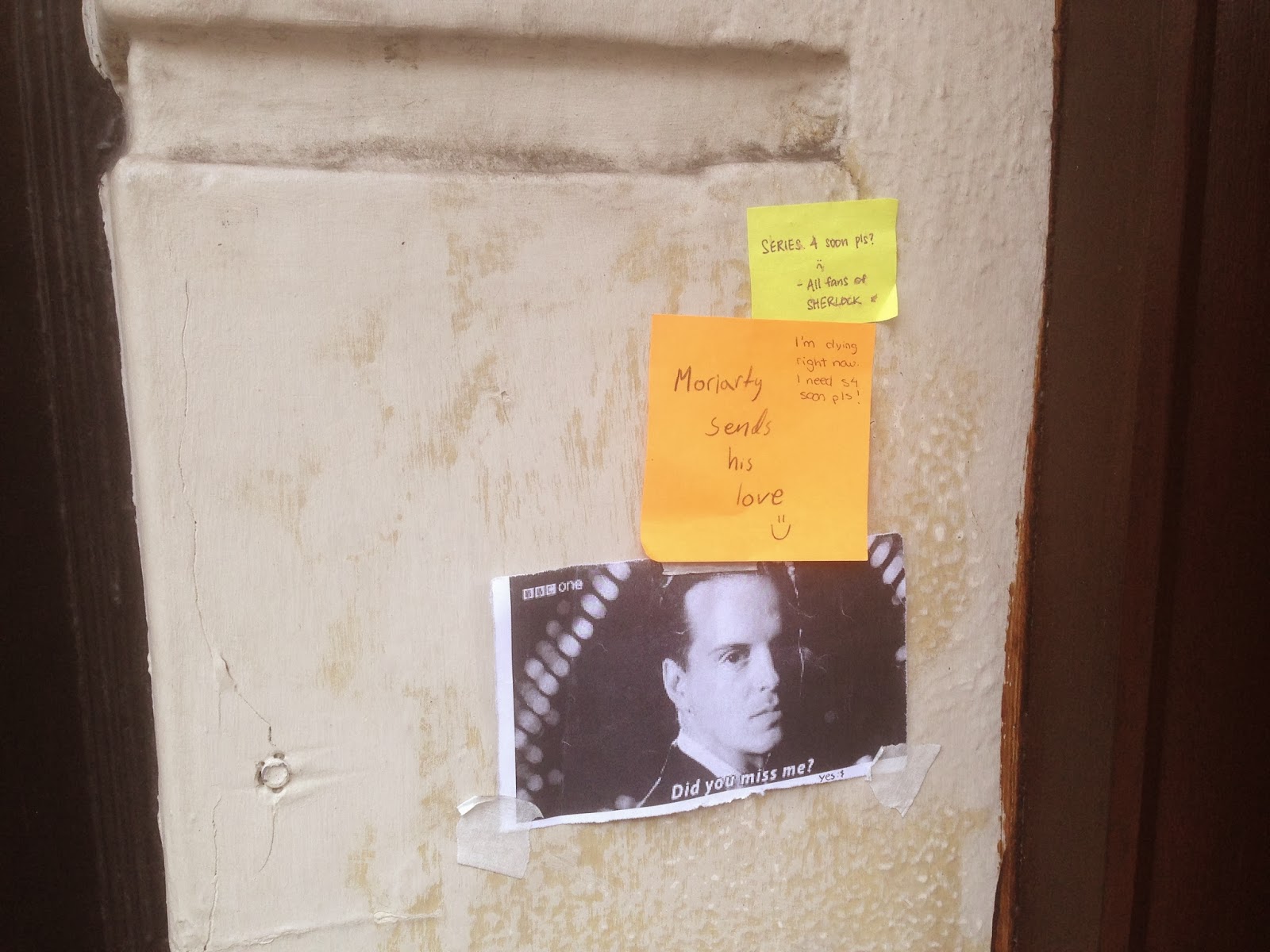
Off the back of the Sherlock museum, we went on the hunt for the location of the BBC series Sherlock.

We found it just off the Euston Road, on North Gower Street.

As we walked up to it, we noticed there was something near the door.

Ah yes, some uberfans before us have left messages to Sherlock, from Moriarty.

Haha.

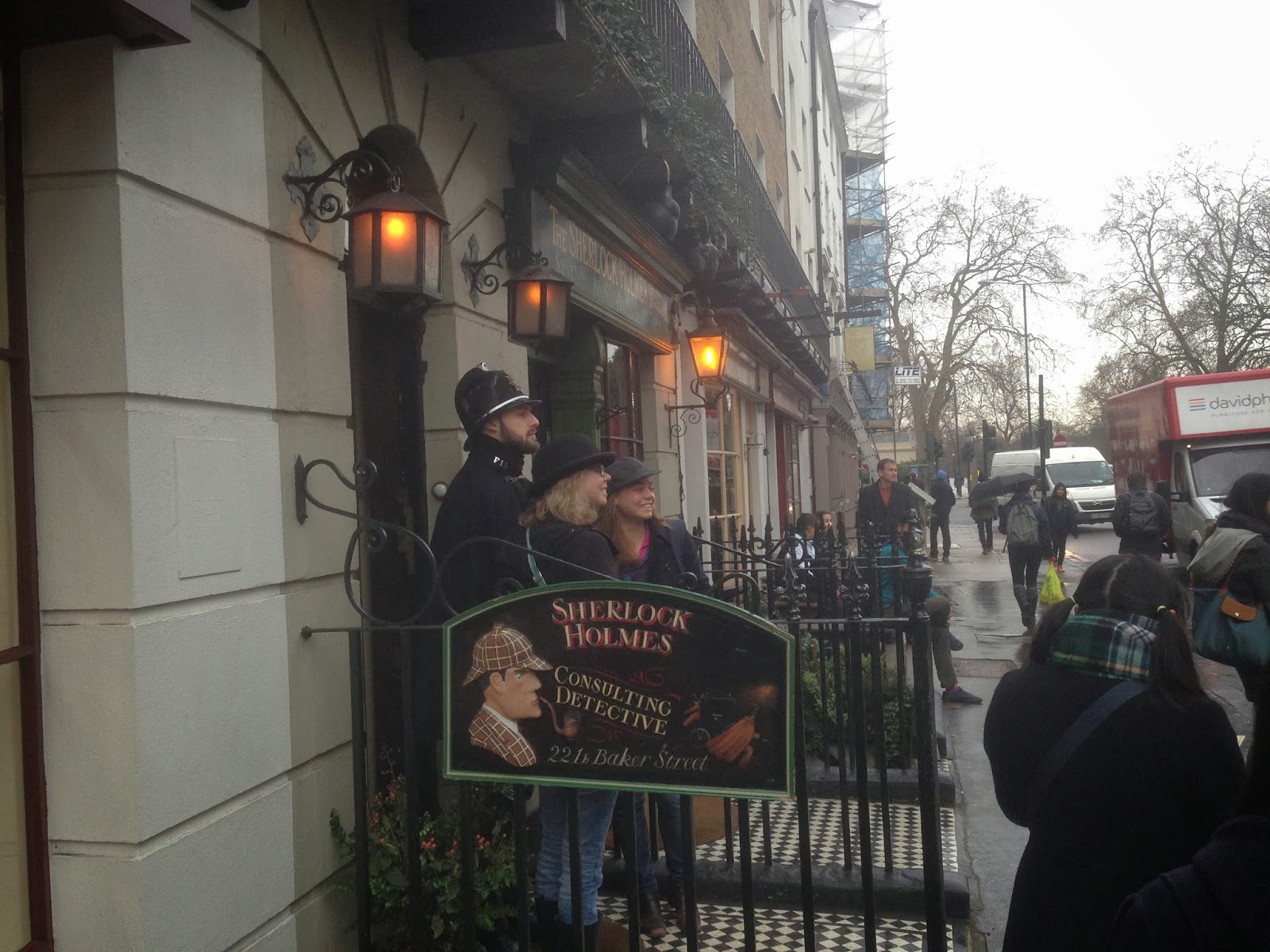
‘twas a dreary, toothache sky Monday that we found ourselves queuing outside the Sherlock Holmes museum on Baker Street.
 
Having worked on Baker Street for a number of years, I’d been looking forward to visiting this one.
 
The queue took almost an hour, and as anticipation built, a jobbing actor posed for photographs with tourists that have never seen a British bobby before.
 
 
I was, of course, fully away that the whole thing was a charade; Arthur Conan Doyle’s works are entirely fictional and no man called Sherlock Holmes had ever lived at this address.
But I’m not sure everyone else us was quite so up to speed.
And whatever you do, don’t try telling them…
 
 
Once inside, you climb the stairs to the first floor of the house and step inside what is supposedly Sherlock’s bedroom.
 
 
Very quickly, you ascertain that you aren’t going to see anything of any real historical significance here.
There are bits and bobs bygone, sure, but no Conan Doyle artefacts or TV/film props. 
And the stuff that IS in there, isn’t labeled. The whole experience is a bit like walking around the house of a borderline hoarder.
Which leaves me in a bit of a conundrum – very few facts for my write-up.
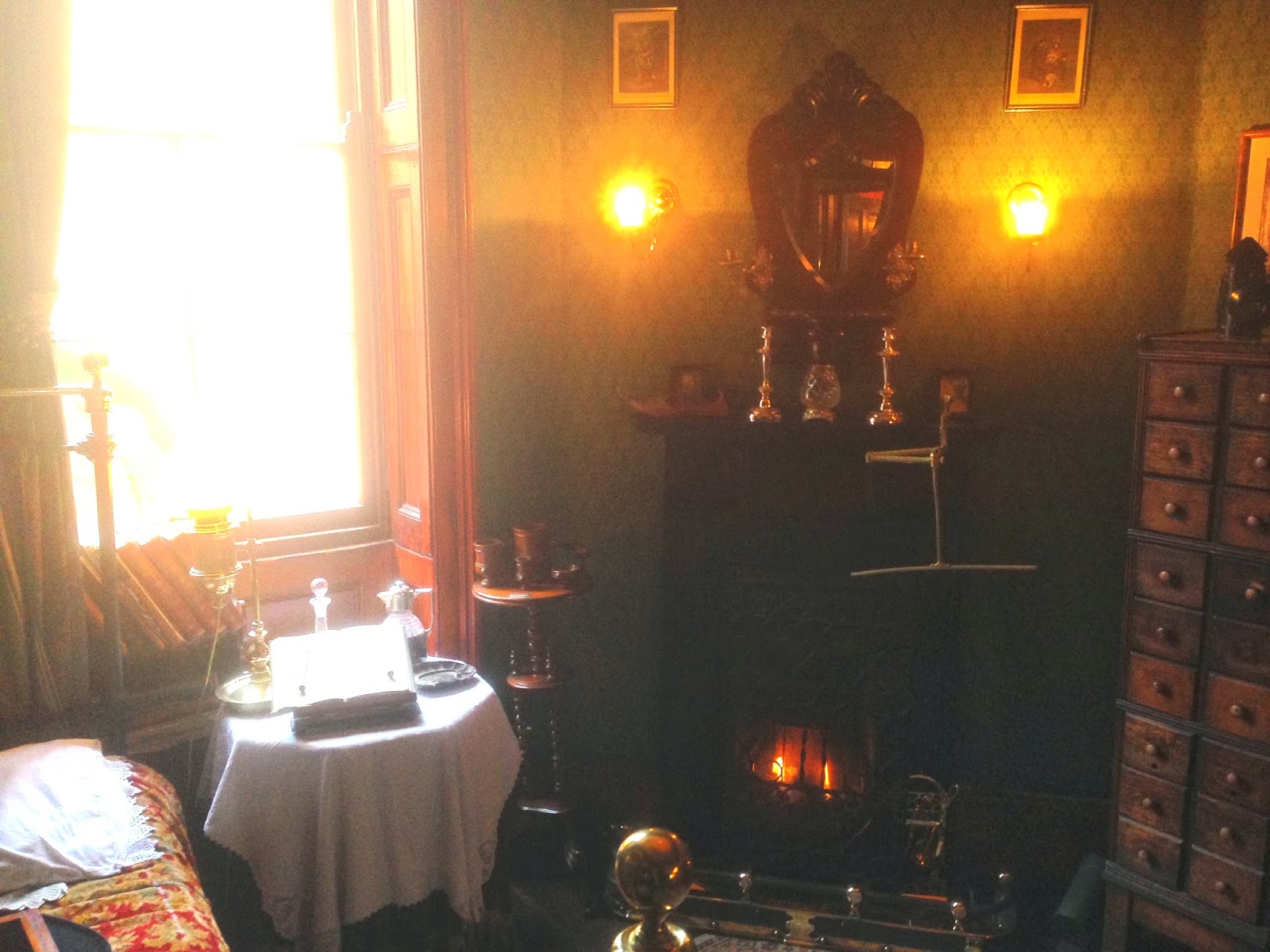
The décor, on the other hand, is pretty great – fantastic inspiration if you want to pull off that apothecary grime look.
So here you have it – less facts, more furnishings, from 221B Baker Street.
 

Loved these old tomes:

And this old fella:

Also quite a big fan of this wallpaper – nice:

A pipe rack, of course:
More tobacco paraphernalia:
And a violin too:

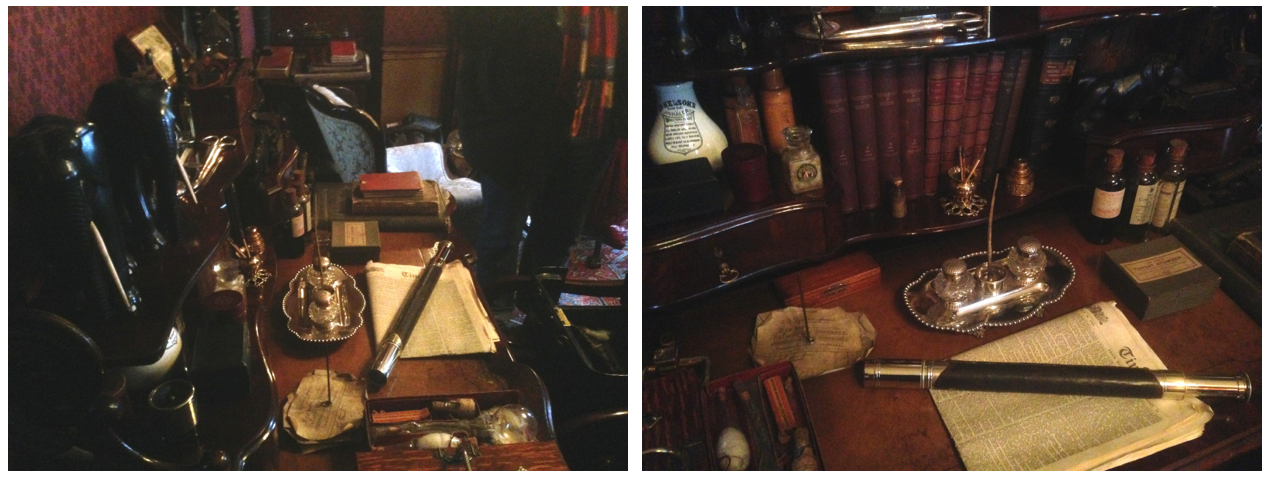
Every man needs a desk like this:

I really liked how understated this letterhead is:
 
And I also quite like this sneaky way of concealing a revolver around the house:
I wasn’t such a big fan of the strange character mannequins, that can be found on the top floor of the museum.
That’s pretty much everything that you can glean from the Sherlock Holmes museum I’m afraid.
The only thing left for me to find out was whether or not the signature deerstalker suited me as well as it had when I was younger…
 
FIVE FACTS
#1. Sherlock seemed to have a fascination with books on bees. I spotted three.
#2. The Red Headed club was dissolved on October 9, 1890.
#3. There are some real obsessive fans of Sherlock Holmes, that write to him from all over the world. A personal favourite was the advice one uberfan sent him: “Smoke less and rest well!”.
#4. Moriarty “sits motionless, like a spider in the centre of its web, but that web has a thousand radiations, and he knows well every quiver of each of them.”
#5. Sherlock supposedly received a medal in on honour of services rendered to the French Goverment.
1. Cartoon Museum
2. Churchill War Rooms
3. Cinema Museum
4. Dennis Sever’s House 
5. Dr Johnson’s house
6. Design Museum 
7. Down House 
8. The Geffrye Museum
9. London Film Museum 
10. London Transport Museum
11. Mansion House 
12. Brunel Museum 
13. Museum of the Order of St John 
14. Musical Museum 
15. Old Operating Theatre Museum & Herb Garret
16. Pollock’s Toy Museum 
17. Rose Theatre exhibition 
18. Fashion and Textile Museum 
19. Royal College of Music Archives and Museum of Instruments 
20. Sherlock Holmes Museum 
21. Twinings Museum
22. V&A Museum of Childhood 
23. Bank of England museum
24. The Stephens Museum 

It’s been a while since I visited a museum on the list, so I was glad when Wist suggested we tackle one this weekend.

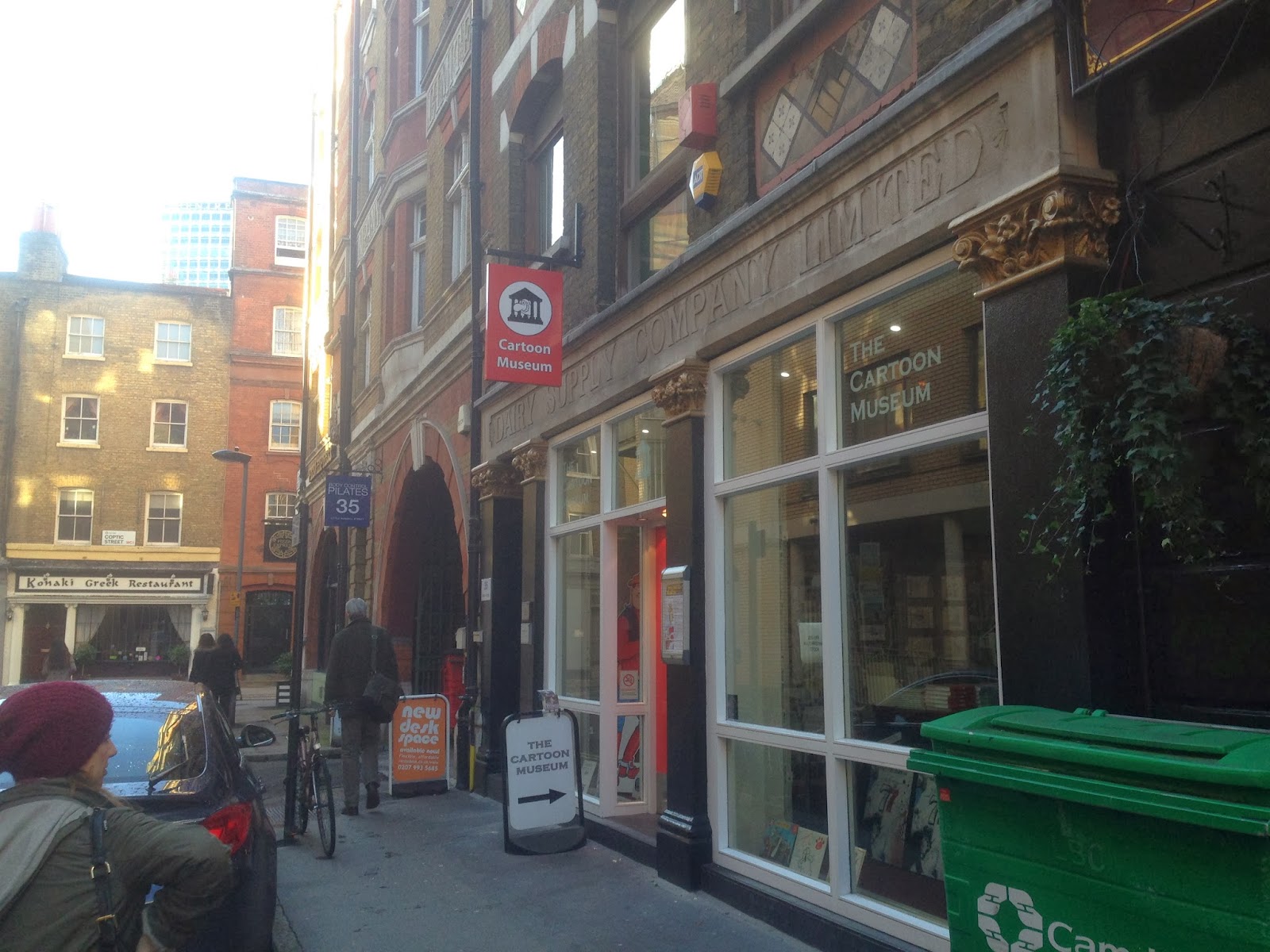
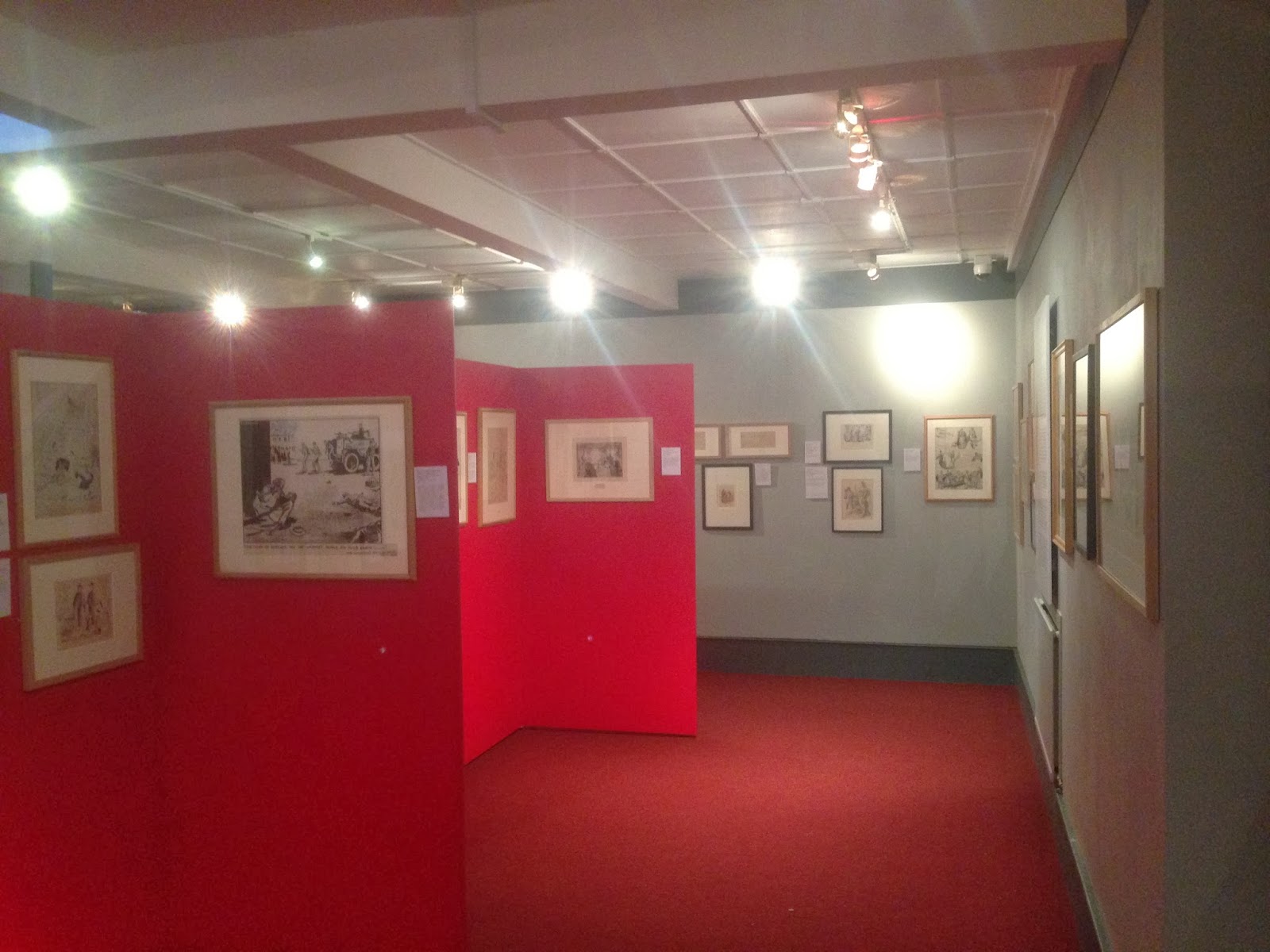
We chose the Cartoon Museum, just off of Museum Street.
The museum itself is dwarfed by the British Museum behind – but what it lacks in size it doesn’t lack in spirit.

On the ground floor, you can learn a little about the history of cartooning.

Caricature developed in Italy (Italian ‘caricare’ means to load, or exaggerate) and was spread to UK polite circles by young gents that had picked up their technique when on their grand tours.

William Hogarth had little time for caricature – regarding it a ‘foreign art’. He created a new form of picture story – and is widely regarded as the first comic artist.
Amateur artists Townshend, Bunbury, Woodward and Nixon transformed the art further – introducing a lighter, more playful tone. James Gillray perfected the art – becoming known for his power of imagination and cultural commentary.

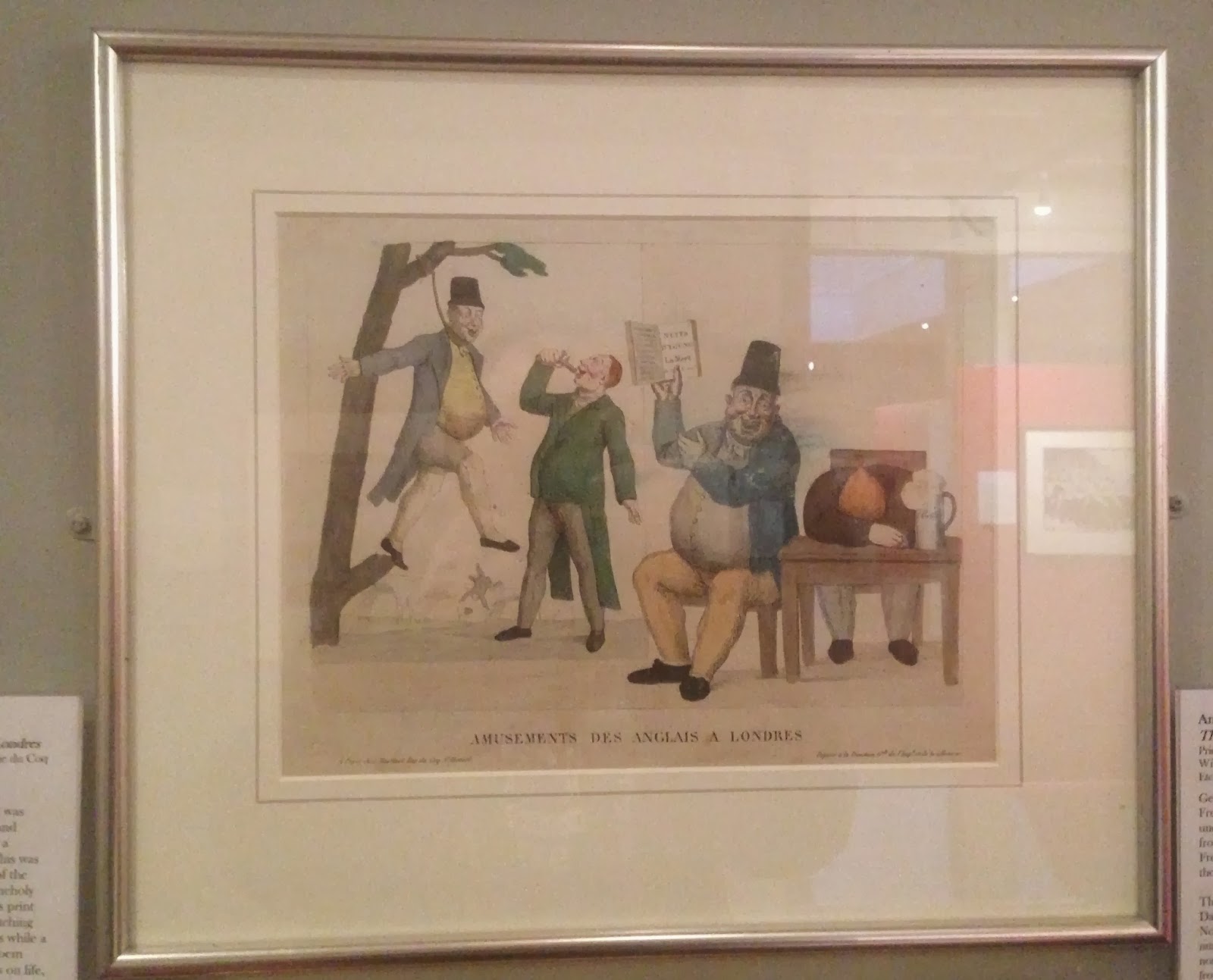
I thought this cartoon (etched by an anonymous individual) was interesting – commenting on the belief that the English were a particularly suicidal nation, due to the gloominess of the English climate and the melancholy of the national character.

The first half of the twentieth century saw the heyday of the popular magazine, and cartoons sat centre-stage amongst many of these. William Heath Robinson was one such cartoonist who entertained the Great British public through two world wars, with his intricate cartoon contraptions (pre-dating Rube Goldberg machines in America.)

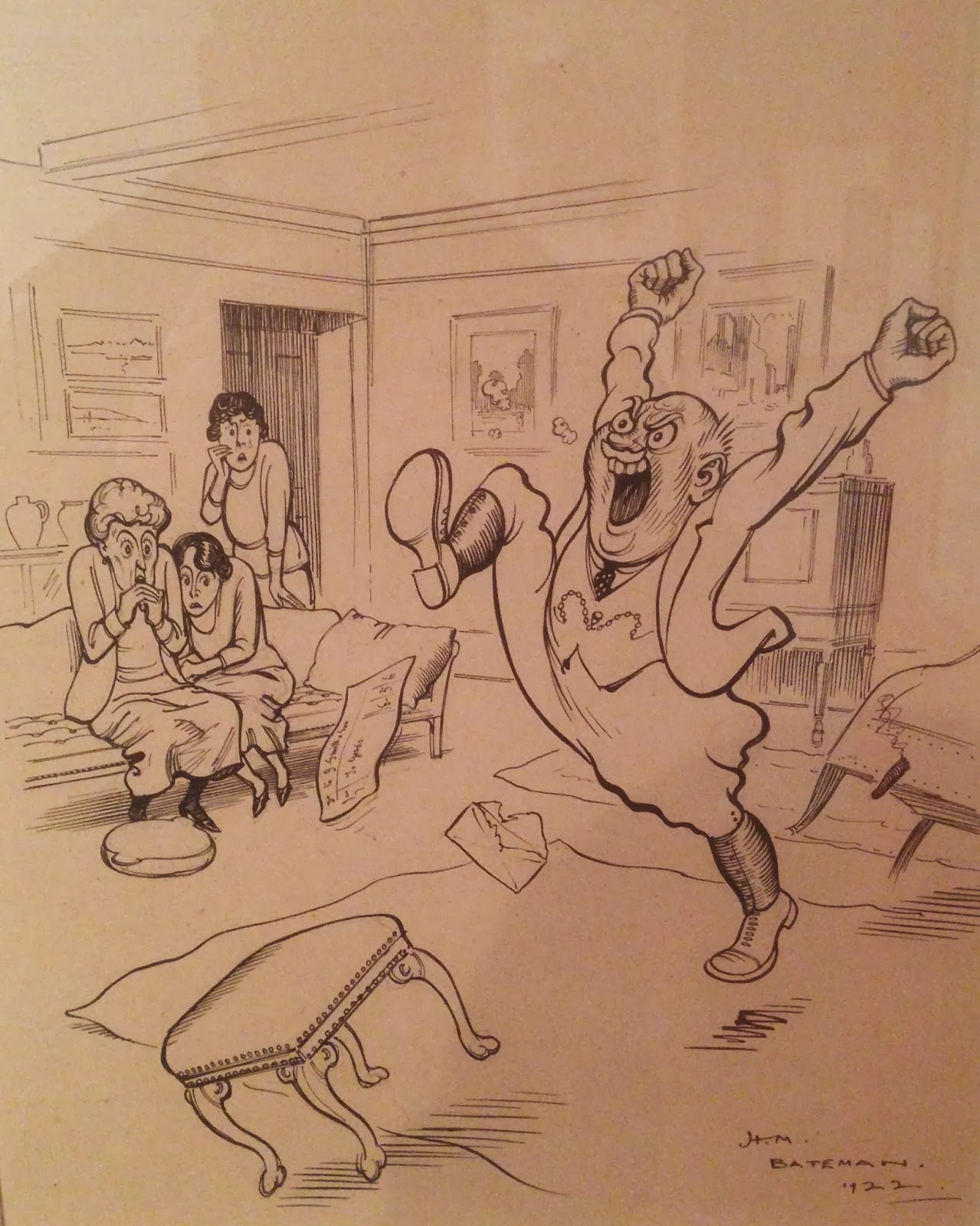
Henry Mayo Batemen was the first British cartoonist to draw with a dynamic and expressive line, that many found funny even without the caption. Here’s one:

Joke cartoons continued to appear in magazines and newspapers throughout the twentieth century.
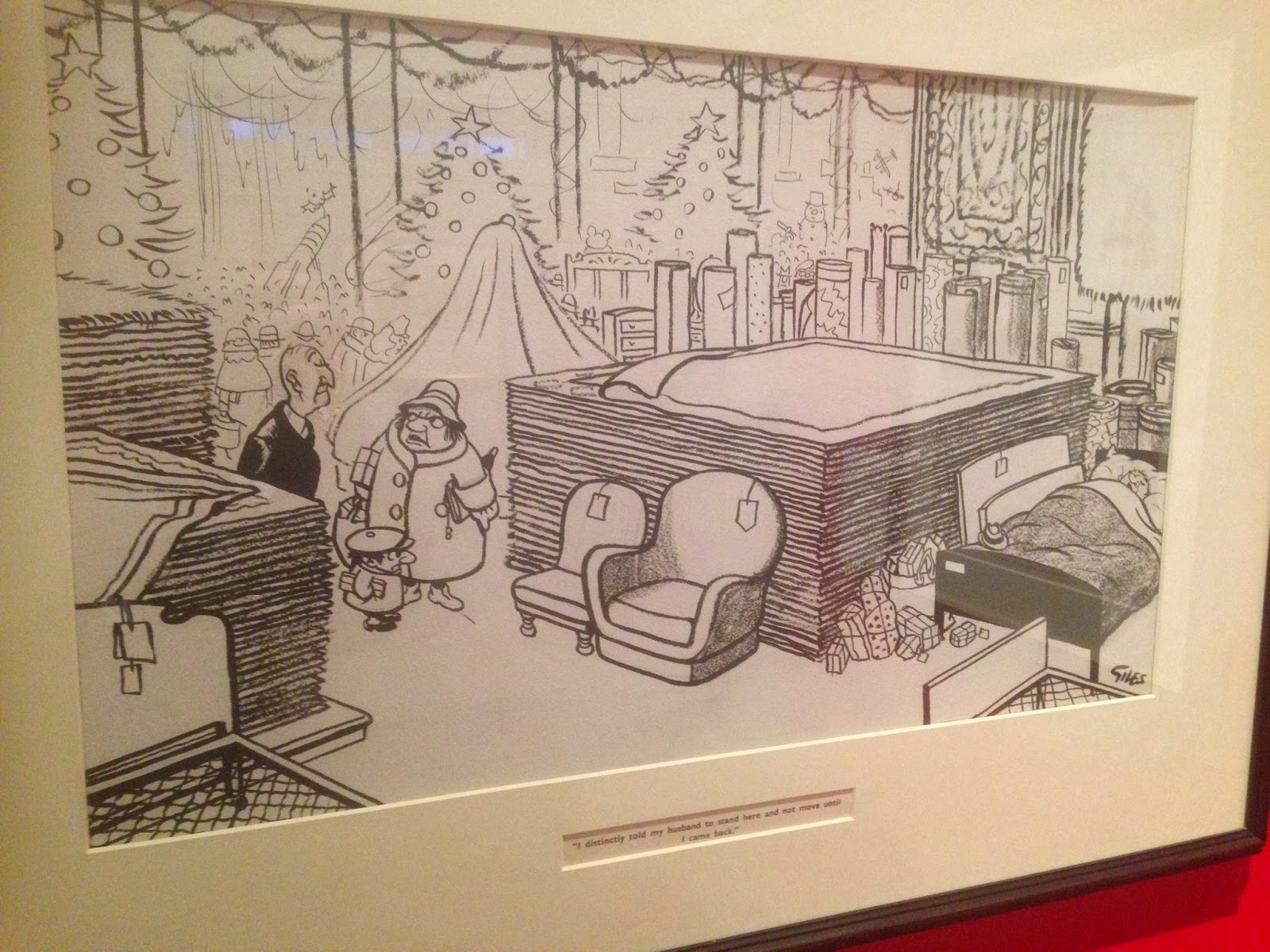
Carl Giles work was one such success story in this genre, famed for creating the Giles family.

In the 1960s and onward, Britain began to leave behind the deference and social conformity that had dominated society during the world wars. Edgier cartoon satire began to appear, of which the most notable was Private Eye in 1961.
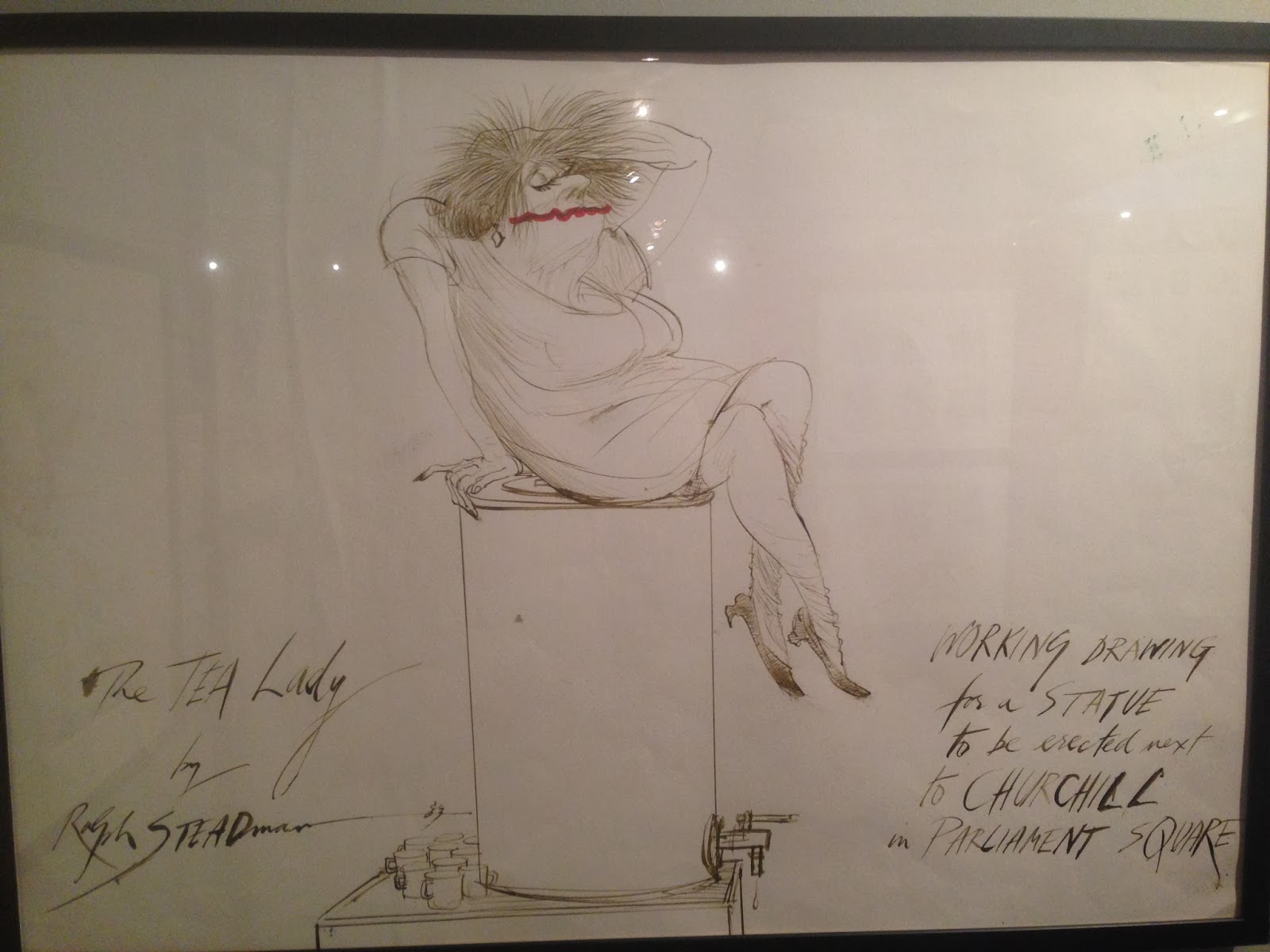
Artists including Ralph Steadman and Gerald Scarfe voiced their own discontent through angry, violent drawings.

The 2009 Ralph Steadman above is called “The Tea Lady – Working Drawing for a statue to be erected next to Churchill in Parliament Square”

For such a small museum, the quantity of beautiful cartoons really is quite astounding.

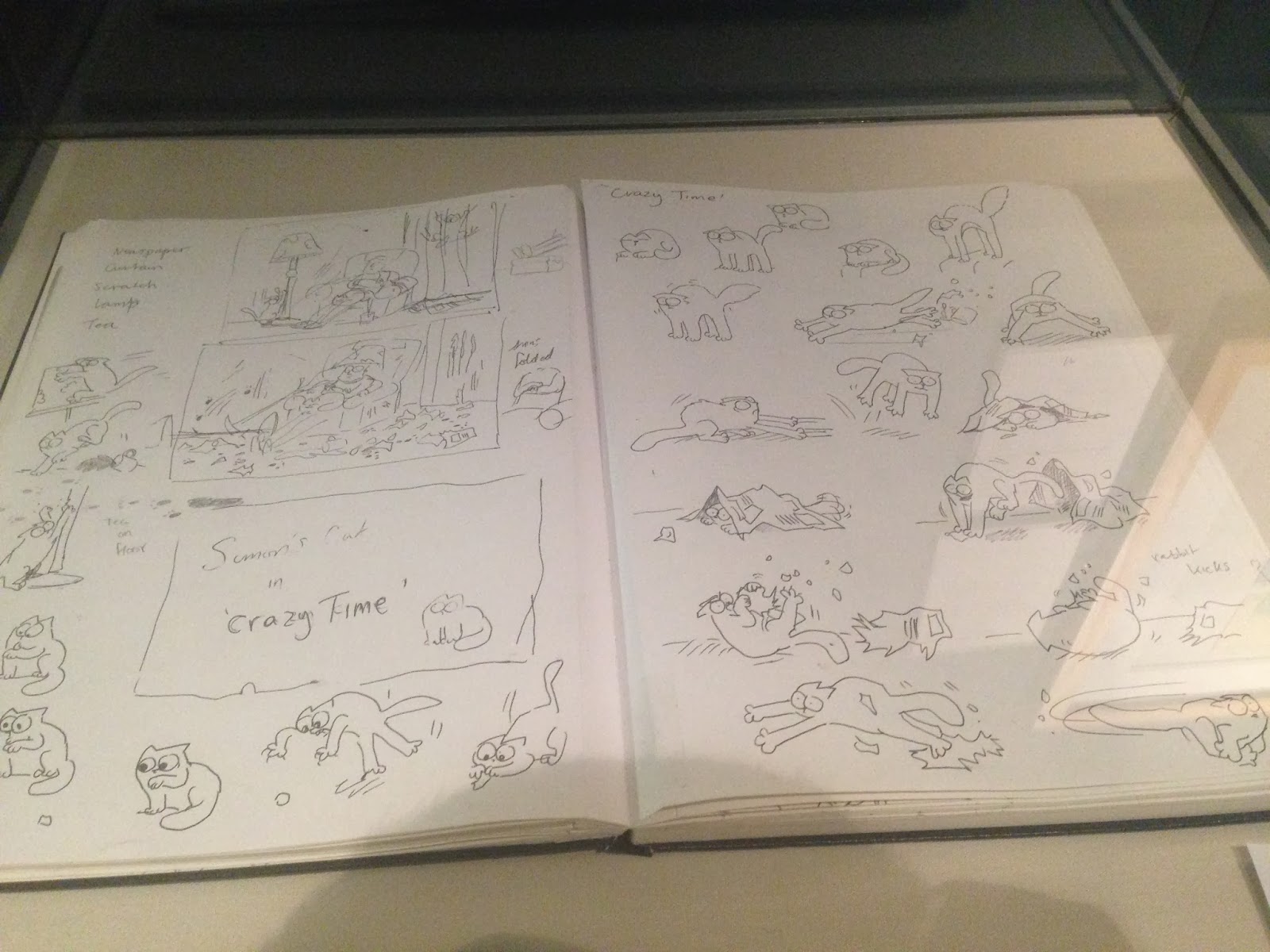
It was great to see the original sketchbooks of Simon Tofield, who created ‘Simon’s Cat’.

Upstairs, fun facts and layouts of modern comics were shared.
We learnt that Korky the Cat was the staple feature of the Dandy front page, until 1984 when Desperate Dan forced him off of the top spot.
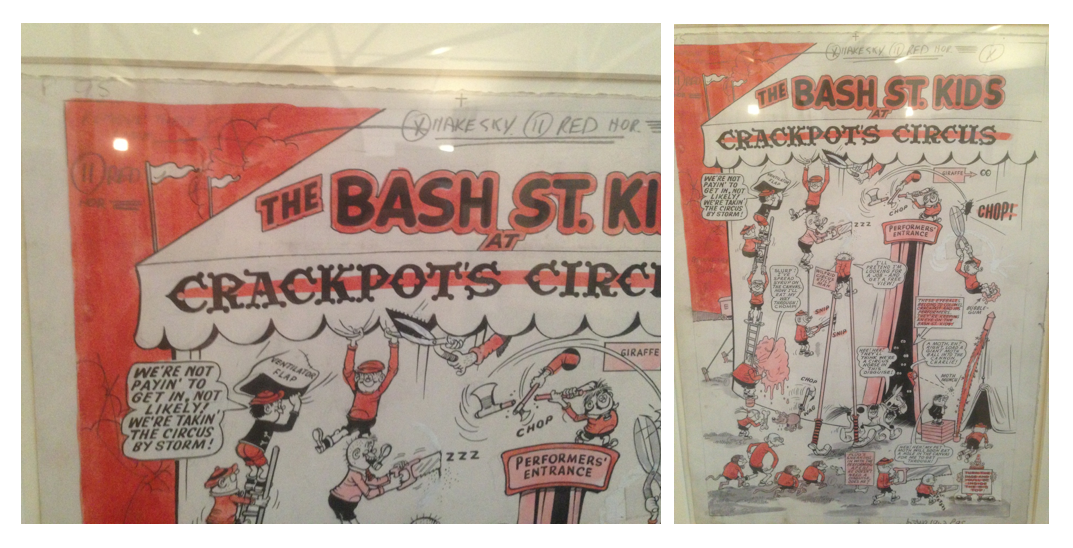
And that in certain editions of the Beano, there are strong similarities between the Bash Street Kids Teacher and his wife. Note the tash.
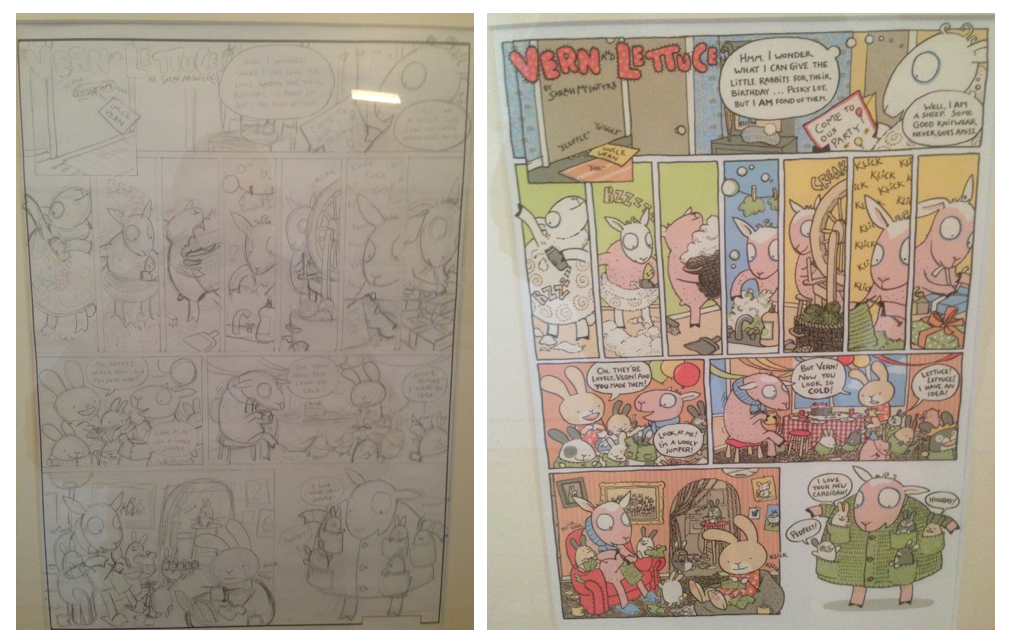
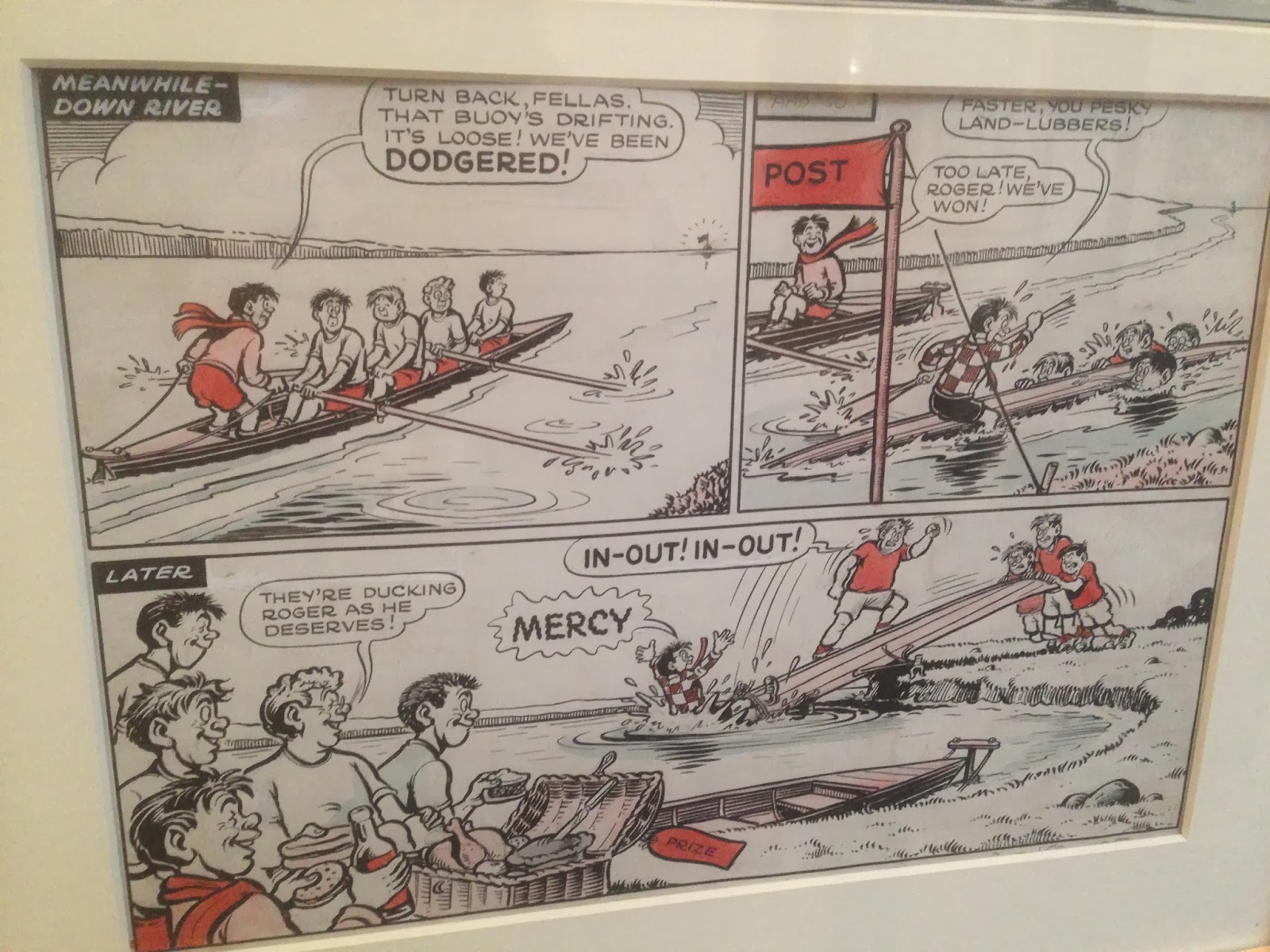
As ever, it was great to notice the artists own notes on their artwork.
I find artist’s drafts and work-in-progress layouts fascinating.
Roger the Dodger was a cartoon character I’d completely forgotten about.
His debut in 1953 started with the rhyming couplet: ‘Here comes Roger! Always scheming! You will never catch him dreaming.”
Catchy…
The museum is a whirlwind of nostalgia. If you’ve every read comics (as a child, or an adult) its worth popping down for a visit. It’s £7 a ticket, which felt fairly steep considering the size of the place, but niche museums like this don’t get an awful lot of funding so I guess it’s understandable.

FIVE FACTS
#1. The wholesome comic ‘Boys’ Own Paper’ (which featured tales of sporting prowess and imperial adventure) was introduced after fears that the dark and lurid ‘Penny Dreadfuls’ would have negative effects on impressionable young adults.
#2. Precursors to The Dandy (1937) and The Beano (1938) launched by DC Thompson included The Wizard (1927), The Rover (1929) and The Hotspur (1937)
#3. Christian groups, fearful of the influence of American horror comics imported into the UK, decided to launch their own comic book in response. ‘Eagle’ subsequently raised the bar for the entire British comic genre.
#4. Bryan Talbot introduced what is regarded as the first British graphic novel in 1977 (surprisingly late!)
#5. The original name of the cartoon strip ‘The Bash Street Kids’ was ‘When the bell rings’ but was changed two years after launch.

1. Cartoon Museum 
2. Churchill War Rooms 
3. Cinema Museum 
4. Dennis Sever’s House 
5. Dr Johnson’s house 
6. Design Museum 
7. Down House 
8. The Geffrye Museum 
9. London Film Museum 
10. London Transport Museum 
11. Mansion House 
12. Brunel Museum 
13. Museum of the Order of St John 
14. Musical Museum 
15. Old Operating Theatre Museum & Herb Garret
16. Pollock’s Toy Museum 
17. Rose Theatre exhibition 
18. Fashion and Textile Museum 
19. Royal College of Music Archives and Museum of Instruments 
20. Sherlock Holmes Museum 
21. Twinings Museum 
22. V&A Museum of Childhood 
23. Bank of England museum 
24. The Stephens Museum 
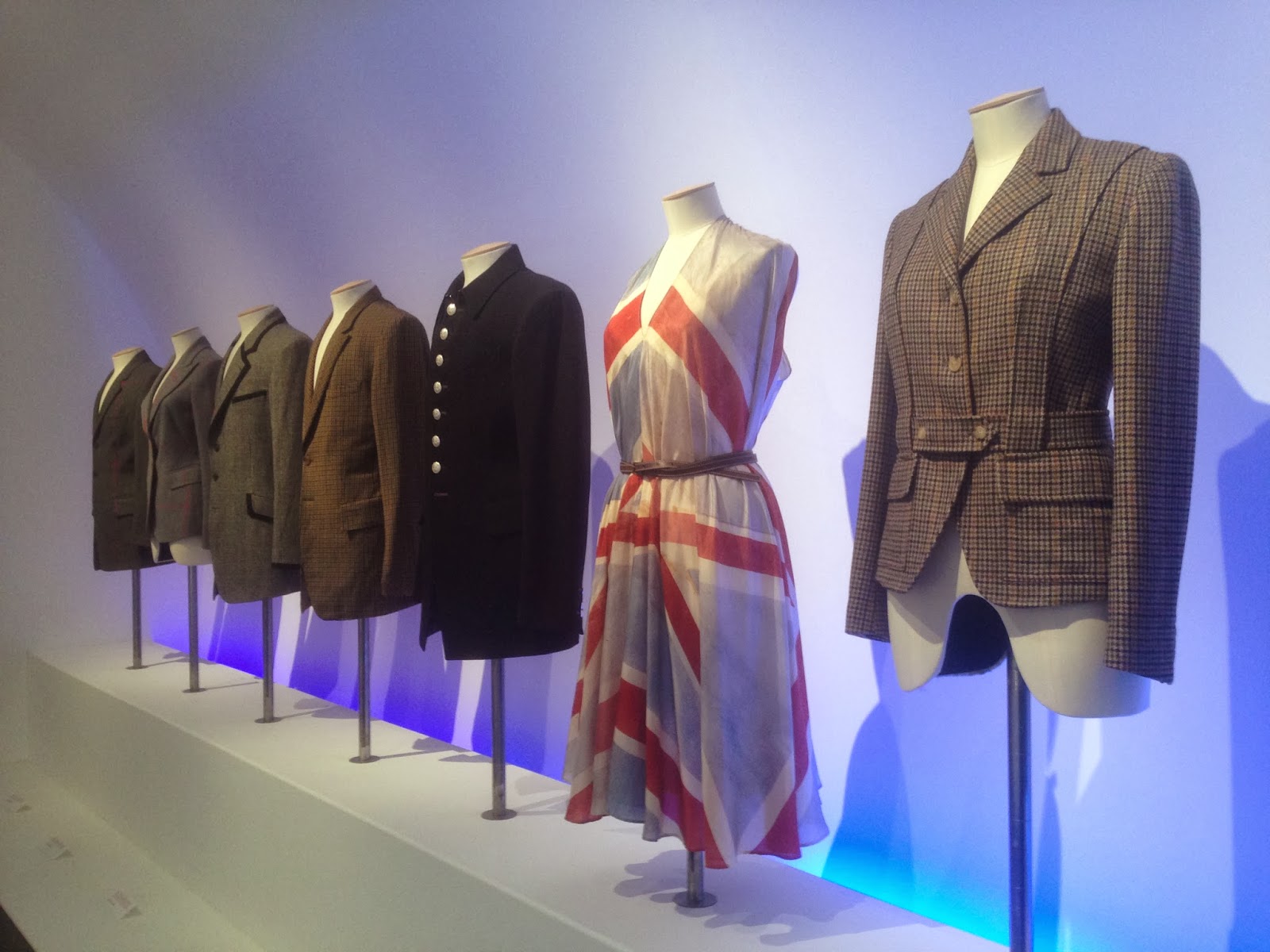
I’ve already ticked the Design museum off of my 24 museums list, but I was so impressed last time, that I bought a membership. So I’m afraid a Design museum write-up might end up a regular feature.
They’ve changed over the main exhibition since the last time we visited – it’s now a Paul Smith retrospective called ‘Hello my name is Paul Smith’
The exhibition is great. Really great.
It covers Paul’s life and design philosophy – from school to present day.
Paul left school at age fifteen, with the dream of being a cyclist.
After a serious road accident, he started to take his job at the clothing warehouse a little more seriously.
After conversations in the hospital with city’s art school students, he decided to manage a boutique.
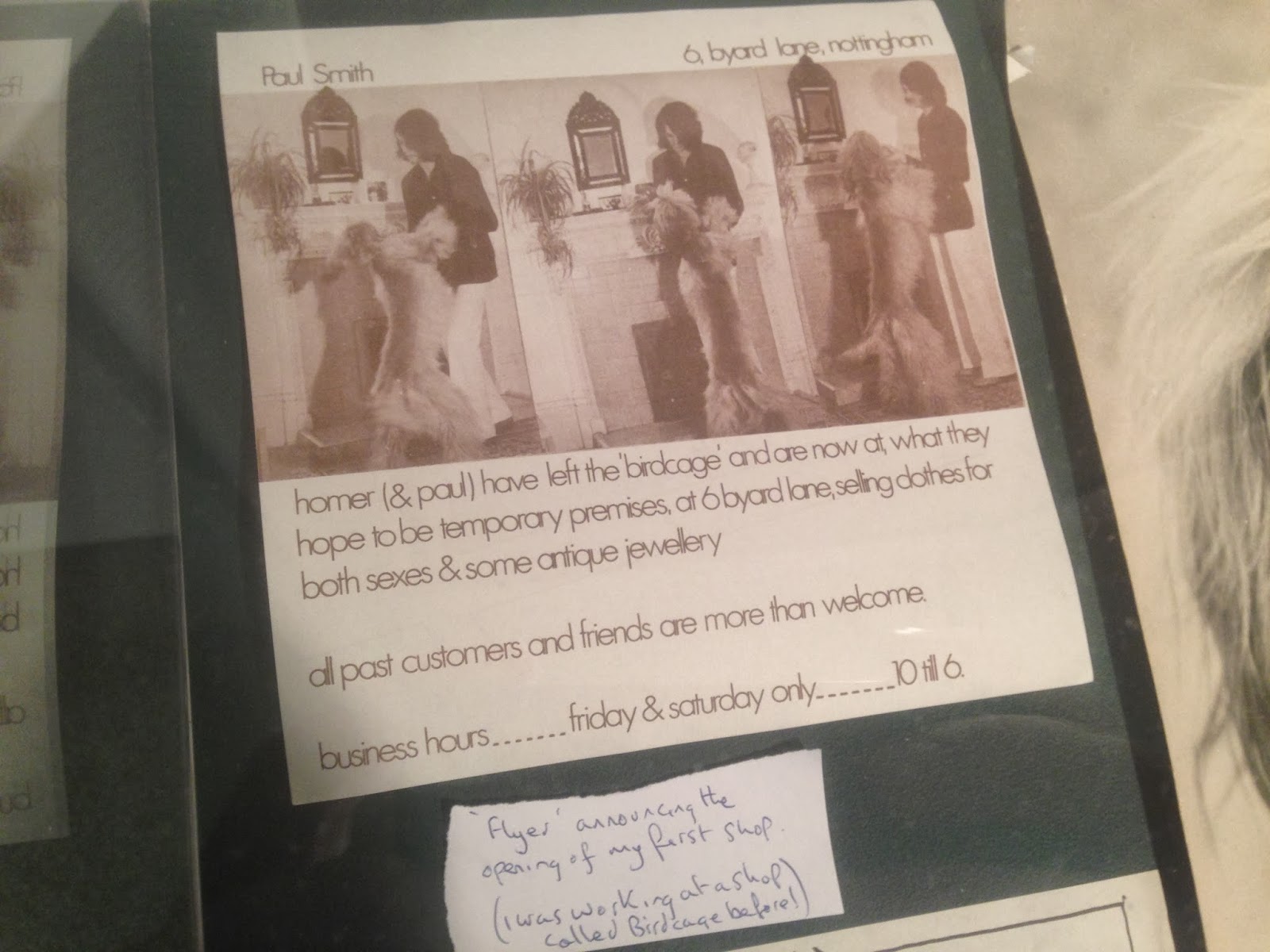
With encouragement from his wife Pauline (!), he opened his own tiny shop on a backstreet in Nottingham in 1970.
The shop was 3×3 metres square, with no windows. Essentially a big cupboard.
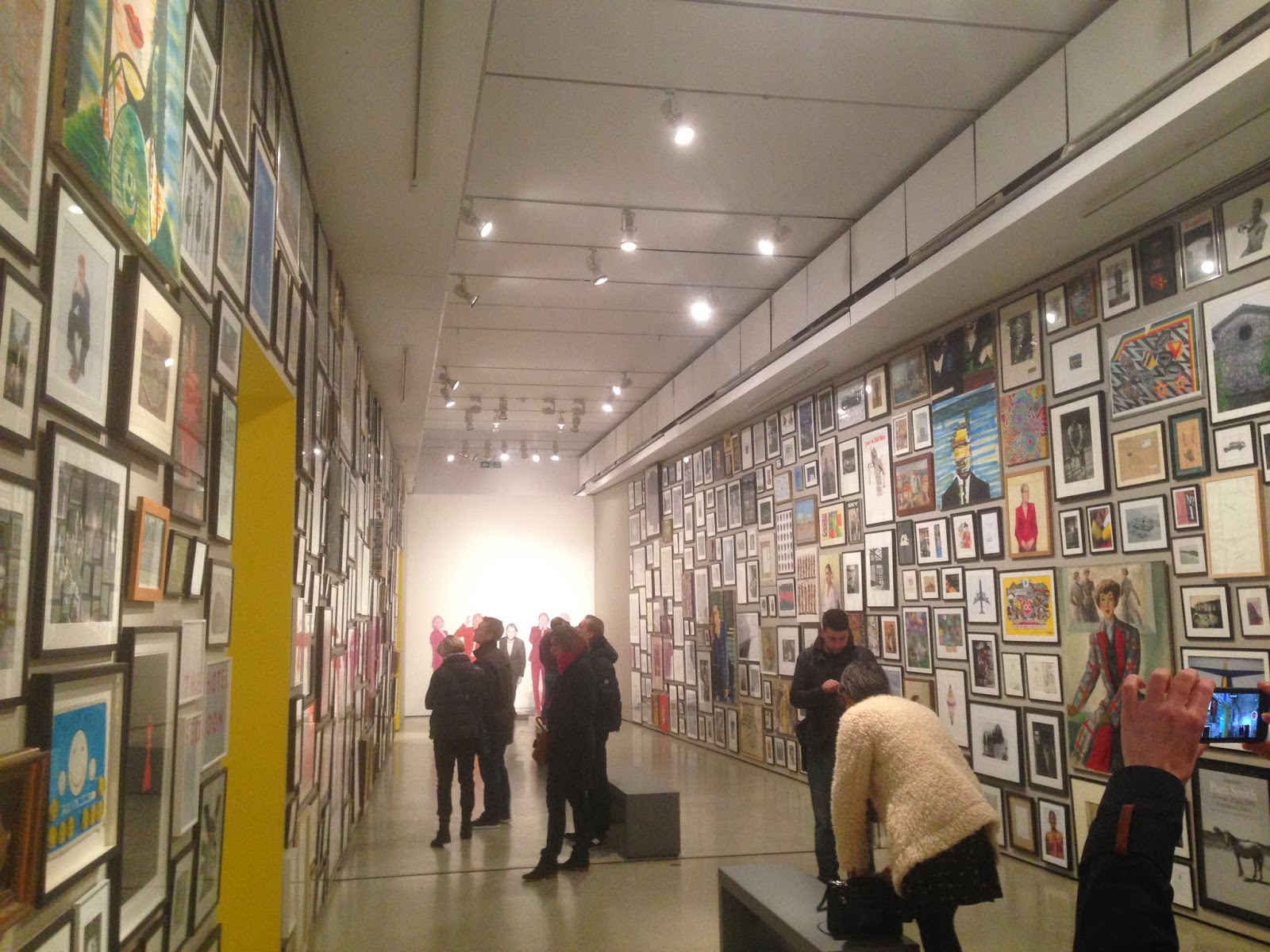
The next exhibition room shared a small part of Paul’s art collection.
Paul writes that his collection at home includes Warhol, Hockney and Banksy, but also works which have been sent by friends, family and ‘unknown enthusiasts’ since the 1990s.
The collection is beautiful – I’m sure you could spend hours in this one room and not get bored.
A theme that emerges again and again throughout the exhibition is the notion that ideas can come from anywhere.
Paul keeps track of the countless images and ideas that come into his head with a digital camera and a notebook, that he fills with sketches, words and telephone numbers.
In Pauls words: “Everyone looks, but not everyone sees.”
There’s a reconstruction of Paul’s Covent Garden office – which is cluttered with lots of objects – testament to his philosophy of jumble inspiration.
“The only tidy surface in my office is a huge rosewood table that is always empty. The rest of my office is a madhouse – there are books, bicycles, cameras, rabbits, robots, kitsch things, letters, bills, and bits and bobs from all over the place.”
In the next space along, there was a layout of Paul’s first ever show room, in a Paris hotel.
It was drawn out in cartoony, inked style – I loved it.
There was also a reproduction of the Covent Garden design studio.
Paul, again, talks about the huge quantity of references that are used to form new ideas.
Again, it shows.
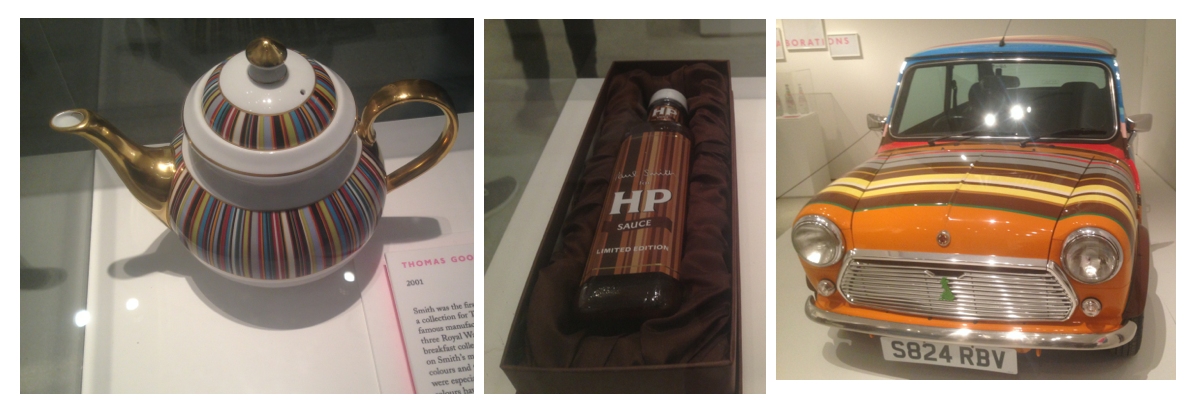
Paul’s signature stripes were (obviously) on show here too.
They develop their stripes by winding coloured yarn around cardboard.
This lets them see how the colours are working together, and how the balance of the stripe will work on a garment.
For some reason, I was really drawn to this invitation for a fashion show.
It’s handwritten, photocopied onto luminous orange – and it looked cool as f***.
Talking on his approach to fashion – Paul said:
“My clothes are rooted in tradition and express modernity. Classic with a twist. I like my clothes to hold a secret – a sober grey suit with a brightly coloured lining, ties with unexpected linings.”
“My stripes have been popular because they are colourful – colour makes people happy. If used in the right way, colour can add interest and express positivity. Colour has been added to classic garments in the forms of linings, or simply punctuation marks.”
“My designs often draw on very British traditions and motifs. Past collections have referenced, for example, the British postage stamp, rock’n’roll, the Women’s Land army, British poets, artists and eccentrics, and much, much, more.”
Top stuff from Paul Smith & the Design Museum.
If you have a spare afternoon before it ends, take the time to visit – you won’t regret it.

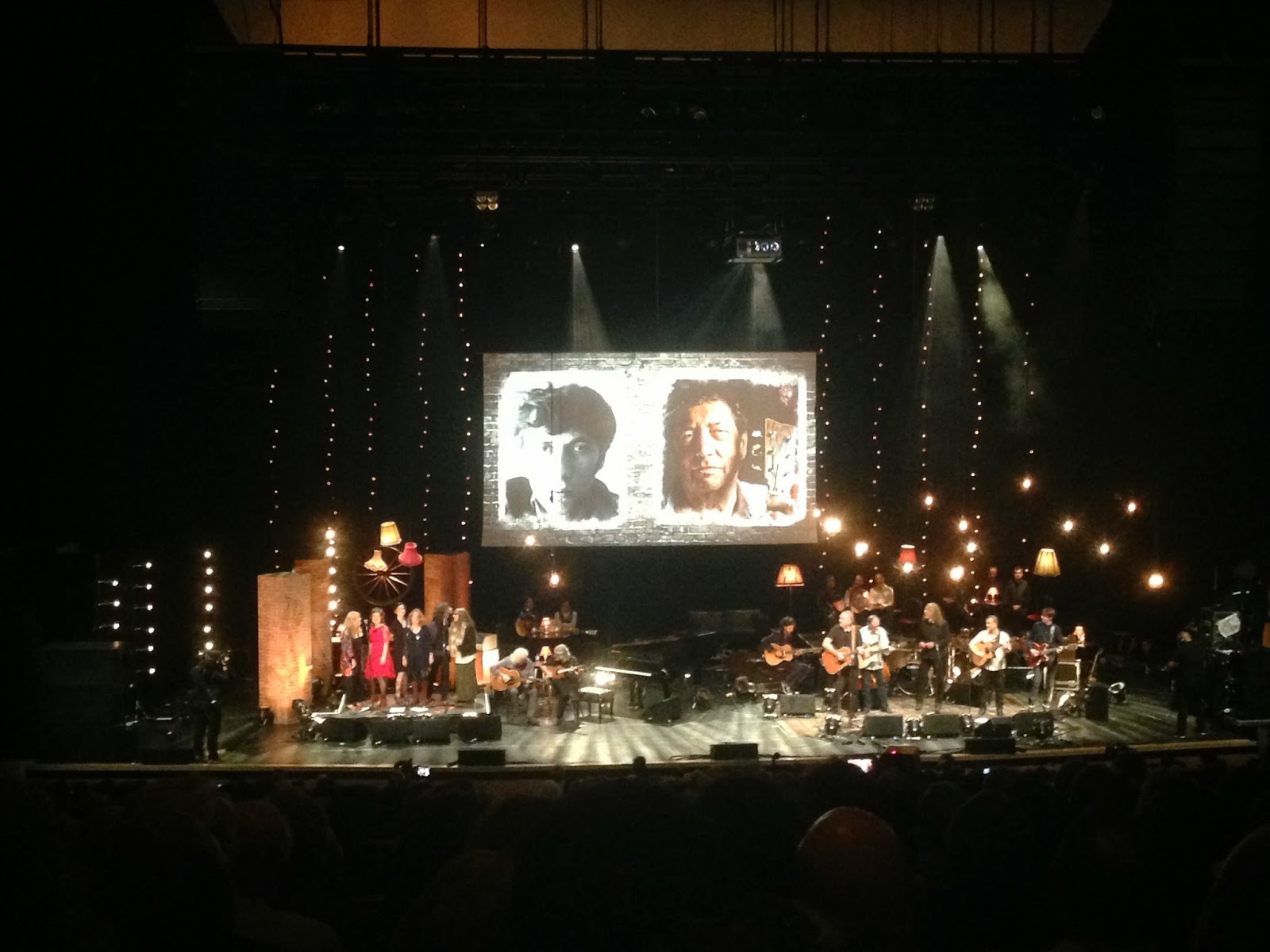
A few nights ago, Wist and I went along to the Bert Jansch Tribute gig at the Royal Festival Hall.

Inimitable front man Robert Plant was one of the many legends on the bill.
Clapton dropped out on the day – which was a little disappointing – as I’d have loved to have seen old Slowhand having a crack at a Jansch number.

The main man on stage for me was Danny Thompson. Performing a double bass solo of Goodbye Pork Pie Hat – the man combined incredible stage craft with impeccable technique.

There was a great video exclusive of Neil Young and Jack White performing at Third Man Records in Nashville.

And a horribly under-rehearsed performance from Martin Carthy, who stumbled through a rendition of Rosemary Lane.

Bernard Butler played some unreal guitar. He still looks effortless cool – ageless – and he’s got the chops to match.

But for me, the stand out acts were the younger, lesser known acts: Lisa Knapp in particular.

Great night – and a fitting celebration of everything Bert Jansch did for guitar and for music.

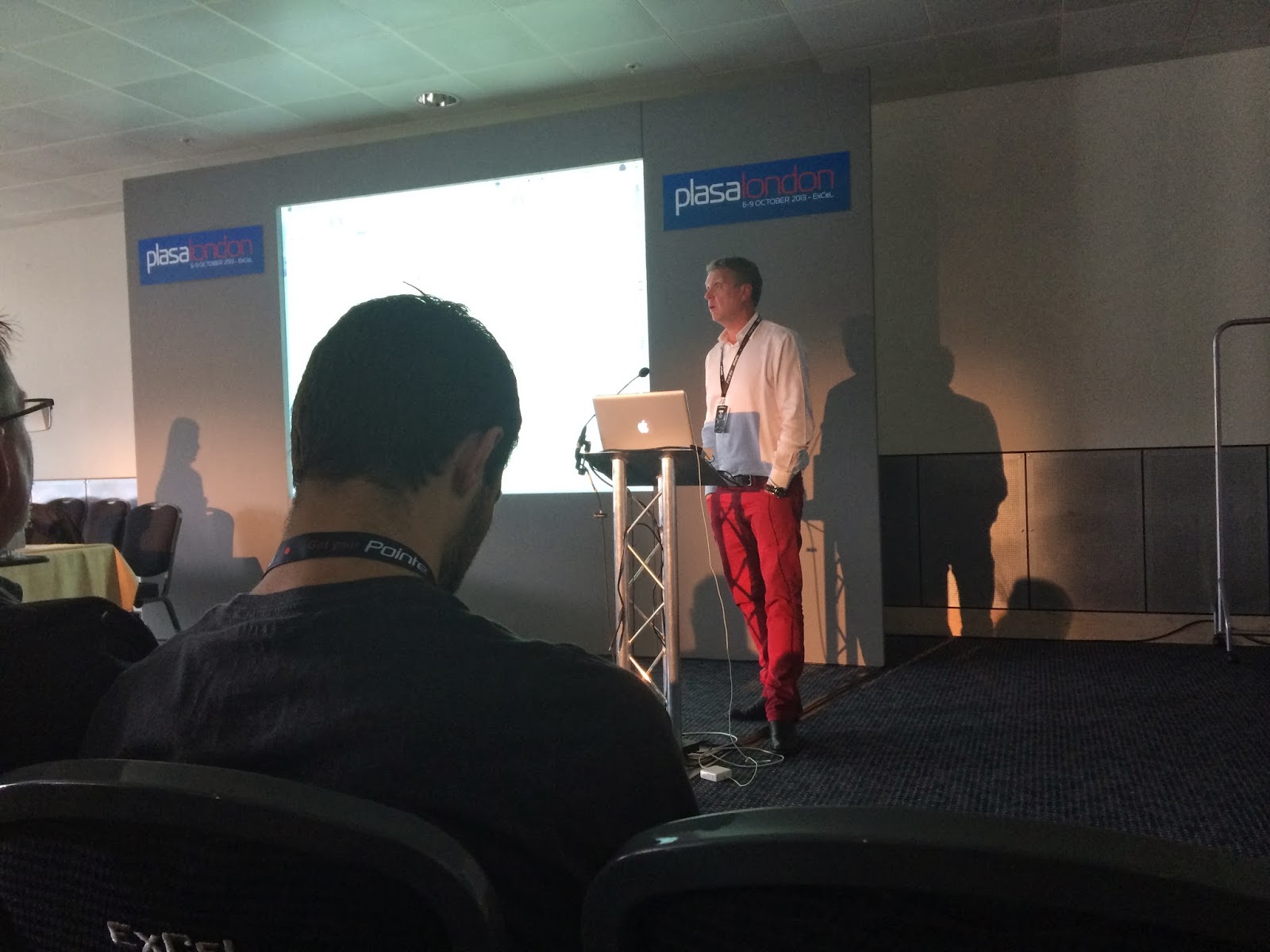
I managed to take a couple of hours out a couple of weeks ago to pop along to PLASA 2013.
Plasa is an audio and lights conference for entertainment professionals – sound techs, lighting engineers etc. A previous life…

I caught a talk by Al Gurdon – an Emmy award winning lighting designer, who’s past work includes the Superbowl (past four years) and tours for The Who, Madonna, Beyonce, Black Eyed Peas and more. Oh and the Olympic Ceremony!

It was interesting to see the parallels of his work, with that of agency life.
One theme that came up time and time again was that of compromise.

He mentioned that in the initial ideas stage, he’s always very keen that he and the team don’t think about the mandatories / budget / timings / locations etc.
“You shouldn’t ever start with the idea of compromise. Instead you should decide what you want to do, and then fight as hard as possible to get it to those ideals.”
Once the general idea is there, you can then start working through the specifics of what you know. If the stage is in the round – you can’t do backlighting particularly well, if there’s not a roof to hang lights from – you’ll have to find some other way of doing it etc.

It was interesting to hear the different levels of involvement that the talent will allow.
The Who were quite happy to accept a change in the set-list to accommodate an idea he had for a big start. Beyonce and Madonna on the other hand were a little tighter – they’d send across a medley / compilation in the order they want to run in, and they’ve often got certain ideas about what they want to do from an AV point of view.
In particular, I was amazed to see the artists themselves giving really specific feedback.
It’s something that they definitely don’t get enough respect for – you expect them to not be that involved in the creative process, but here they are – giving pages and pages of notes…!

Talking more specifically about the Superbowl, I was amazed by the precision and timing pressures that the team are under.
From the point when the half time whistle is blown by the referee, they have 8 minutes.
8 minutes to build the entire stage and secure it tightly, set the lights, calibrate the video screens, check the audio.
8 minutes!!
Al mentioned that there’s around 500 volunteers on the night, who are each given one job. Like ants, they each drop off one bit of stage, or bolt together one section, or plug in one cable. The project manager must be a god.

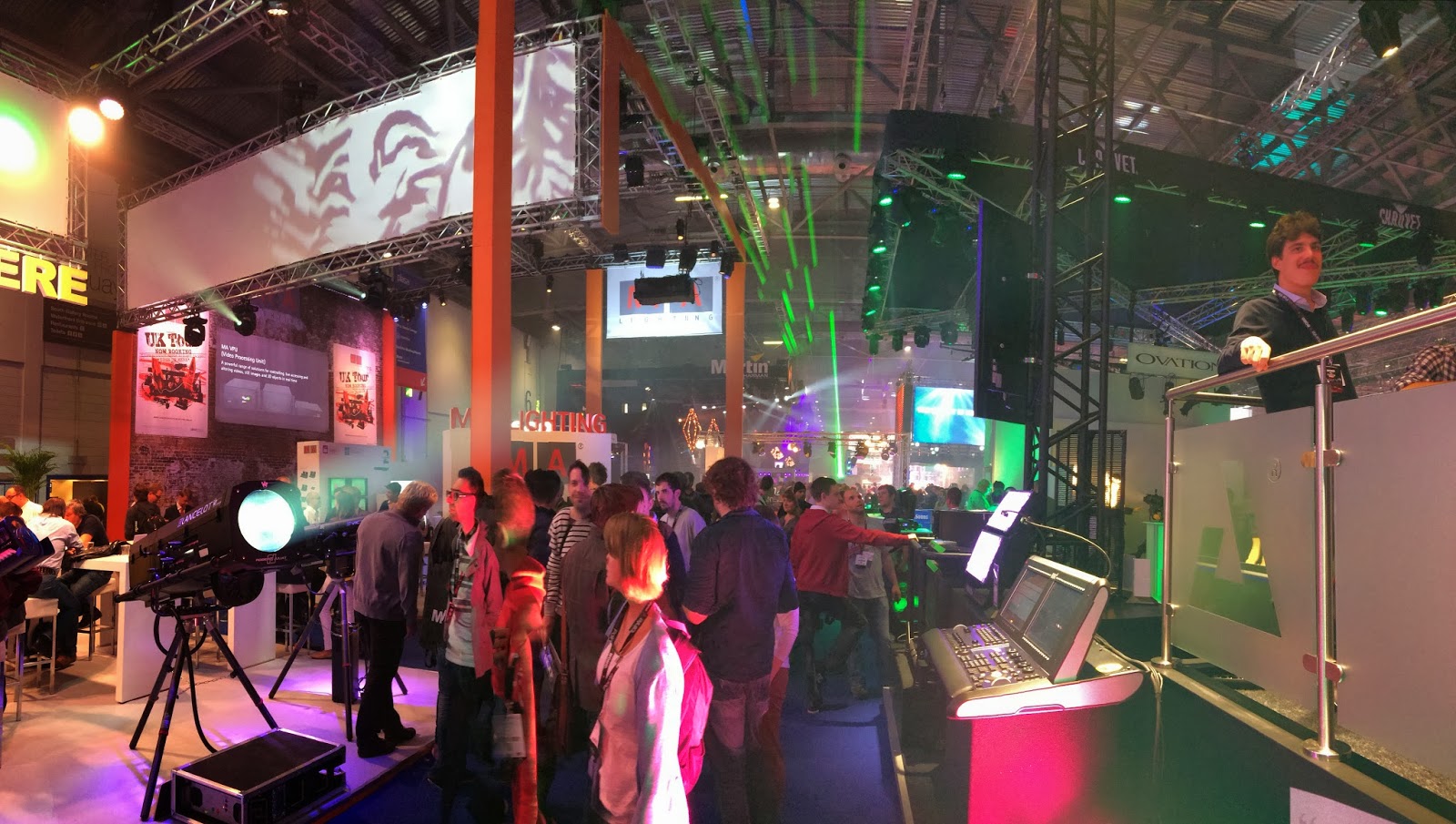
Once the talk had finished, I had a quick twenty minutes run around the conference to see if anything caught my eye.
These things stuck out for me:

I’d been looking forward to this conference for weeks – and it certainly didn’t disappoint.

Even the venue was exciting – Conway Hall. I’d wanted to go there for ages – but I’m always far too lazy on a Sunday morning to haul myself out of bed in time for their weekly lecture.

Duncan Fitzsimmons was up first.

He’s a partner at a design studio called Vitamins.
I hadn’t heard of the studio, but I’d seen some of their work – it’s fantastic.

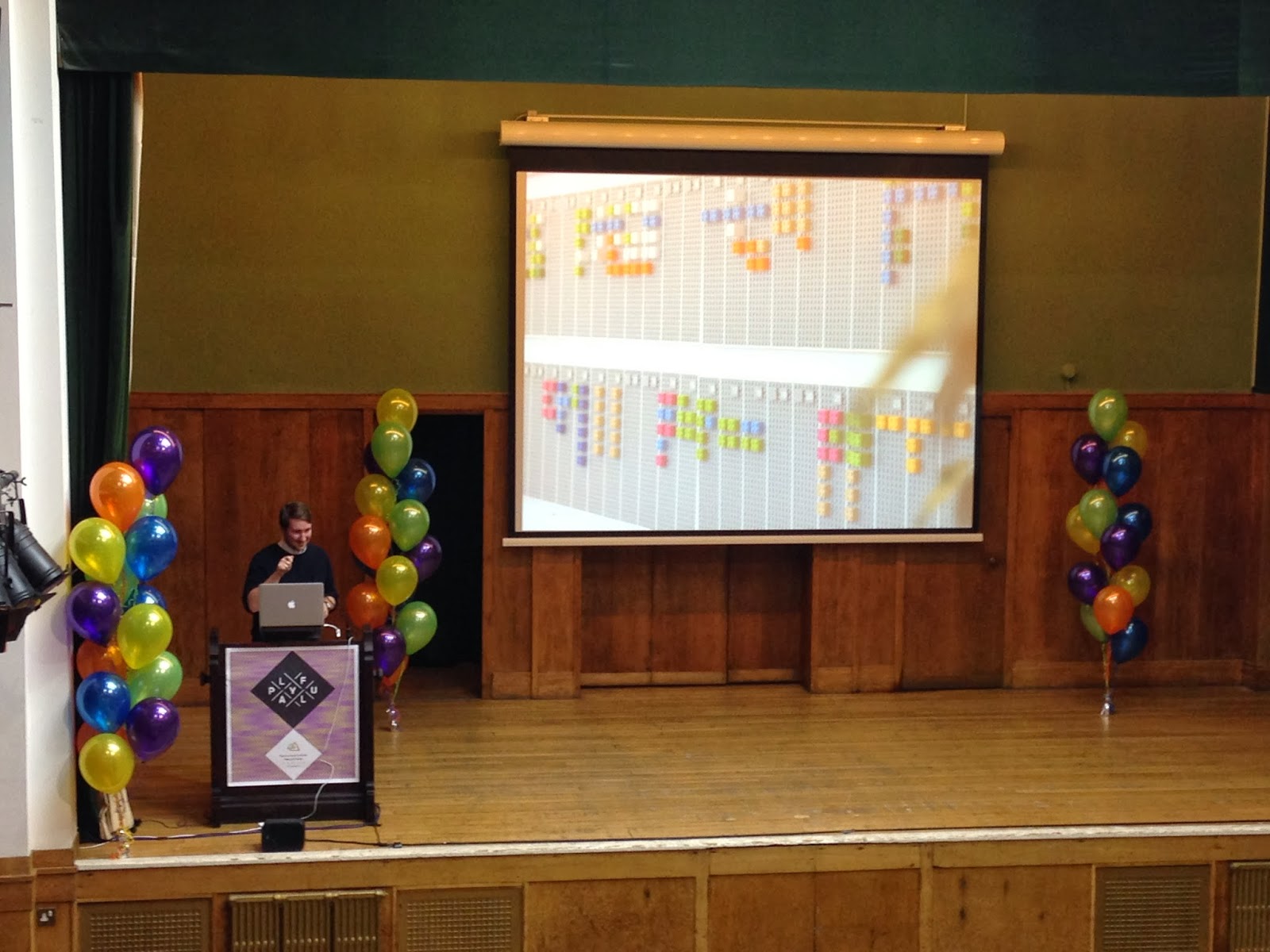
This manual idea for a mobile phone is nothing short of genius.And I like what they’re doing with the lego calendar too – it could seem like a bit of a waste of money considering the payoff – but it’s interesting because it starts to explore how using 3D tactile hardware transforms our experience with digital things.

Anne Holiday was up next.

There was a lovely quote in her presentation – ‘Build what it is you want to build and learn as you go’.

She’s recently made a documentary about the Society for Model and Experimental Engineers. It was beautifully shot and I’m looking forward to watching it.

She talked about how making gets you into the flow zone – where you’re immersed completely in a project. When you let yourself go like that, great things can happen.

George Buckenham is a game designer.

He talked about inputs for gaming, which was fascinating. There’s a whole subculture on the web that obsessively discuss this stuff – discussions about the right pressure / dimples / size / shape / feedback of a button to stir nostalgia for a particular arcade game, or the correct joystick movement for a new game design.

It’s interesting to understand that for most games, inputs don’t enter the design process – you’re going onto a pre-existing platform and you therefore only have a certain amount of inputs to play with. But if you stop worrying about costs and take commercial problems out of the equation – you can design the inputs to work best for the game, rather than the other way around.

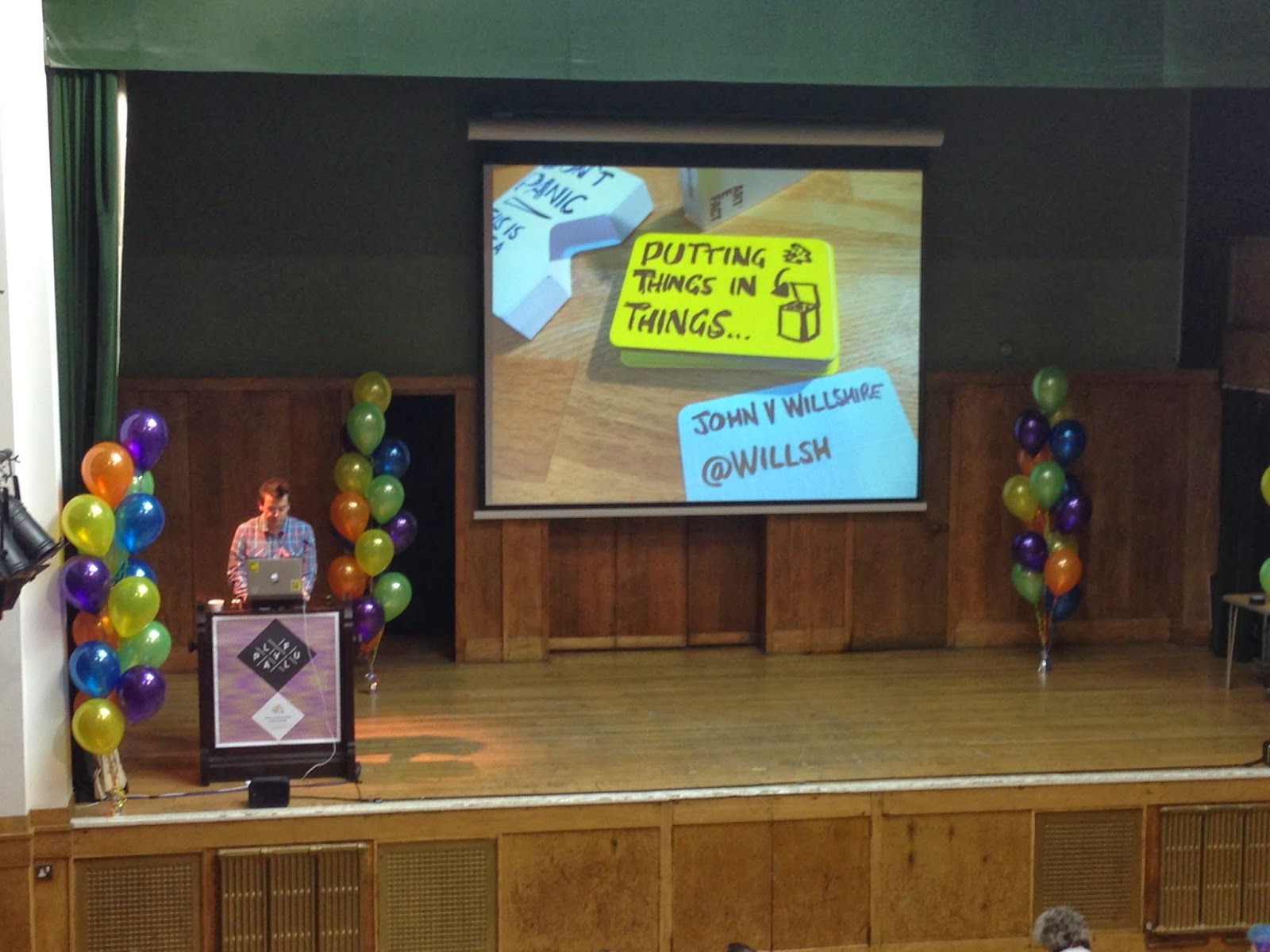
John Willshere spoke next.

He was fantastic – totally wins my vote for best speaker of the day.
He spoke about ‘putting things in things’ and how a box is often better than the thing inside it. The mystery and anticipation gets your heart pumping more than the stuff contained within.

And we often think of media as boxes too. Media is just a collection of boxes to be filled.
The silly thing about that, is that we often think of the boxes as the limit – the constraint.
Much like a vacuum is defined by it’s vessel.
Instead we should confront the boxes and figuring out how we can bend them to what’s best.

He also talked about the Artefact cards project (which I’ve seen before, and is really interesting) and a new project he’s just completed with the Said Business School at the University of Oxford. The project involved getting senior business people to start doing things with their hands again – making products rather than just thinking about them. The project culminated in them pouring molten brass into a mould that they’d each made – to create a beautiful key as a memento for the course.
Fran Edgerley spoke about some of the architectural projects that she’s been involved in.

Turning an empty petrol station into a cinema was a personal highlight.

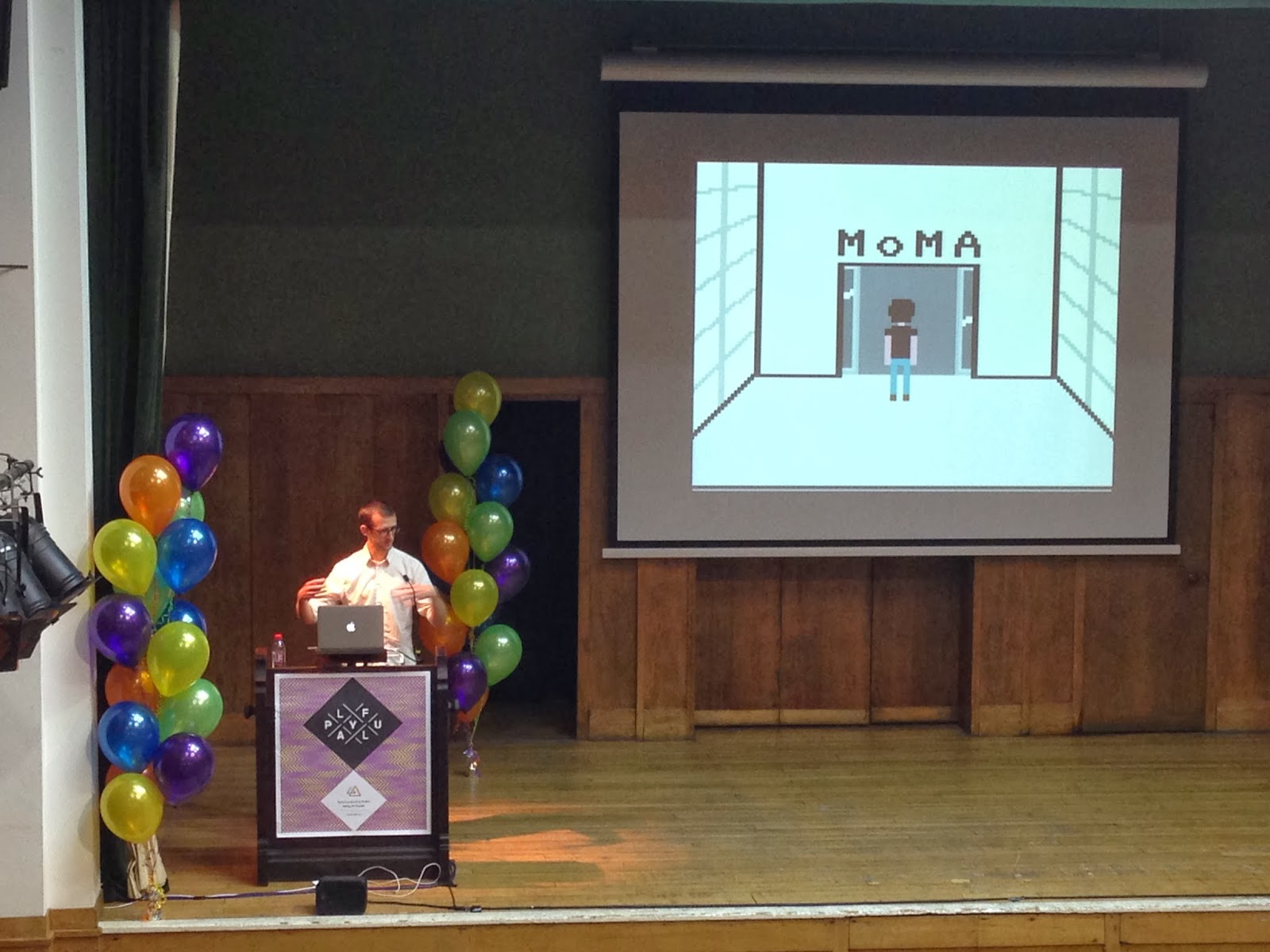
Pippin Barr is another games designer. He talked about some of the projects he’s created recently – which was fascinating.

One of the topics he talked about was the fragility of games – how one change in the rulebook can have massive effects on the gameplay. For example, if you allow the paddles to move left and right (as well as up and down) in pong, it has a dramatic effect on the experience.

Another topic he touched on was the perfection of iPhone as a device, and how it’s a personal mission to create things that jar slightly with that. The creation of a game called Snek (based on Nokia’s Snake), where ‘awkward’ input patterns are used to direct the movement was a great example of that.

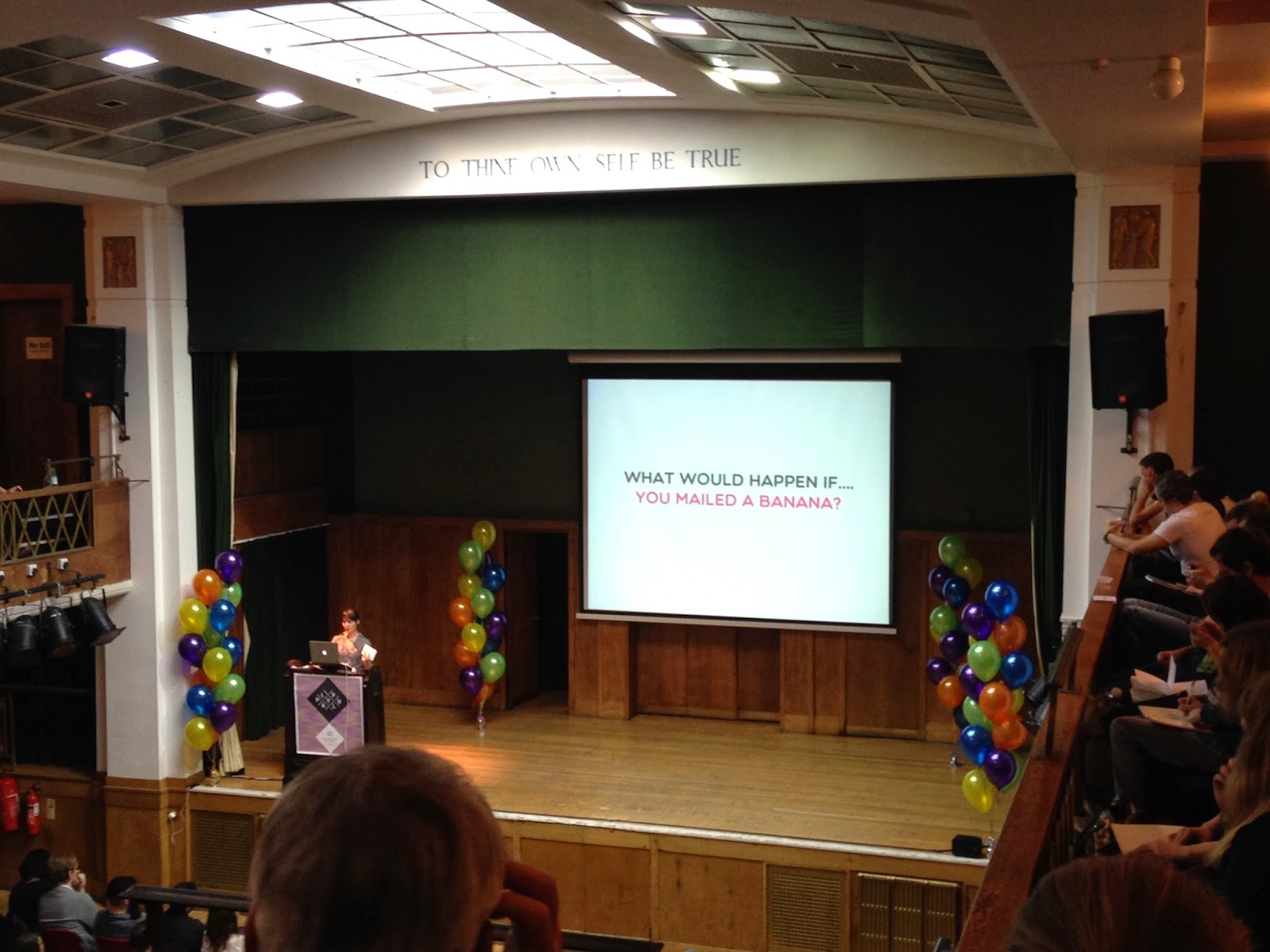
Dani Lurie spoke about the merits of mischief.

I thought it was a pretty great talk – and some of the experiments that she’s been ‘conducting’ to learn new things were really quite funny.

A personal favourite was experimenting with Royal Mail and their delivery procedures – what’s the weirdest item that we can get them to deliver (unwrapped). She stuck stamps on bananas, money, porn DVDs, umbrellas, crisps, reaaaaally long envelopes – lots of stuff! And then posted them out to see if they’d arrive. Most did – amazingly.

Marie Foulston spoke about her relationship with the game Animal Crossing.

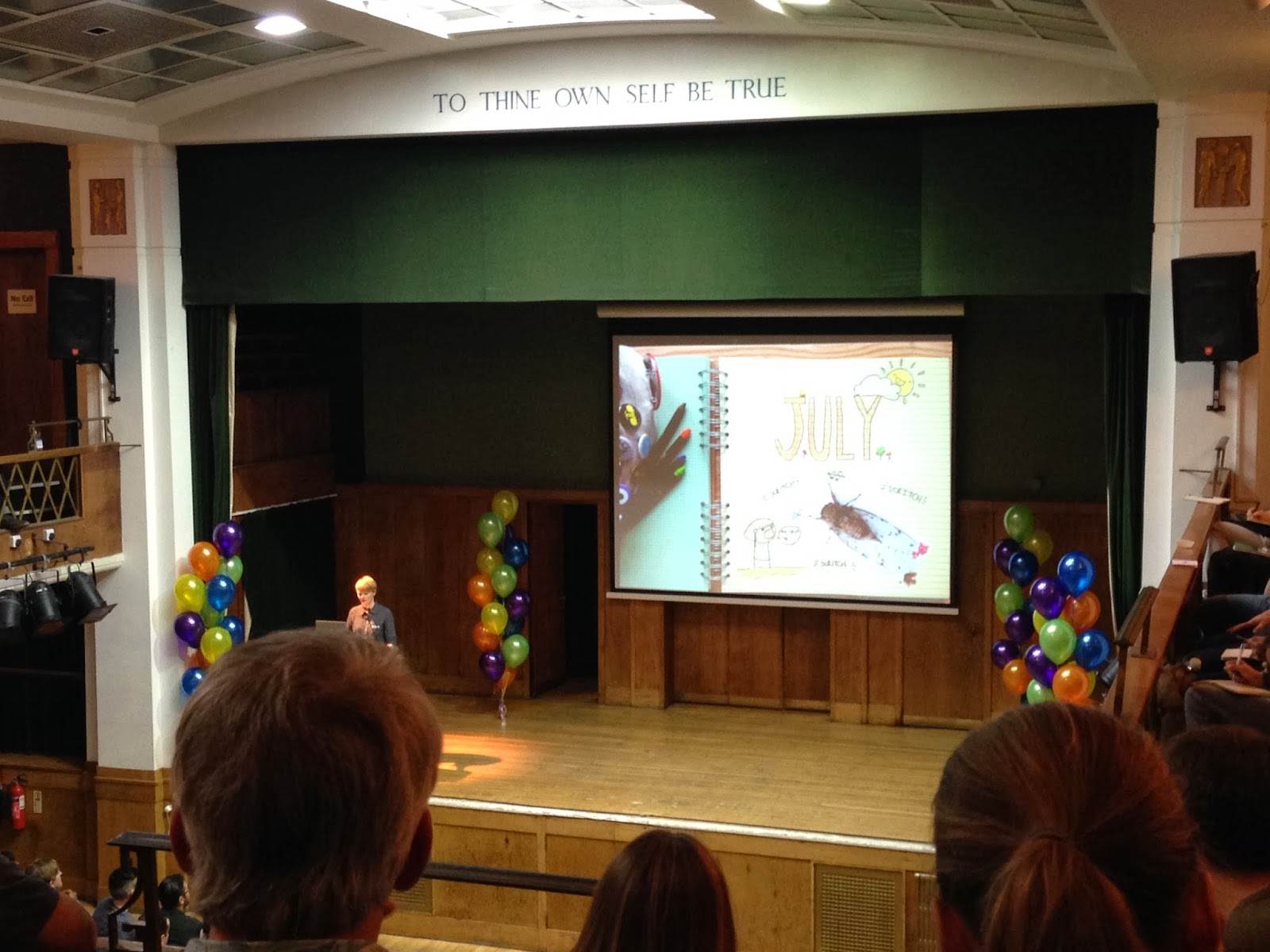
She presented it in a diary format – which was really novel, and the slides that she’d designed were beautiful (the best we saw all day.)

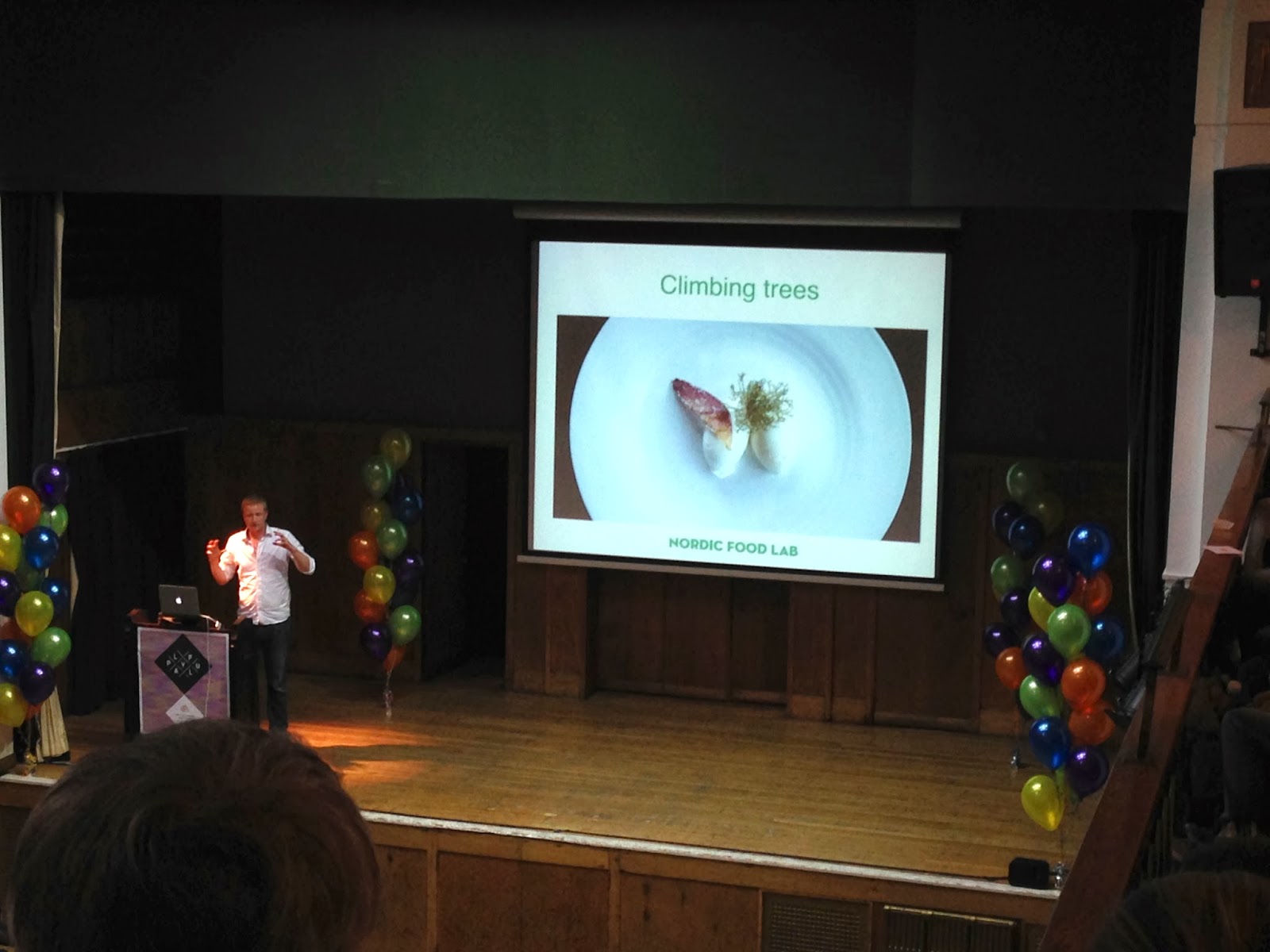
Ben Reade is an Head of Culinary Research at the Nordic Food lab.

He started with a great quote – “Only play with your food when you’ve eaten all your toys.” He mentioned that there are two words in Danish for play: Spille and Lege.

Spille is play time with rules (a boardgame or chess). Lege is open play – exploration.
Ben thinks the English language lacks something without this differentiation. I think he could be right.

At the moment he’s spending his time working with fermentation and mould.
There isn’t much of a precedent in terms of robust science behind culinary tricks using fermentation.
It’s an interesting proposition, and I’ll certainly be following to see where it goes.

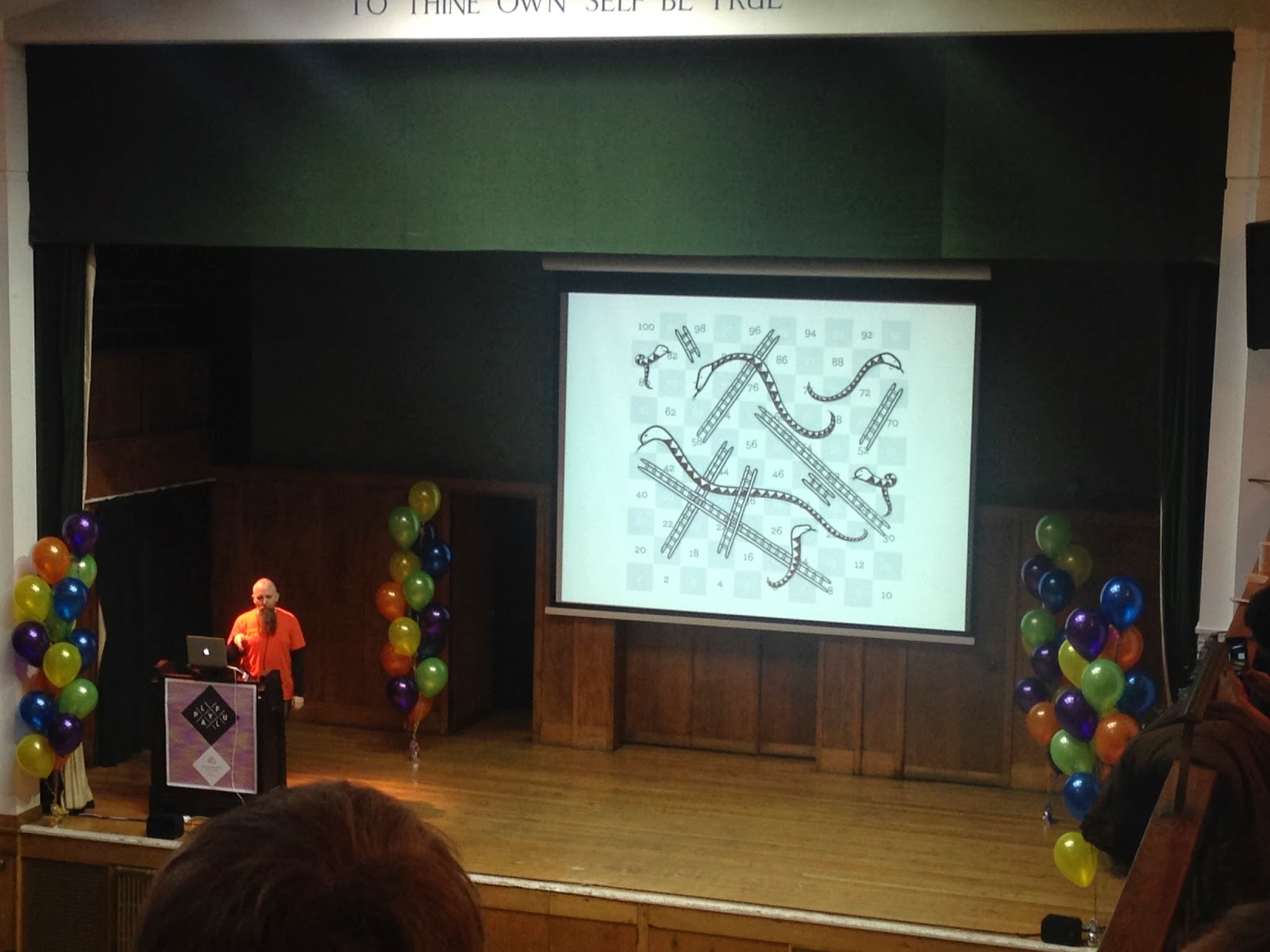
Dan Catt was a fantastic speaker.

He came up with an idea several years ago, that the large kindle could be used as a changeable board for a board game.

He loves Snakes and Ladders, and was inspired by something Russell Davies said on Shift Run Stop about the grading of jigsaws vs. the lack of grading for Snakes and ladders – so he decided to start experimenting with different Snakes and Ladders boards.

10 computers, 922,500,000 boards, nearly 10 billion ‘run throughs’ later – he’s found a pretty optimal Snakes and Ladders board. What a fantastic expression of commitment and passion.

He also talked briefly about ‘slow computing’ – which is a brilliant idea.
When you’re not using your computer, the computer should be doing stuff for you in the background. Maybe it’s pulling together all of your social media posts, and rendering a beautiful photograph with them – but it should be doing something. Why do you have to be sat at your desk, for it to be working? It’s a nice idea and I’m sure they’d be loads of ideas off the back of that brief.

Stefanie Posavec talked about data-related design and shared some of her most recent work – which included an installation at the Memory Palace exhibition at the V&A, and the ‘dance’ installation at Facebook HQ in the US.

Both were great ideas, and it’s great to see someone passionate about communicating insight from data – we’re gonna need more Stefanies in years to come.

Finally Rob Lowe talked about his art.

His work is beautiful – geometric shapes, with real depth.
He talked a little about Moire patterns, and how that’s influenced his work.
All quite interesting.

A top day – look forward to next year!


Wist very kindly bought me a ticket to The Battle of Ideas for my birthday.

It’s a fantastic event curated by the Institute of Ideas. You pick and choose the talks you’d like to see (there’s around six or seven running in parallel) and then race around the Barbican in the gaps to get to the next one.

First up – we went to see ‘The crisis of innovation: Dude where’s my flying car?”
There were some fantastic speakers and some really interesting things were discussed.

We learnt about the Sailing Ship effect – where the introduction of a new technology accelerates the innovation of an incumbent technology. We heard that Landrover define innovation as something that is new, articulately depicted and that creates value. Something that is new but that someone wouldn’t pay for isn’t counted as an innovation. And someone used a very cool engineering phrase ‘If there’s no heat, there’s probably nothing happening.’ I also loved this quote that was used – ‘An expert is one who knows more and more about less and less until he knows absolutely everything about nothing.’

Next, we went to a fascinating debate called ‘Time to get serious about irony?’

It was great to see Julian Baggini on the panel, as I’ve read a couple of his books and they’re fantastic. His talk was fantastic – finishing with the sentence ‘In order to seriously examine yourself, you need to be aware of the comic mismatch between ambitions and actions.’ John Waters talked about metaphysical anorexia – our view on ‘self’ is diminishing in modern society as we morph ourselves to fit with public opinion. Late in the questions, he also dropped a fantastic CS Lewis quote – ‘You can’t see through everything. To see through all things is akin to seeing nothing. The window is transparent because the garden beyond it is opaque.’

The ‘Art of Biography’ session was good too – the central theme being that it’s the flaws in us that make us human, and it’s those flaws that make us interesting.

I’m a little light on notes from the talk – and there was a bit too much chat about Benjamin Britten for my liking – but it was good all the same.

Finally then, we popped along to the session ‘Baby on board: the battle over pregnancy.’ Wist established that she wanted to see this talk to help with work. Before that, I was a little worried…

If I’m brutally honest – this wasn’t a topic that I was particularly interested in and I wasn’t cognitively in the room for a lot of it – but apparently it was good. You’ll have to ask Wist if you want to know the details…

Brilliant birthday present and really fun day – well done everyone at the Institute of Ideas for putting on such an interesting event.