Restaurant: Sushi Tetsu, Jerusalem Passage
Time: Friday evening
With: Wist
Stand-out dish: Prawn Nigiri
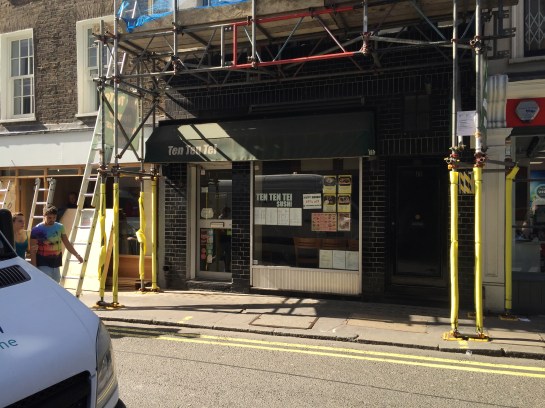
The best sushi I’ve ever eaten. Perhaps the best meal I’ve ever eaten. With an address on Jerusalem Passage, I won’t be the first to have used sacrilegious wordplay about Sushi Tetsu. But it really is worthy of a pilgrimage; it’s divine. There are only seven seats, and one chef. The chef’s wife works front of house – chatting about the best ways to eat sushi and Japanese culture, whilst ensuring drinks are always topped up. The menu is omakase – chefs choice – and from start to finish, the flavour and finish is outstanding. The sashimi plate was almost too beautiful to eat; you’re advised to start on the right and work your way left (from white fish to dark). Beyond that, each piece of sushi is individually crafted by the chef and placed in front of you. You get to taste it just moments after its creation. If I could get another reservation easily, I would. It’s worth every penny.

IMG_1466IMG_1482

Nairn’s London #7
Long bar, Henekeys, Holborn

THEN: Any long bar implies serious drinking, but this has a sense of dedication that is far beyond mere commerce. Perhaps because of this it is often cram-full: it is more of an experience to be uncomfortable here than to relax amongst a farrago of cliches. It does not depend on Victorian ornament either. The effect is due to the long, tall proportions, the dark woodwork and especially to the scale of the huge oval barrels behind the bar, as concise as an airliner’s skin. A walkway high up connects rooms tucked under the roof and you expect to see acolytes coming out on it to perform some liturgy of alcohol. Cabins all round the walls, as a souvenir of Belfast or Dublin; but this place needs no stage props. They sell spiced buns.

NOW: Now called Cittie of Yorke, this is a listed building, and very little seems to have changed since Nairn’s time. On a Friday afternoon the bar was bustling, but we found solace in the plush front room. The room is a beauty; the barrels behind the bar are vast and draw your eye upwards towards the gabled roof. The only place in London still serving beer from a wooden cask, a tasty pint. Unfortunately the spiced buns are no longer.

Henekeys.001


Restaurant: Maki, Old St
Time: Friday lunchtime
With: –
Stand-out dish: Chargrilled salmon nigiri
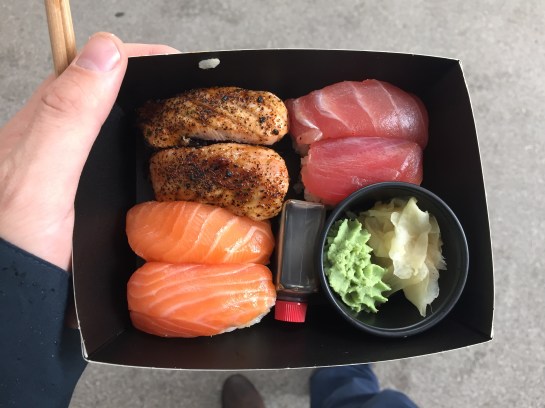
Notes: Easy going lunchtime spot, with outside seating. Not busy but the weather wasn’t great. Pick your own sushi menu, but I plumped for small salmon set box. The fish wasn’t anything to shout home about, but heartening to see proper sushi rice being used. The chargrilled salmon nigiri used chinese black rice – delicious. Good for a quick, no frills, Japanese lunch on the move.

IMG_1302IMG_1304

Restaurant: Bone Daddies, Old St
Time: Friday evening
With: Wist
Stand-out dish: Sweet Spicy Pig Bones
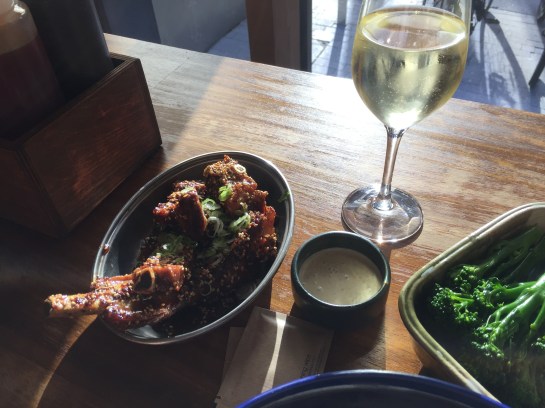
Notes: Early evening table, rushing to get to Wembley for Louis CK. Restaurant had plenty of empty tables, but still felt buzzy. Cool decor, with Sake bottles lining the windows. Efficient staff got us in and out in an hour. I ordered ramen (Tantanmen) and Wist had a selection of starters and sides. The broccoli with spicy yuzukosho mayo was incredibly tasty, as was Wist’s heirloom tomato salad. If I went again, I’d choose a different ramen option – the pork with chicken didn’t sit quite right. The cheesy Japanese potato salad was gooey and delicious, but the stand out dish of the night were the pig bones. Crispy, sweet, and flavourful.

IMG_1275

IMG_1181

Nairn’s London #8
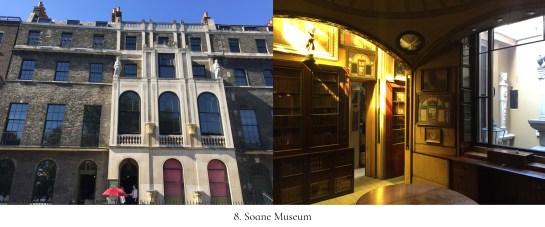
Soane Museum

THEN: Extreme greatness in art has two faces. One takes the usage of the time and transfigures it with humanity and intensity. The other leaps forward not only in style, but into what appears to be a higher organisation of humanity altogether. Rubens v. Rembrandt, Handel v. Bach – and Wren v. Soane. The Soane Museum is as deep as St Paul’s dome is wide; an experience to be had in London and nowhere else, worth travelling across a continent to see in the same way as the Sistine Chapel or the Isenheim altarpiece. Soane as a man was proud and cantankerous, but his architectural imagination was superhuman or saintly. The museum was his house, and he altered it to contain his collections in a series of meditations on space which go as deep as any more orthodox mystical experience. After a visit here, four walls and a ceiling can never look quite the same. The outside is idiosyncratic enough, but like many of Soane’s buildings is no more than the fly-leaf of the book. Inside you get every trick of mirrors, proportion and shock juxtaposition of scale; but it is not thrown at you, never done primarily for illusionistic effect, always a by-product of an ever deeper burrowing into the nature of space – Soane splitting the spatial atom – and also into the personality of space. Soane was after what he called ‘the poetry of architecture’, and so his rooms are never just exercises. His library on the ground floor with its hanging ceiling is a ‘mood’ room, meant to be lived in; the stylised details, which are certainly odd, are quite subservient to this. Shane’s imitators could only copy the details; the only true match is in Nash’s interiors for the Brighton Pavilion. (As might be imagined, Soane hated Nash and Nash held Soane in amused contempt.) His imagination was always truly original, rather than conventionally original: half way up the stairs there is a recess devoted to shakespeare. It has plaster cherubs on the ceiling, arranged neither with symmetry nor with artful asymmetry. They just seem to have arrived at random – literally flown in from the treetops outside; and so you can believe in them. Because of this, the crustiest of Soane’s archaeological confrontations seem credible, and his Monk’s Parlour has the authentic frisson that Fuseli could only grope for. And along with all the plaster casts and weather fragments from the Palace of Westminster, there are two of Hogarth’s best known moral sequences: The Rake’s Progress and The Election.

All these are really sidelines to Soane’s primary purpose, the metaphysical inner exploration of space which had to wait a century and a half for its physical counterpart, astronautics. On the first floor there are twin drawing-rooms, sober and spacious and at all times suitable for their worldly purpose (Soane here was several up on most mystics.) The front room has a flat ceiling with panels cut in it, into which separate little segmental roofs have been fitted. Easy; yet somehow the whole business of what ceilings are for has been looked at afresh. In the back room the roles are reversed; a big segmental ceiling contains a coffered central square recess. The drawing-room talk is not self-consciously different, but not quite the same either.

And God knows what the breakfasts must have been like. The Breakfast Room is downstairs, behind the staircase. One of Soane’s hanging ceilings fits over it (and over you) like a floppy hat, elegantly top lit. But it is embroidered with tiny convex mirrors which show up the room with you in it, in miniature – a microcosm. On two sides of the ceiling, great bleary light comes streaming down from inside – macrocosm. The third side is a bookcase (inner life), the fourth side is the outside world (outer life). It is all the bathroom mirrors anybody ever looked into rolled into one. And it is also probably the deepest penetration of space and of man’s position in space, and hence in the world, that any architect has ever created. You might infer the second part from Soane’s other buildings, but the first part, the human understanding of the nature of eating breakfast, can only be caught here. If man does not blow himself up, he might in the end act at all times and on all levels with the complete understanding of this room.

NOW: Nairn devoted a hefty two pages to Soane’s museum. And its clear to see why. The house is magnificent; an abode to be jealous of. I’m not going to attempt to match his word count. As ever, he has managed to sum up the emotion of the space perfectly. And the Soane Museum trust have done such a fantastic job of preserving the space, that everything Nairn wrote back then still holds true. The stair recess devoted to Shakespeare is an interesting feature. It was interesting to read how the architects of Soane’s day drew inspiration from Shakespeare’s first folio; its little wonder he set up a shrine in a place he’d pass daily. The amount of natural light that gets to all rooms is a wonder to behold. The breakfast room is the real triumph here; a light and airy space in which you long to sit down in, with a dippy egg and the weekend papers.

Soane museum.001

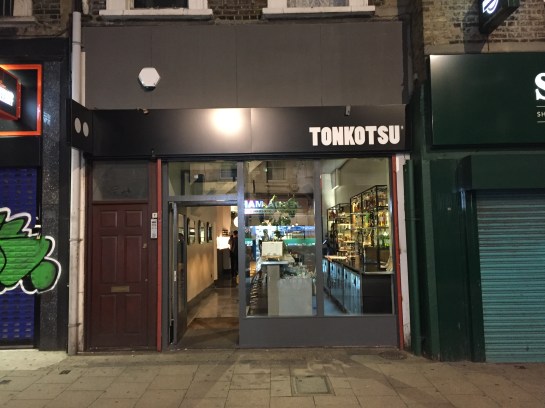
Restaurant: Tonkotsu, Mare St
Time: Saturday evening
With: Wist
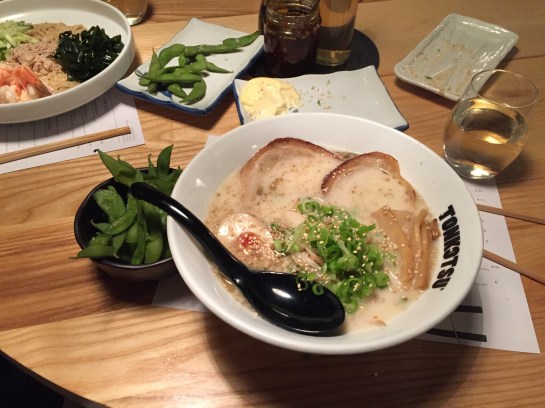
Stand-out dish: Tonkotsu Ramen
Notes: Late night table, so the restaurant was quiet. Pretty decor, and friendly staff. One of a few locations. We both ordered ramen (mine Tonkotsu, Wist’s seafood) and a selection of sides. The crab korokke were gooey and tasty, and the three Mochi icecream flavours were dainty little morsels, but my ramen was the best dish of the night. Creamy and fresh, with a deep pork undertone.

IMG_0875

IMG_0872

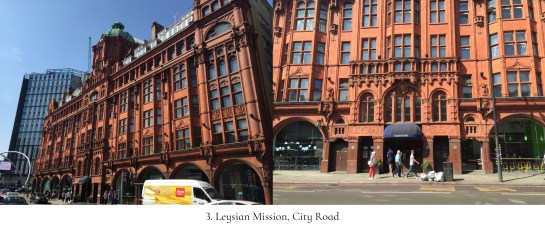
#3. Leysian Mission, City Road
Having lived in Old Street for three or four years, this building only crept into my consciousness around twelve months ago. Inside, the great hall is long gone, filled in with plush Old Street apartments. But the outside is still magnificent, and it’s topped up with a beautiful green dome sitting proudly on top. The words Leysian Mission are still visible at the entrance: a constant reminder of what this building was originally built for – a helping hand for the East End London slums.

My London - photos far copy.001

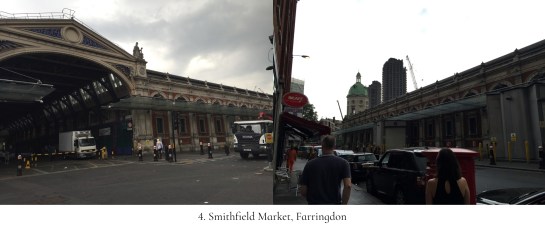
#4. Smithfield Market, Farringdon
Perhaps my favourite building in London. My wife and I even had our wedding photos taken underneath one of the wrought iron caverns. Victorian grandeur at its best; with cathedral-like loading bays and ornamental metalwork. The market is one of the few places in zone 1 that has resisted white collar urban renewal, but all that may change once the Museum of London moves in, in 2021.

My London - photos far copy.002

Nairn’s London #23
The Ritz

THEN: The overwhelming thing about the Ritz is not ostentation or even luxury but a deep quiet. Through the swing doors is another world from Piccadilly. The tempo gently winds down; the long corridor, the space and the unhurried waiters seem to have come out of a dream. Money here does not buy a multiplication of gadgets but deep wedges of privacy. At the Ritz they are enclosed by decoration in eighteenth-century French style of the utmost delicacy and discretion, done from conviction and not fashion. The outside is just the same: polite and respectful but never obsequious. Mewes was French and elderly, Davis was English and young, and they made admirable partners.

NOW: I doubt The Ritz has changed all that much since Nairn wrote about it. Calm, quiet and private: it’s still very much a sanctuary for those that need it. The long corridor still runs from end-to-end, with a staff member positioned every few metres; each of which shot me disparaging looks as I hadn’t donned a tie for entry. A bastion of old England.

Nairn's London - photos far.001

Nairn’s London #2
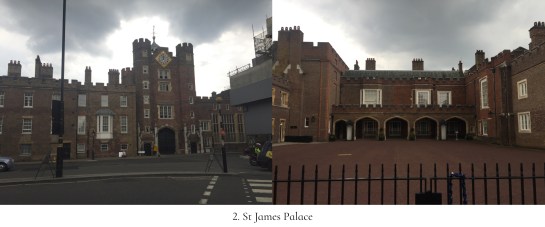
St James Palace

THEN: Like many other places in London, you have to play this by ear. The eye won’t help you much in an organised, Hampton-Court sense. The courtyards are ordinary, deliberately casual: the red tunics and bearskins are no less military than at the Palace but seem here to be just doing a job, semi-casually. Tourists come in accidentally, perhaps sidetracked from the Palace and The Mall by the thought of a cuppa. No hope of that this side of Piccadilly, this is the underside of a monarchy, an equivalent to the garden side of Buckingham Palace which no ordinary person can ever see. And not only of a monarchy: we would have been a republic long ago if this passion for discreet authority, understatement and privacy were not part of the essence of most Englishmen. It is not so much one note in the English scale as a key signature.

NOW: A building I must have skirted past one hundred times, without acknowledging properly. Much like the Tower’s ravens, you sense this is the Royal family’s true stronghold: forget Buckingham Palace, without this one, the crown would fall. No red tunics or bearskins on display when I walked past – a great pity – as their colours would have lifted the brickwork’s warmth on what was a dreary wet day.
Nairn's London - photos far.002

Nairn’s London #24
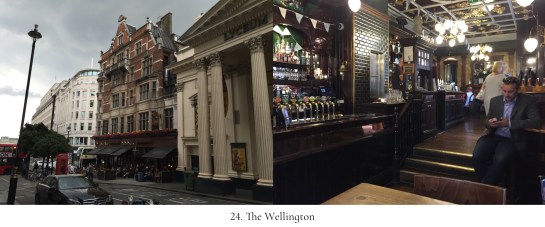
The Wellington (corner of Strand and Aldwych)

THEN: Extraordinary-ordinary; comfortable and quietly elegant and what every pub or street should be and isn’t. The amazing thing is that this has happened in the last few years. A recent redecoration has realised potentialities which have been lying fallow for half a century. Two bars have been thrown into one: usually a fatal step, here essential to give an overall shape. The distinction between the bars is still made by a couple of steps; everything else is made really new, but quietly, so that you can register the difference without noticing it. Good stuff behind the bar (a Free House), spirited Irish girls to serve it; more truly up to date than the most trumpeted pub rebuilding.

NOW: Now a Nicholsons, I fear that many of the edges that prompted Nairn’s favourable review have been sanded down over the years. The steps up to the second bar remain, and there are subtle design differences in cornicing between the two spaces, but the pub is no longer remarkable. Nonetheless, a perfectly decent boozer, with a variety of beer taps and gins. The spirited Irish girls must have been working a different shift when I visited.
Nairn's London - photos far.003

Nairn’s London #5
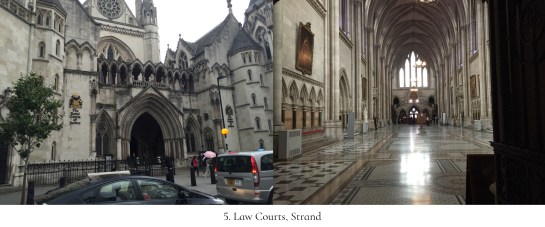
Law Courts, Strand

THEN: Just as the Houses of Parliament killed Barry, so the Law Courts put an end to G.E. Street. There was never enough feeling to go round, and it was concentrated into one stupendous room. The rest of his practice – all the outside, all the country churches of the 1870s – was clever, heartless, hack-work. Nothing but duty would entice you through the main entrance, yet inside it is all different. The Great Hall is a superb room, useless only by those legal definitions of architectural function which recognise merely the visible part of the iceberg. It seems as though Street has knocked it back into the thirteenth century through sheer will, the kind of endurance that confounds medical prediction: ‘he shouldn’t have lasted the night out’. And there it is, magisterial in all the good senses of the word: ordered, compassionate, direct and to a huge scale. It is a funny way to get to greatness – Beethoven’s way in the Ninth Symphony, and in human terms the hardest, most meritorious way of all. Every word of this is wrung out against my own inclinations, for I hate what Street did by pretending to himself that he was sensitive and understanding: so this may be the truest entry in the book. There is a good deal more in the Law Courts, including a bar, the unlikeliest local of all, and the courts themselves – stuffy Dickensian rooms where lawyers argue endlessly through civil actions whilst their principals are miles away.

NOW: I’d wager this is one of the most beautiful buildings in London. The entrance is dark and foreboding: a colossal mass that somehow manages to pull focus onto its small front doors (an effect not unlike Alfred Hitchcock’s dolly zoom.) Once you’re through security, and inside, the building is awe-inspiring. The Great Hall is magnificent. I imagine when the balance of evidence is on your side, this space only serves to embolden you. And when you know you’re guilty, its scale intimidates you until you’re near breaking point. Other highlights include the Bear Garden (a room so called because the volume of lawyers in there, discussing last-minute case revisions, prompted Queen Victoria to describe it like ‘a garden full of bears’) and the first floor balcony (which currently houses a costume exhibition.)
Nairn's London - photos far.004

Restaurant: Japanese Canteen, Middlesex St
Time: Friday lunchtime
With: Wist
Stand-out dish: Nothing. I’d have to say the TsingTao.
Notes: Slow-moving queue out of the door; a busy lunchtime venue. Long parallel benches and tables. Draught beers were off. And somehow, they only one cold bottle of beer, as the fridge was broken. Ordered chicken katsu donburi, pork dumplings, chicken chili fried rice. Hectic service – they brought us the wrong food twice. Food was very average – watery dumplings and dry rice.

IMG_0746

IMG_0744